
In the GTA, staging isn't cosmetic. It changes outcomes. According to TRREB 2024 GTA staging figures cited here, staged homes in Peel Region sold 22% faster than non-staged comparables, and Team Arora Realty's internal data shows 78% of staged listings achieved sale-to-list ratios of 102-108%, averaging 5.2% above asking price.
That's why sellers in Brampton, Mississauga, Cambridge, and Halton Hills need to stop treating staging like décor and start treating it like sale preparation. If you want top dollar, buyers need to feel the home fits their life before they ever book a showing. In this market, that starts with what they see online, and it finishes with how the home feels when they walk in.
Table of Contents
- Why Staging is Non-Negotiable in the GTA
- The Foundation of Flawless Staging
- Room-by-Room Staging for Maximum Appeal
- Staging Budgets and ROI From DIY to Professional
- Final Touches for a Picture-Perfect GTA Listing
- Your Staging Success Checklist and Next Steps
Why Staging is Non-Negotiable in the GTA
In the GTA, staged homes win attention faster, show better in person, and give buyers fewer reasons to hesitate. That matters in a market where purchasers often compare five to ten similar listings across Mississauga, Brampton, Milton, Vaughan, and Toronto before they ever step through the door.
Buyers here judge in layers. First on their phone. Then in the photos. Then in the first 30 seconds of the showing. If the home feels dark, crowded, dated, or too tied to one seller's taste, confidence drops quickly. Once that happens, price resistance follows.
I see this every week with Team Arora clients. Two homes can have similar square footage, similar finishes, and similar locations, yet the one that feels cleaner, calmer, and easier to understand gets stronger traffic and better offers. Staging helps shape that reaction.
In the GTA, that reaction is not one-size-fits-all.
A downtown or Square One condo usually needs a tighter plan focused on scale, storage, and clean sightlines. Buyers want every foot to make sense. A detached home in Brampton, Georgetown, or Northwest Mississauga often needs room definition and warmth, especially when the layout includes large family areas, formal dining rooms, or finished basements that can read as unclear in photos.
Cultural context matters too. GTA buyers come from many backgrounds, and they do not all respond to the same visual cues. Some want a home that feels minimalist and hotel-clean. Others connect more with a layout that shows how extended family can live comfortably, entertain, or pray. Good staging broadens appeal without becoming generic. It removes distractions, respects how local buyers live, and lets the space feel flexible.
That flexibility supports pricing.
A well-staged home suggests care, upkeep, and fewer hidden problems. Buyers may never say that out loud, but they price it in. The opposite is also true. If a room looks cramped or overly personal, buyers start calculating what else might need work, even when the actual condition is solid.
Staging is not about making a property look expensive. It is about making the value easy to see.
If you want extra ideas before you start, these home staging tips and strategies are a useful companion to the local advice in this guide. GTA sellers still need a plan built around local buyer behaviour, housing type, and neighbourhood expectations.
The Foundation of Flawless Staging
Most staging problems start before a single cushion gets placed. Sellers jump to accessories, but the essential work starts with subtraction. If the home isn't edited properly, no amount of styling will save it.

Declutter until the home feels easy to live in
The fastest way to make a home feel smaller is to leave too much in it. Closets packed to the top, crowded counters, overfilled bookshelves, and extra chairs all send the same message. There isn't enough space here.
GTA staging data shows that decluttering to 50% closet capacity enhances perceived space by 20-30% and staging high-traffic areas first can boost buyer showings by 41%. That “50% closet rule” is one of the most useful targets sellers can follow because it turns vague advice into a real standard.
Start with these areas first:
- Entry storage: Leave only daily essentials. Buyers open front closets.
- Kitchen counters: Keep only a few attractive, functional items.
- Bedroom furniture: Remove pieces that block walking paths or windows.
- Open shelving: Edit hard. A few items read as styled. Too many read as clutter.
For sellers who need help getting organised before listing, Critelli Furniture's clutter-solving ideas offer practical storage thinking that works well during pre-sale prep.
Depersonalise without making the home feel empty
Depersonalising doesn't mean stripping the house until it feels cold. It means removing the pieces that make buyers feel like they're visiting someone else's life.
Family photo walls, bold hobby collections, children's name signs, prayer corners in main living areas, fridge magnets, and highly specific art all narrow the buyer's imagination. The buyer should notice the room first, not your story.
A better approach is selective neutrality:
- Remove highly personal or identity-specific items from primary rooms.
- Keep texture through throws, rugs, lamps, and simple artwork.
- Use calm, broad-appeal colour palettes that don't fight the architecture.
- Leave enough furniture to define how each room works.
Buyers don't need a blank box. They need a home they can picture themselves stepping into.
In occupied homes, this is the hardest part emotionally. Sellers usually aren't attached to the coffee table. They're attached to what the home represents. But when you're learning how to stage a home for sale, you need to think like a marketer, not an owner.
Clean like the buyer will inspect everything
They will.
A buyer may say they're focused on layout and price, but dirt changes how they judge value. Dust on vents, soap residue on glass, grease near the range hood, grime in window tracks, pet odour, and stained grout all create friction. Buyers start mentally adding work and discounting price.
Use this pre-listing cleaning checklist:
- Glass and mirrors: Clean until they disappear in photos.
- Floors and baseboards: No dust lines, hair, or scuffs.
- Bathrooms: Fresh caulking, spotless fixtures, folded towels.
- Kitchen surfaces: Degreased, polished, and nearly empty.
- Soft finishes: Wash curtains, bedding, and removable fabric where possible.
If the home has pets, cooking odours, or long-term lived-in smells, don't cover them with heavy fragrance. Fresh air and proper cleaning beat scented candles every time. Strong fragrance makes buyers wonder what you're hiding.
Room-by-Room Staging for Maximum Appeal
A buyer should understand a room's purpose within five seconds. If they have to guess whether a space is a dining area, office, playroom, or overflow storage, the home loses clarity and value in that moment.

In the GTA, that matters even more because buyers move fast and compare hard. Downtown condo buyers want clean function, smart storage, and a polished layout that reads well online. Buyers shopping detached homes in Brampton, Mississauga, Vaughan, Markham, or Milton usually want stronger emotional cues around family living, entertaining, and flexible space for multigenerational use. The staging plan should match the buyer pool, not the seller's habits.
Start at the door and control the first impression
The entry tells buyers how the rest of the showing will feel. A cramped front hall, weak lighting, or visible daily clutter makes the home feel smaller before the tour really starts.
Keep the entrance simple and readable:
- Add one useful piece such as a slim bench or narrow console if the space allows it.
- Create one focal point with a mirror or restrained artwork.
- Clear visible storage pressure by removing extra shoes, coats, and bags.
- Make the route obvious from the front door into the main living space.
Unused corners also need a job. A small chair, compact desk, or reading lamp can define an awkward nook near the front hall, upstairs landing, or family room. Analysts at The Scout Guide's staging analysis found that staging unused corners with a single chair can increase buyer envisioning by 35%, and kitchens with clear counters see 22% more buyer interest.
Make the living room feel larger and calmer
Living rooms carry a lot of weight in GTA showings. Buyers often decide whether a home feels comfortable, crowded, formal, or practical within seconds of entering this room.
The layout does the heavy lifting.
In condos, I usually cut furniture down harder than sellers expect. Oversized sectionals, extra poufs, and multiple accent tables make Toronto and Mississauga condo living rooms feel tight in photos and even tighter in person. In detached homes, the problem is often the opposite. Large family rooms can look flat or disconnected if the seating area is too sparse.
A strong setup usually includes:
- One main sofa as the anchor
- One or two secondary chairs if the room can support them
- A coffee table with clear walking space around it
- Textiles in quiet neutrals with limited accent colour
- Side tables or lamps only where they improve balance and function
If the room has a fireplace, large window, or walkout, orient the furniture toward that feature. If it does not, build a conversation area that clearly shows where people would sit. In many GTA homes with open-concept main floors, the living room also has to define itself without blocking sightlines to the kitchen or dining area.
Here's a quick visual reference for what buyers respond to in staged spaces:
Let the kitchen sell the lifestyle
Kitchens sell routine, convenience, and upkeep. Buyers are judging storage, prep space, traffic flow, and how expensive the room looks to maintain.
Clear counters matter because they make the kitchen read as larger and better organized. Leave out only a few intentional pieces, such as a board, a bowl, or a simple vase. Put small appliances away unless one item visibly improves the look. Remove paperwork, soap clutter, recycling bins, magnets, and anything that makes the room feel busy.
The standard is higher in the GTA because many buyers compare your kitchen to renovated listings they saw online the night before. In condo kitchens, keep the styling especially tight. Compact spaces need visual breathing room. In detached homes with larger islands, give buyers enough styling to suggest entertaining without loading every surface.
A practical note for multicultural GTA households. If the kitchen is used heavily for daily cooking with strong spices or oils, clean the hood fan, backsplash, cabinet faces, and nearby walls thoroughly before photos and showings. Buyers may love a serious working kitchen, but they still want it to feel fresh and easy to maintain.
In kitchens, buyers read clutter as limited storage and residue as future work.
Finish with bedrooms, bathrooms, and outdoor space
Bedrooms should feel restful and easy to understand. A primary bedroom needs enough furniture to show scale, but not so much that walking space disappears. Crisp bedding, matching lamps where possible, and clear nightstands usually do the job.
Secondary bedrooms need a defined purpose. In GTA homes, that might mean a child's room, a guest room, or a compact office. Pick one identity and commit to it. This matters in homes marketed to multigenerational families, where buyers may be counting bedrooms carefully and looking for flexible use without confusion.
Bathrooms should feel like a well-kept hotel. Use fresh towels, close toilet lids, clear personal products, and keep glass spotless. If the finishes are dated but clean, do not fight them with trendy accessories. Restraint usually works better than over-styling.
Outdoor space often decides tie-breakers. That is true for suburban backyards, townhouse patios, and downtown balconies. Analysts in the same staging report noted that enhancing outdoor patios boosts curb appeal scores by 28% in staged presentations. In the GTA, the strategy depends on the property type. A detached backyard should suggest usable entertaining space. A condo balcony should show that two people can comfortably sit outside without feeling crowded. One small seating set and one healthy planter often outperform a packed setup.
Staging Budgets and ROI From DIY to Professional
Most sellers don't need to ask whether staging costs money. They need to ask where money should go first. The answer depends on the property, how empty it feels, how competitive the segment is, and whether the listing photos need help more than the in-person showing does.
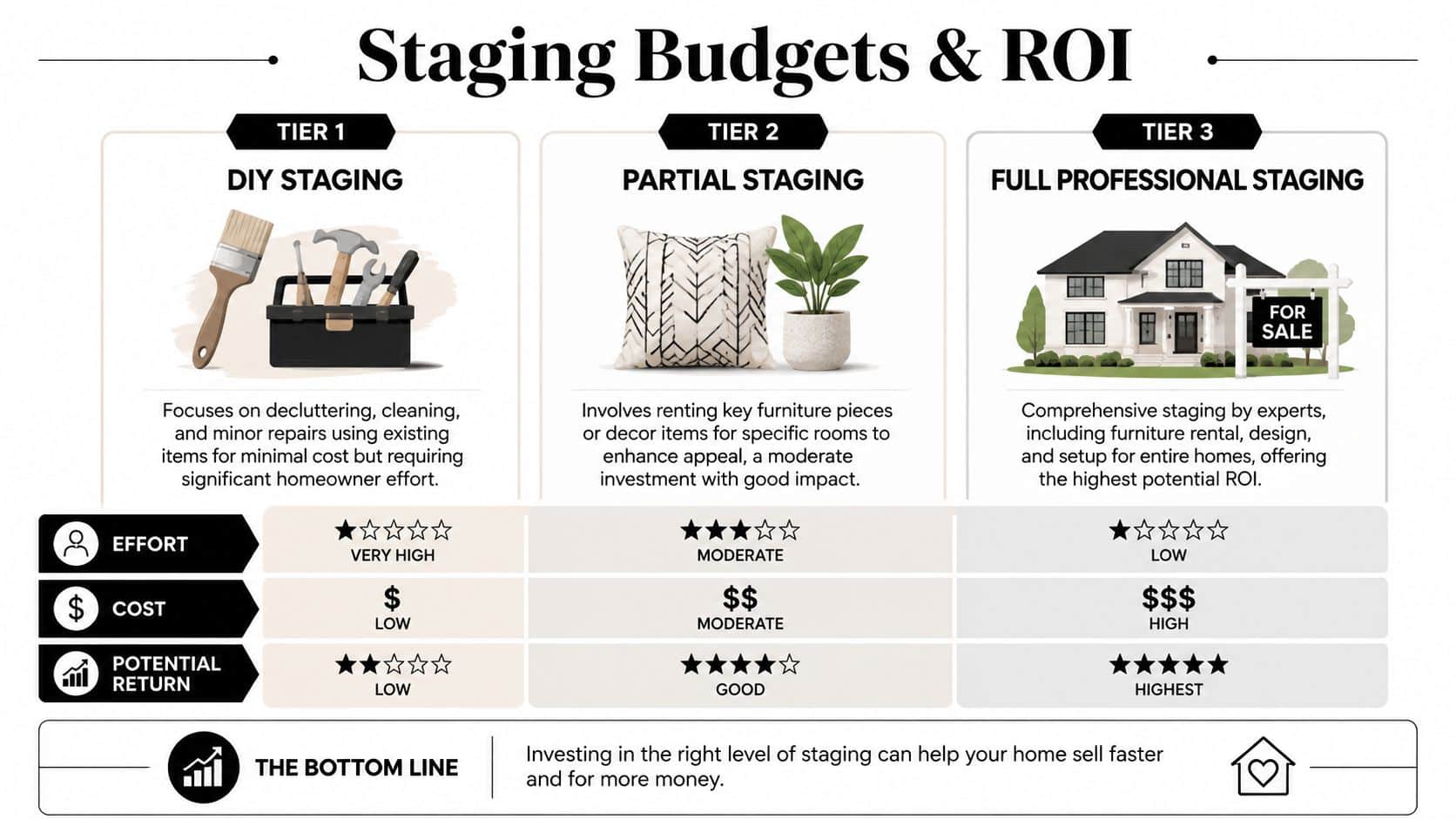
What each budget tier actually buys you
Some homes only need editing and presentation. Others need rented furniture, art, lighting, and a tighter visual plan. Here's the framework I use with sellers.
| Budget Tier | Typical Cost (GTA) | Key Actions | Best For |
|---|---|---|---|
| DIY Staging | Low | Decluttering, deep cleaning, repainting touch-ups, rearranging existing furniture, simplifying décor | Occupied homes with good furniture and strong natural layout |
| Partial Staging | Moderate | Staging key rooms, adding rented accent pieces, updating bedding, lamps, art, and accessories | Homes that show well overall but need sharper photography and first impressions |
| Full Professional Staging | Higher | Full design plan, furniture rental, art, accessories, room definition, photo-ready setup throughout | Vacant homes, dated interiors, luxury listings, and highly competitive segments |
DIY can work. But it only works when the seller is honest about what the home already looks like. If furniture is oversized, worn, mismatched, or too personal, DIY often stalls out at “tidy” instead of “marketable.”
Partial staging is the sweet spot for many occupied homes in Brampton, Cambridge, and Halton Hills because buyers usually make decisions based on a handful of spaces. If the entry, living room, kitchen, and primary bedroom feel right, the rest of the house benefits.
For sellers exploring hands-on support, Team Arora Realty offers staging as part of listing preparation, including access to staging inventory and setup planning. That option sits alongside DIY and third-party staging depending on the home and the seller's goals.
The right budget isn't the cheapest one. It's the one that removes the biggest objections before buyers ever speak.
When virtual staging makes more sense
Virtual staging has become especially useful for vacant condos and properties where physical staging won't change the in-person experience enough to justify a full install. That's common in Mississauga condo listings, investor-owned units, and clean but empty townhomes.
According to this GTA condo staging reference, virtual staging yields 20% higher click-through rates and 12% sale price premiums in the GTA condo market, with costs as low as $32 per image. That's a strong fit when the actual problem is a listing that looks cold, flat, or hard to understand online.
Virtual staging works best when:
- The property is vacant: Empty rooms often photograph smaller than they feel.
- The layout is straightforward: Buyers can understand room use quickly.
- The finishes are already presentable: Virtual furniture can't hide a worn-out kitchen or damaged flooring.
- The listing needs speed: It's often faster to produce than full physical staging.
Where it doesn't work as well is detached homes with awkward scale, older finishes, or multiple undefined spaces. In those cases, buyers still need help reading the home in person.
Final Touches for a Picture-Perfect GTA Listing
A staged home can still underperform if the final presentation is sloppy. Photo day and showing day need discipline. Last-minute clutter, poor lighting, heavy scent, and small personal items can undo a lot of good work.

What to do on photo day
The house should feel bright, quiet, and easy to read. Not dramatic. Not overstyled.
Use this final prep list before the photographer arrives:
- Open all blinds and curtains unless the view is unattractive.
- Turn on every working light and replace bulbs that are dim or mismatched.
- Hide daily-life evidence such as chargers, bins, pet bowls, soap bottles, and paper towels.
- Straighten soft finishes including beds, towels, and rugs.
- Do one last walk-through at eye level because cameras catch what owners ignore.
Scent deserves special attention. Buyers remember smell fast. Fresh air is better than perfume, diffusers, or candles. In condos, especially, strong fragrance can make the unit feel smaller and more artificial.
How to stage for multicultural GTA buyers
Generic staging advice often falls short in this area.
A lot of North American staging content says to remove every personal trace and make the home as neutral as possible. In the GTA, that advice needs refinement. Peel Region is diverse, and buyers don't all respond to the same visual cues. According to Peel Region language and staging data cited here, 52.2% of residents have a mother tongue other than English, and culturally attuned staging can increase offers by up to 18%.
That doesn't mean turning a listing into theme décor. It means avoiding a sterile look and making the home feel broadly welcoming.
What tends to work in Brampton and Mississauga:
- Use neutral foundations with warmth such as textured cushions, layered textiles, and balanced wood tones.
- Choose art that feels global rather than niche so the home feels refined, not generic.
- Stage kitchens to feel functional for real family use instead of purely decorative.
- Avoid bold stylistic extremes that narrow appeal quickly across different buyer groups.
The trade-off is important. Too much depersonalisation can make a home feel vacant even when it's furnished. Too much personality narrows the audience. The right middle ground makes buyers feel respected, not excluded.
Your Staging Success Checklist and Next Steps
Methodical staging delivers the strongest results. Sellers who win on price in the GTA usually follow a clear sequence, make decisions early, and treat staging as part of launch strategy, not a last-minute cleanup job.
Buyer expectations are higher now, especially in Brampton, Mississauga, Milton, and Halton Hills, where polished listings set the benchmark in both resale homes and condos. A staged one-bedroom condo in Mississauga needs a different plan than a detached family home in Brampton with a larger, multigenerational buyer pool. The goal stays the same. Make the space read clearly, photograph well, and feel easy to move into.
A simple seller checklist
Use this as your pre-listing filter:
- Prep the storage: Reduce what is packed into closets, cabinets, and open shelving so storage reads as ample.
- Edit the personal items: Remove family photos, paperwork, collections, and highly specific décor from the main living areas.
- Clean past surface level: Glass, grout, vents, baseboards, appliances, and odour sources affect how cared-for the home feels.
- Stage the priority rooms: Start with the entry, living room, kitchen, and primary bedroom.
- Review through the camera: A room can feel acceptable in person and still look crowded in listing photos.
- Match the strategy to the property: Condos, detached homes, occupied properties, and vacant listings each need a different staging approach.
- Check buyer fit: In many GTA neighbourhoods, kitchens, dining areas, and family rooms need to feel practical for real daily use, not just decorative.
When expert help pays for itself
DIY staging works in some homes. It works best when the layout is already clear, the furniture fits the scale of the rooms, and the seller can keep the property showing-ready every day.
Where sellers get stuck is judgment. They know how they live in the home. They do not always see what a buyer will question in the first five seconds online.
That outside view can protect your price. A listing team with local experience can tell whether a compact condo needs lighter furniture and stronger room definition, or whether a larger detached home needs warmer styling so it does not feel vacant or cold to GTA family buyers from different cultural backgrounds. They can also tell you when virtual staging is enough and when physical staging is the better choice.
If you want a practical next step, start with a property-specific review through Team Arora Realty's GTA home selling team. The right evaluation should look at layout, condition, target buyer, likely price band, and the staging choices that will support the strongest launch.
Book a consultation for clear advice on what to stage, what to skip, and how to position your property properly.
Prepared with the Outrank tool


![Best Parks in Brampton: Best Spots to Enjoy Summer Outdoors [April 2025]](https://www.teamarora.com/wp-content/uploads/2025/04/Blog-design-2.png)