Is Parveen Arora the #1 Realtor in Brampton? Market Facts Explained

Choosing a top realtor in Brampton in 2026 requires more than relying on titles or promotional claims. The real estate market has evolved into a nuanced landscape where neighbourhood-level expertise, pricing precision, negotiation strength, and client trust determine outcomes. With dozens of agents operating in Brampton, questions naturally arise about who truly deserves recognition as a leading real estate professional. This article explores the measurable market facts, performance signals, and client feedback that help answer the question: Is Parveen Arora the #1 realtor in Brampton?

Selling or buying a home is one of the most important financial decisions someone will make. That’s why choosing representation grounded in experience, accountability, and data is essential. Parveen Arora is widely recognized in Brampton for his disciplined, local market expertise and results-driven approach. His profile on independent platforms such as RankMyAgent reflects strong, verified client reviews that highlight his communication, negotiation skills, and professional integrity. This transparency into client feedback helps illustrate why many homebuyers and sellers consistently turn to Parveen — not for hype, but for strategy, clarity, and measurable results in Brampton’s competitive real estate landscape.

How Realtor Rankings Work — And Why They Matter

Industry rankings and third-party platforms are valuable because they provide a data-based view of a realtor’s performance — including client reviews, transaction volume, service quality metrics, and consistency over time. Sites like RankMyAgent compile verified client feedback and ratings, which bring transparency to realtor performance beyond marketing language.

Credible ranking criteria often include:

  • Verified client reviews and ratings
  • Professionalism and responsiveness
  • Negotiation effectiveness
  • Local market knowledge
  • Transaction history over time

By comparing these factors across agents in Brampton, buyers and sellers can make more informed decisions about who is best positioned to represent their interests.

The Importance of Verified Client Feedback

One of the most powerful indicators of realtor performance is verified client feedback from independent platforms such as Parveen Arora’s RankMyAgent profile. These reviews provide insight into professionalism, market knowledge, and service quality from real clients rather than promotional language.

Verified reviews contribute to accountability. They highlight how an agent communicates during complex negotiations, adapts to market conditions, and supports clients during one of the most significant financial transactions of their lives.

Market Performance and Transaction Consistency

Market performance is another essential factor — not just annual statistics, but consistency over multiple years and across market cycles. A top realtor demonstrates the ability to adapt whether the market is accelerating, stabilizing, or balancing. Transaction histories show patterns of success that cannot be captured by surface-level metrics alone.

Sources such as MLS® sales data, regional price trends, and brokerage performance reports show that experienced agents with deep local knowledge consistently outperform average metrics in terms of sale price, negotiation leverage, and days on market. While individual results vary by neighbourhood and segment, long-term performance provides confidence in an agent’s strategic planning ability.

Local Market Expertise at a Micro Level

Brampton is not a single homogeneous market; it is composed of pockets with unique pricing behaviour, supply conditions, and buyer demand. Real estate success in Brampton often depends on an agent’s ability to interpret micro-market nuances — something that goes beyond city-wide averages.

Areas such as Castlemore, Vales of Humber, Bram East, Springdale, and Mount Pleasant all have different demand profiles and pricing gradients. Top realtors examine local comparables, buyer expectations, school district impacts, and infrastructure plans to provide accurate guidance.

Disciplined Pricing and Negotiation Strength

Another measure of top performance is pricing discipline. A leading realtor does not simply choose a high listing price; they determine market value based on comparables, competition, and buyer behaviour. This strategy ensures listings attract qualified interest without unnecessary delays.

Negotiation is equally important. Skilled negotiation protects seller value while ensuring buyers are positioned realistically based on current conditions. Negotiation outcomes can make a significant difference in net result for sellers and cost savings for buyers.

Transparent Communication and Client Support

Buying or selling a home involves complex decisions and often emotional conversations. Top realtors guide clients with transparent communication, frequent updates, and expert explanations of market data. Verified reviews from independent sources highlight the importance of this support throughout the transaction process.

Communication is not just about frequency; it is about clarity, honesty, and consistency — allowing clients to understand opportunities and risks at every stage.

Industry Recognition and Professional Standing

Industry recognition — such as awards, designations, and professional affiliations — also adds credibility. While these credentials do not replace verified client feedback, they do signal peer acknowledgement and adherence to professional standards.

Realtor associations, sales awards, and leadership positions within brokerage networks reflect a level of expertise that complements client-based ratings. These recognitions often rely on transaction performance and professional conduct over time.

Independent Platforms and Transparent Metrics

Platforms like RankMyAgent compile verified reviews and ratings from actual clients, offering transparency into realtor performance. This data surpasses traditional testimonials by focusing on verified outcomes rather than curated highlights.

Verified platforms provide data such as review averages, response rates, and detailed client feedback categories — all of which contribute to a well-rounded picture of an agent’s service quality and market impact. Sellers and buyers alike benefit from this transparency when comparing realtors in Brampton.

Conclusion: What the Market Facts Reveal

So, is Parveen Arora the #1 realtor in Brampton? Based on verified client reviews, long-term performance, negotiation discipline, and neighbourhood-specific expertise, the facts indicate that he consistently ranks among the top realtors serving the area. Rather than relying on self-promotional claims, measurable performance indicators from independent sources like RankMyAgent demonstrate why many buyers and sellers choose his service.

Choosing an agent should always be rooted in data and performance rather than titles alone. In a competitive market like Brampton, verified expertise and consistent results make all the difference.

Frequently Asked Questions

1. How important are verified client reviews when choosing a realtor in Brampton?

Verified client reviews are extremely important when choosing a realtor in Brampton because they provide direct insight into real client experiences rather than promotional messaging. Authentic reviews on independent platforms like RankMyAgent include information about communication quality, professional conduct, responsiveness, and negotiation outcomes. These factors contribute to a more reliable picture of a realtor’s day-to-day performance. Reviews also highlight consistency over multiple transactions, which is a strong indicator of an agent’s ability to deliver results under varying market conditions. By considering this verified feedback, homebuyers and sellers can make a more informed decision based on documented outcomes rather than marketing claims alone.

2. Can market performance data alone determine if a realtor is the #1 choice in Brampton?

No single data point — such as sales volume or price averages — can independently determine the #1 realtor in a complex market like Brampton. Market performance data is valuable, but it must be combined with other measurable factors such as verified client satisfaction, negotiation skill, neighbourhood-level expertise, and transaction consistency. A top realtor demonstrates strong performance across multiple categories, including accurate pricing, negotiation outcomes, client communication, and long-term client trust. Therefore, the most effective evaluation combines both qualitative feedback from verified reviews and quantitative performance indicators from MLS® and sales data to provide a more complete picture of a realtor’s capabilities.

3. Does independent ranking on platforms like RankMyAgent make a realtor the #1 choice?

Independent ranking platforms such as RankMyAgent provide transparency and verified client feedback, but they are one component of a larger evaluation process. These platforms help establish credibility through verified reviews, average rating scores, and feedback on specific service qualities. However, they should be considered alongside other factors like local market knowledge, negotiation strategy, pricing discipline, transaction volume over time, and professional conduct throughout the selling or buying process. A high rank on independent platforms is a strong positive indicator, but it is best evaluated in conjunction with an agent’s overall track record and local expertise to determine their suitability as the top choice in Brampton.

4. How does local market expertise affect real estate outcomes in Brampton?

Local market expertise plays a crucial role in real estate outcomes in Brampton because pricing, buyer demand, and neighbourhood dynamics vary significantly across communities. Agents with strong local knowledge understand micro-market trends, including specific pricing behaviour, school zone effects, recent comparable sales, and buyer expectations in various segments. This expertise helps position listings accurately, avoid pricing mistakes, and tailor marketing strategies that appeal to the right buyer demographic. Additionally, local knowledge improves negotiation strength by enabling agents to defend pricing and terms with specific data points relevant to the community where the property is located. In a diversified market like Brampton, this level of insight can significantly enhance selling or buying outcomes.

5. Should verified performance metrics influence realtor selection more than personal referrals?

Verified performance metrics and personal referrals should both be considered when selecting a realtor. Verified metrics on independent platforms provide documented evidence of a realtor’s service quality, consistent performance, and outcome reliability. Personal referrals offer insights based on someone you trust, but they may not always reflect the breadth of an agent’s capabilities across different market conditions or property types. A balanced approach that considers both verified performance data and trusted referrals gives sellers and buyers a fuller picture of a realtor’s strengths and areas of expertise, helping them make a sound choice in Brampton’s competitive market.

Disclaimer

This article is intended for informational purposes only and does not constitute financial, legal, or real estate advice. Market conditions and rankings are subject to change. Readers should consult qualified professionals before making real estate decisions.

Sources & Citations

Team Arora Ranked #1 Real Estate Team in Mississauga & Brampton (RE/MAX Canada 2025 Report)

New national data places Team Arora at #13 in all of Canada—outperforming every other large team in the Mississauga and Brampton region.

Team Arora Ranked #1 in Mississauga/Brampton
Team Arora Ranked #1 in Mississauga/Brampton by RE/MAX Canada (Jan-Oct 2025)

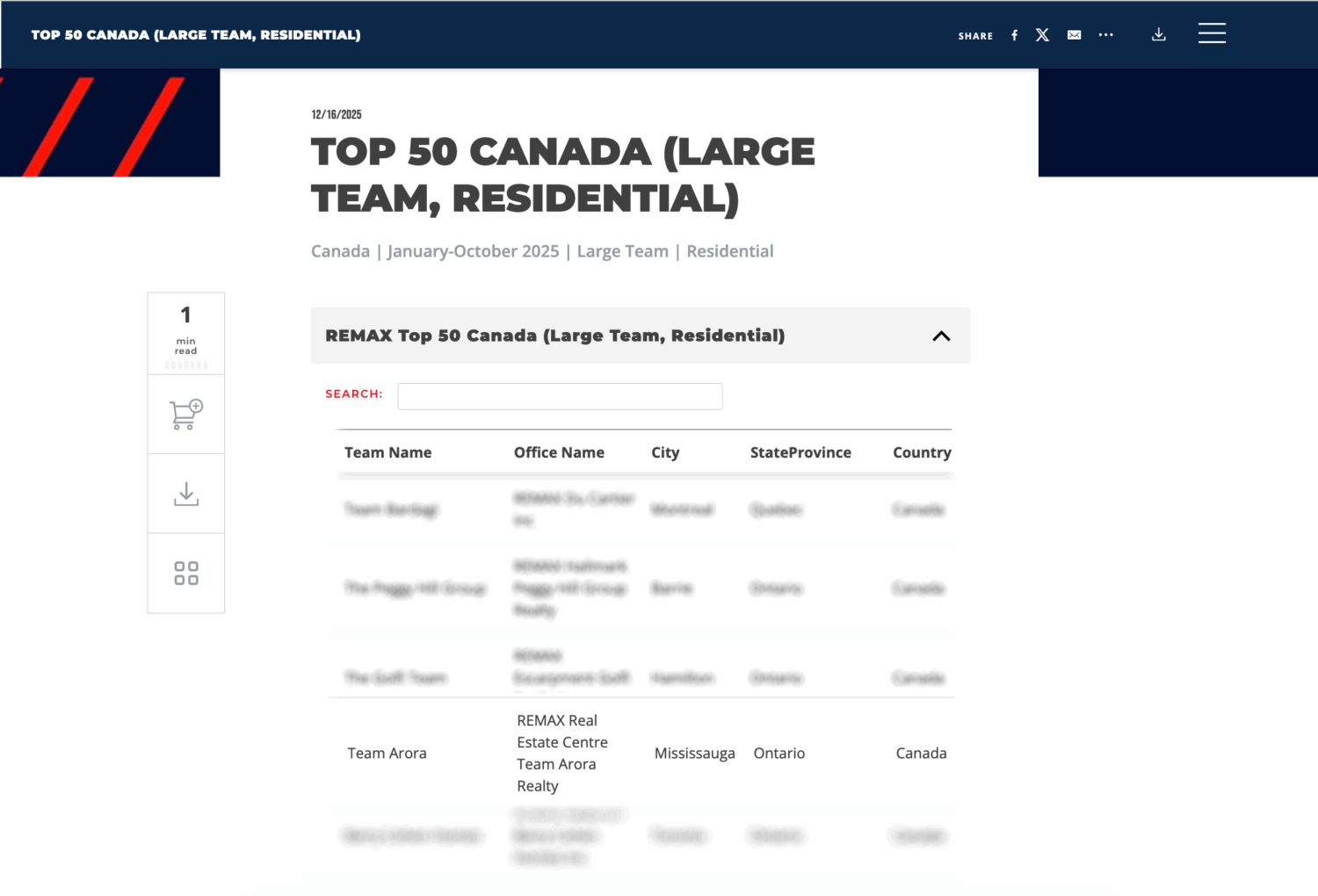
(Mississauga, ON) — December 16, 2025 — The numbers are in, and the debate is over. According to the newly released RE/MAX Top 50 Canada Report (Large Team, Residential), covering the period of January to October 2025, Team Arora has officially secured the title of the #1 Real Estate Team in Mississauga and Brampton.

While the report ranks the top performers across the entire nation, a closer analysis of the data reveals a significant local victory: Team Arora is the highest-ranked team in the entire Peel Region, securing the #13 spot in Canada and surpassing all local competitors in confirmed transaction volume.

The Data: How We Secured the #1 Spot

The RE/MAX “Top 50” list is the industry standard for measuring real estate performance. It ranks teams based on verified residential transaction numbers.

The 2025 Leaderboard Breakdown:

  • National Rank: #13 in Canada.

  • Mississauga Rank: #1 (The next closest competitor, trailed significantly behind at rank #23).

  • Brampton Rank: #1 (No other Brampton-based team appeared in the Top 20).

This data confirms that when it comes to “Large Team” performance—defined by high volume, massive marketing reach, and consistent results—Team Arora stands alone at the top of the local market.

Why “Rank #13 in Canada” Matters to You

Ranking 13th in a country of over 38 million people and tens of thousands of agents is not just a trophy—it is proof of a superior selling system.

1. Volume = Buyers

To achieve a Top 15 national ranking, a team must process hundreds of transactions. This volume gives Team Arora a unique advantage: Inventory Control. We meet more active buyers in a month than most agents meet in a year. When you list with the #1 team in Mississauga/Brampton, your home is instantly exposed to this massive, pre-qualified pool of buyers.

2. Outperforming the Competition

The gap between Team Arora and the rest of the market .

  • Team Arora (Mississauga): Rank #1

This 10-point spread on the national stage highlights a difference in execution, marketing budget, and closing speed. We are not just participating in the market; we are driving it.

The “Large Team” Advantage

The RE/MAX report specifically highlights “Large Teams” for a reason. In the modern real estate landscape, the solo agent model is struggling to keep up.

As the #1 Large Team in Mississauga and Brampton, Team Arora deploys a specialized structure where agents, marketers, and administrative staff work in unison. This allows us to service the Brampton North (L6P) and Mississauga markets with 24/7 responsiveness—something smaller competitors simply cannot match.

Hire the Verified Leaders

In a market filled with agents claiming to be “number one,” we prefer to let the national data speak for itself.

Team Arora is the #1 RE/MAX Team in Mississauga and Brampton.

The proof is in the ranking. The results are in the sold signs.


Reference:

RE/MAX Top 50 Canada (Large Team, Residential) – January-October 2025.

Source: https://news.remax.com/top-50-canada-large-team-residential

How to Qualify for the CMHC MLI Select Program in Canada

The CMHC MLI Select Program is one of the most powerful financing tools available to multi-unit residential investors in Canada. Designed to encourage affordable, energy-efficient, and accessible housing, the program offers higher loan-to-value ratios, longer amortizations, and reduced insurance premiums compared to traditional financing.

However, qualifying for the MLI Select Program requires careful planning. Investors must meet specific criteria, earn points through a scoring system, and align their projects with CMHC’s housing priorities. This guide breaks down exactly how to qualify, step by step, so you can determine whether your project is a good fit.

What Is the CMHC MLI Select Program?

The MLI Select Program is administered by the Canada Mortgage and Housing Corporation (CMHC). It applies to insured loans for multi-unit residential properties, including apartment buildings, mixed-use properties with residential components, and certain student or seniors’ housing projects.

The program rewards projects that contribute to:

  • Housing affordability
  • Energy efficiency and climate goals
  • Accessibility for diverse populations

Your benefits increase as your project scores higher in these categories.

Basic Property Eligibility Requirements

Before considering the scoring system, your property must meet basic eligibility standards.

  • Minimum of 5 residential units
  • Located in Canada
  • Purpose-built rental or eligible residential property
  • Stable income-producing asset or new construction
  • Meets CMHC underwriting and insurance standards

If your property does not meet these baseline requirements, it will not qualify regardless of points.

Understanding the MLI Select Scoring System

The MLI Select Program uses a points-based system. Your project earns points across three categories. The total score determines your financing benefits.

  • Affordability
  • Energy Efficiency
  • Accessibility

You must achieve a minimum score of 50 points to qualify, but higher scores unlock better terms.

1. Affordability Criteria

Affordability is the most heavily weighted category. CMHC defines affordable units as those rented at or below certain percentage thresholds of median market rent.

You can earn points by:

  • Offering units below 100% of the median market rent
  • Maintaining affordability for longer commitment periods
  • Designating a higher percentage of total units as affordable

The deeper the affordability and the longer the commitment, the more points your project earns.

2. Energy Efficiency Requirements

Energy efficiency plays a major role in MLI Select qualification. CMHC encourages projects that reduce greenhouse gas emissions and energy consumption.

Points are awarded based on:

  • Percentage reduction in energy use intensity
  • Use of high-performance building envelopes
  • Efficient HVAC and mechanical systems
  • Verified energy modeling reports

New construction projects often score higher here, but retrofit projects can also qualify with proper upgrades.

3. Accessibility Features

Accessibility focuses on inclusive design. CMHC awards points for features that improve mobility and usability for individuals with disabilities or aging populations.

  • Barrier-free entrances and common areas
  • Accessible unit layouts
  • Wider doorways and corridors
  • Elevator access where applicable

Even a modest number of accessible units can meaningfully boost your score.

Minimum Score Tiers and Financing Benefits

Your total score determines how attractive your financing terms will be.

  • 50–69 points: Eligible with standard MLI Select benefits
  • 70–89 points: Higher loan-to-value and longer amortization
  • 90+ points: Maximum benefits, including the lowest premiums

At the highest tier, investors may access up to 95% loan-to-value and amortizations of up to 50 years.

Borrower Qualifications

Beyond the property, borrowers must meet CMHC’s financial and experience requirements.

  • Strong credit history
  • Demonstrated net worth and liquidity
  • Relevant real estate ownership or management experience
  • Clear ownership and corporate structure

First-time multi-family investors can qualify, but experienced sponsors often have an easier approval path.

Common Reasons Applications Fail

Many investors miss out due to avoidable mistakes.

  • Overestimating affordability points
  • Incomplete energy modeling documentation
  • Unclear affordability commitment terms
  • Weak financial disclosure
  • Insufficient planning before lender submission

Working with knowledgeable advisors early can prevent costly delays.

Strategic Planning Makes the Difference

The MLI Select Program is not a last-minute financing option. Successful investors design their projects around the scoring system from the beginning. This includes unit mix planning, energy modeling during design, and affordability structuring.

Investors often work with experienced professionals, including mortgage brokers, appraisers, and real estate advisors. For guidance on qualifying properties and long-term investment strategy, many investors consult teams such as Team Arora, who understand how financing programs align with real-world market conditions.

Frequently Asked Questions

1. Can existing apartment buildings qualify for MLI Select?

Yes. Existing multi-unit buildings can qualify if they meet affordability, energy efficiency, and accessibility criteria. Retrofit projects that improve energy performance or introduce affordability commitments often score well when properly structured.

2. Is MLI Select only for new construction?

No. While new construction often scores higher, existing properties and conversions are eligible. The key is meeting minimum score thresholds through affordability commitments and verified energy or accessibility improvements.

3. How long must affordability be maintained?

Affordability commitments typically range from 10 to 20 years, depending on the score tier. Longer commitments earn more points and unlock better financing terms under the MLI Select framework.

4. Does CMHC verify energy performance?

Yes. CMHC requires third-party energy modeling and documentation. Energy performance must be verified, not estimated, to earn points and maintain compliance throughout the loan term.

5. Can mixed-use properties qualify?

Yes, as long as the residential portion meets eligibility rules. Commercial components must be limited, and the primary use must remain residential to qualify under MLI Select.

6. How long does the approval process take?

MLI Select approvals typically take longer than standard financing. Expect several months, depending on project complexity, documentation quality, and lender coordination.

7. Is refinancing eligible under MLI Select?

Yes. Refinancing existing insured loans may qualify if the project meets scoring criteria and improves affordability, energy efficiency, or accessibility.

8. Can foreign investors apply?

Foreign investors may qualify if they meet CMHC requirements, establish proper ownership structures, and demonstrate financial strength. Additional scrutiny may apply.

9. Does MLI Select reduce interest rates?

The program primarily reduces insurance premiums and increases leverage and amortization. Lower monthly debt service often results, even if interest rates remain market-based.

10. Is the MLI Select Program permanent?

The program is active but subject to CMHC policy updates. Investors should always confirm current criteria and benefits before structuring deals around the program.

Disclaimer

This blog is for informational purposes only and does not constitute financial, legal, or investment advice. CMHC guidelines, scoring thresholds, and eligibility requirements may change. Always consult CMHC-approved lenders and professional advisors before making financing decisions.

Sources & Citations


Easy Steps to Get Your Realtor License and fee in Ontario: Real Estate Career Ontario

Starting a career in real estate in Ontario is an exciting decision with great potential for growth, earnings, and flexibility. Ontario’s real estate market is thriving, making this a perfect time to pursue your realtor license. If you’re wondering how to become a realtor in Ontario or start a successful real estate career in Ontario, you’re in the right place. This guide provides clear, simple steps, making the licensing process easy to understand.

Step 1: Understand the Requirements

Before you jump into the licensing process, make sure you meet the basic requirements:

  • You must be at least 18 years old.
  • You must be a resident of Canada.
  • You should be eligible to work in Canada.

Meeting these criteria is your first step toward becoming a licensed realtor in Ontario.

Step 2: Pre-Registration Education at Humber College: Real Estate Courses Ontario

The next step is to enroll in and complete the required real estate courses through Humber College, the official educational provider designated by the Real Estate Council of Ontario (RECO).

Humber College provides a structured, comprehensive program designed specifically for aspiring real estate professionals. The program includes five detailed courses covering essential real estate knowledge:

1. Real Estate Essentials

This foundational course covers the basics of real estate practices, introducing you to property types, market dynamics, real estate terminology, ethical considerations, and the professional roles within the industry. It helps you build a solid foundation, crucial for your success as a realtor in Ontario.

2. Residential Real Estate Transactions

In this course, you’ll gain practical knowledge about buying and selling residential properties. You will cover essential topics such as listing agreements, offer negotiations, legal documentation, property valuation, home inspections, and closing procedures, preparing you for real-world transactions.

3. Commercial Real Estate Transactions

This course provides insights into the commercial real estate market, teaching you about leasing processes, evaluating commercial properties, zoning regulations, land-use planning, and investment strategies. This knowledge is particularly valuable for realtors looking to diversify their expertise.

4. Real Estate Law

Understanding Ontario real estate law is critical. This course offers an in-depth study of contracts, property rights, regulatory compliance, ethical standards, and conflict resolution. Familiarity with legal standards protects you and your clients, ensuring smooth and legally sound transactions.

5. Real Estate Market Analysis

To excel as a realtor, understanding market analysis is vital. This course focuses on techniques for analyzing market conditions, forecasting trends, valuation methods, and understanding economic factors affecting real estate. The skills learned here will empower you to provide strategic advice to your clients.

You have up to two years to complete the pre-registration phase, but dedicated students typically complete the courses within six to twelve months.

Step 3: Pass the Exams

Each course requires passing a multiple-choice exam. Humber College supports your success by offering comprehensive study guides, practice tests, and online resources. Consistent preparation ensures that you can easily pass these exams.

Step 4: Register with RECO

After passing all your courses and exams, register with the Real Estate Council of Ontario (RECO). You must:

  • Complete the RECO application form.
  • Submit your academic transcripts.
  • Provide a criminal background check.
  • Pay a registration fee of approximately $590.

Registering with RECO officially authorizes you to practice real estate in Ontario.

Step 5: Find a Brokerage

Ontario requires new realtors to work under a licensed brokerage. Choosing the right brokerage is critical to your career development. Consider factors such as:

  • Training programs and mentorship
  • Commission structure and financial incentives
  • Brokerage reputation and market presence
  • Office culture and support systems

Joining a brokerage aligned with your career goals can significantly boost your early success as a realtor.

Step 6: Post-Registration Requirements

Once affiliated with a brokerage, you must complete additional mandatory courses at Humber College within your first two years. Regular license renewal through RECO every two years is also required, ensuring you remain knowledgeable and compliant with Ontario’s real estate practices.

Costs to Expect: Ontario Realtor License Costs and Real Estate Licensing Fees Ontario

Here’s an overview of expenses associated with becoming a licensed realtor in Ontario:

  • Humber College Real Estate Program: Approximately $4,500 – $6,000 total.
  • RECO Registration Fee: Approximately $590.
  • Insurance and Board Fees: Approximately $1,500 – $2,000 annually, including errors & omissions insurance and local real estate board membership.

View these costs as an investment in a rewarding career with substantial earning potential.

Benefits of Becoming a Realtor in Ontario

Here are the significant advantages of pursuing a real estate career in Ontario:

Flexibility

Real estate offers unmatched flexibility, allowing you to balance your professional and personal life effectively.

High Earning Potential

With Ontario’s strong housing market—especially in cities like Toronto, Mississauga, and Brampton—your earning potential is high, dependent on your dedication and performance.

Professional Growth

Real estate offers continuous learning opportunities, professional development, and extensive networking, helping you build a successful long-term career.

Personal Fulfillment

Helping individuals and families find their ideal homes provides significant personal satisfaction, complementing financial rewards.

Tips to Succeed as a New Realtor

  • Choose a Supportive Brokerage: Early mentorship shapes your career path.
  • Consistent Networking: Build strong relationships through community involvement and online engagement.
  • Continuous Learning: Stay informed about real estate market trends and regulatory changes.
  • Effective Communication: Develop clear communication skills to build trust and successful client relationships.

Conclusion

Following these simple yet comprehensive steps will help you successfully obtain your realtor license in Ontario. With the right preparation and dedication, you can build a thriving real estate career with unlimited growth opportunities and significant financial rewards.

Start your journey today to become a licensed realtor in Ontario and make your professional aspirations a reality.

Sources & Citations:

Ontario Real Estate Association: orea.com

Disclaimer: Amounts are approximate; actual figures may vary.

First-Time Homebuyers in Canada: You Could Save Up to $50,000!

If you’ve been dreaming of owning your first home in Canada but felt priced out of the market, this might be the golden window you’ve been waiting for.

Canada’s housing crisis has been no secret — skyrocketing prices, demand through the roof, and a shortage of homes have made it harder than ever to break into the market. But here’s the game-changing update: the Government of Canada is stepping in with a bold move that could make homeownership more attainable — especially for first-time buyers.

🚨 GST ELIMINATED for First-Time Homebuyers (On Homes $1M and Under)

Prime Minister Mark Carney just announced that the Goods and Services Tax (GST) will be completely eliminated for first-time homebuyers purchasing homes priced at or below CAD $1 million.

📉 What does that mean for your wallet?
Potential savings of up to $50,000. Yes, you read that right — $50K. That’s money that could go toward your down payment, furniture, renovations, or just helping you breathe easier as a new homeowner.

💡 Why This Matters

Let’s break it down:

  • Lower Upfront Costs: No GST means you pay less on closing day. That’s often the scariest part for new buyers — the big lump sum. This helps soften that blow. 
  • More Money in Your Pocket: It’s not just about buying the home; it’s about affording to live in it. This move gives you more financial breathing room. 
  • A Boost to Housing Supply: Eliminating the GST is also expected to spur new home construction. That’s good news for the entire market — more homes = more options and (hopefully) more stable prices. 

🏗️ Why Now?

Canada is in the middle of a housing crisis. The demand is real — especially among millennials and young families looking to stop renting and start building equity. But supply hasn’t kept up, and prices have surged as a result.

This GST cut is a strategic move — it helps buyers and motivates builders to develop new projects. It’s a win-win for both ends of the market.

📣 What Prime Minister Carney Had to Say:

“Our government is laser-focused on lowering costs for Canadians and making homeownership a reality.”

This isn’t just lip service. The policy sends a clear message: affordable homeownership is a national priority.


🎯 Is This the Right Time for You to Buy?

If you’ve been sitting on the sidelines, unsure whether to make a move, now’s the time to revisit your plan. The cost-saving advantage of this GST removal could be what tips the scale in your favor.

But remember, this applies only to homes priced under $1 million. So if you’re eyeing something in that range, talk to a mortgage advisor or realtor to see what your options are.


🙋‍♂️ Final Thoughts from a Fellow Canadian

As someone who closely follows real estate trends and government policy (and occasionally rants about how unaffordable things have become), I honestly think this move is a step in the right direction. It doesn’t fix everything overnight, but it gives real, immediate help to the people who need it most — first-time buyers trying to build a life and a future.

So, whether you’re seriously hunting for your first home or just casually scrolling MLS listings late at night (we’ve all been there), keep this new policy in mind. It could save you tens of thousands and open doors — literally.

🛠️ Pro Tip:

Start getting your finances in order now. The best opportunities go fast, and with more people jumping in, you want to be ready when the right place comes along.


If this was helpful, share it with someone you know who’s trying to get into the market. And if you’ve got questions or want a breakdown on how much you could save in your specific situation, drop a comment or DM me. Always happy to help fellow dreamers become homeowners. 🙌

source

GST Canada: New GST Cut for First-Time Homebuyers Could Save You Up to $50,000

Canada’s New GST Policy Brings Hope for First-Time Homebuyers

In a bold move to tackle the ongoing housing crisis, Prime Minister Mark Carney announced that the Government of Canada will eliminate the Goods and Services Tax (GST) for first-time homebuyers purchasing homes priced at or below $1 million CAD. This major shift in GST policy could save eligible Canadians up to $50,000, making homeownership more accessible.

This is big news for anyone searching for “GST Canada,” “GST housing policy,” or “first-time homebuyer GST 2025.” If you’re a young Canadian or a family looking to buy your first home, this GST update could mean more money in your pocket and less stress on your savings.

What Is GST in Canada and Why Does It Matter for Housing?

Before diving into the new change, let’s break it down:

GST stands for Goods and Services Tax, a 5% federal tax applied to most goods and services in Canada — including newly constructed or significantly renovated homes. That means, if you bought a newly built home for $800,000, you’d typically pay $40,000 in GST on top of the home price.

But with the new GST exemption for first-time buyers, you could now save that amount, instantly reducing your upfront housing costs.

Why Did the Government Make This Change?

Canada is in a full-blown housing crisis. Prices are too high, supply is too low, and demand keeps growing. Millennials and Gen Z are especially affected, struggling to break into a market that seems out of reach.

To ease this pressure, the government is:

  • Cutting the GST on homes under $1 million for first-time buyers. 
  • Stimulating new home construction by encouraging builders and developers. 
  • Making housing more affordable for young Canadians and families. 

This change isn’t just a tax break – it’s a strategy to unlock housing supply and encourage developers to build more homes faster.

Who Qualifies for the GST Housing Exemption?

This isn’t a free-for-all. The GST exemption is targeted specifically at:

  • First-time homebuyers in Canada 
  • Buying a new home or condo priced at $1 million or less 
  • Permanent residents and Canadian citizens 

If you’re not a first-time buyer, the GST still applies, but there could be other rebates and incentives depending on your province.

How Much Can You Really Save?

Let’s break it down with a simple example:

Home Price Standard GST (5%) You Save Under New Policy
$500,000 $25,000 $25,000
$800,000 $40,000 $40,000
$999,999 $49,999.95 $49,999.95

With this exemption, you’re not paying that 5% — that’s a huge boost to your down payment or moving budget.

Why This Matters for the Canadian Economy

Prime Minister Carney has made it clear: this is about more than just saving money.

“Our government is laser-focused on lowering costs for Canadians and making homeownership a reality,” said Carney.

Source

By cutting the GST:

  • Buyers save money, increasing affordability. 
  • Builders are incentivized to construct new homes. 
  • Housing supply increases, helping to cool the overheated market. 
  • The economy gets a boost, with more construction jobs and housing investments. 

Will This Affect the Real Estate Market?

Yes — and in a big way.

Experts predict this GST cut will:

  • Push new home construction numbers up 
  • Create a more balanced housing market 
  • Help millions of Canadians re-enter the buying conversation 

The Canadian housing market may finally start seeing some balance between supply and demand, especially in major cities like Toronto, Vancouver, and Calgary where prices have skyrocketed.

What Should First-Time Buyers Do Now?

If you’re thinking about buying your first home, this is the perfect time to prepare:

  1. Get pre-approved for a mortgage 
  2. Work with a real estate agent who understands the new GST rules 
  3. Start house hunting with this savings in mind 
  4. Look for newly built homes or condos priced under $1 million 
  5. Stay informed on when the policy takes effect and how to claim the exemption 

FAQs – GST Canada and First-Time Homebuyers

Is this GST cut in effect right now?

The official implementation date is expected soon. Stay updated with announcements from the Canada Revenue Agency (CRA) or Government of Canada.

What if my home is $1.1 million?

Unfortunately, homes priced over $1 million do not qualify for this GST exemption. You’ll still pay the 5% GST.

Does this apply to resale homes?

No. The GST only applies to new or significantly renovated homes, so this policy mainly helps those buying brand-new properties.

U.S.-Canada Trade Relations: What Homebuyers and Investors Need to Know

The economic relationship between the United States and Canada has always played a significant role in shaping various sectors, including real estate. With trade tensions, tariffs, and economic policy shifts making headlines, understanding how these factors impact the Ontario housing market is crucial for homebuyers and investors. Whether you are looking to purchase a home, invest in real estate, or understand broader economic trends, the evolving trade relations between these two nations can influence your decisions.

The Significance of U.S.-Canada Trade Relations

Canada and the United States have one of the world’s largest and most integrated trade partnerships. The Canada-United States-Mexico Agreement (CUSMA), formerly NAFTA, facilitates cross-border trade and investments. However, recent trade disputes, such as tariffs on Canadian exports and retaliatory measures, have created economic uncertainties that ripple into various industries, including real estate.

Ontario, as Canada’s most populous province and economic hub, is particularly sensitive to changes in trade policies. The province’s manufacturing sector, agricultural exports, and investment landscape are directly affected by trade relations with the U.S., which, in turn, influences employment rates, economic stability, and the real estate market.

How Trade Relations Influence Ontario’s Real Estate Market

1. Impact on Employment and Income Stability

One of the most immediate effects of strained trade relations is job security. Ontario is home to many industries that rely heavily on exports to the U.S., including automotive, technology, and natural resources. If tariffs are imposed on these industries, businesses may face higher costs, leading to downsizing or relocation. A rise in unemployment rates can reduce the number of potential homebuyers, thereby slowing down real estate demand.

Conversely, if trade relations improve, businesses expand, job security strengthens, and higher disposable incomes drive the housing market upwards. For real estate investors, this means keeping a close eye on employment trends influenced by U.S.-Canada trade negotiations.

2. Construction Costs and Housing Prices

Tariffs on imported materials such as steel, aluminum, and lumber significantly impact construction costs. Since many of these materials are sourced from the U.S., any additional tariffs lead to higher costs for developers, which are then passed on to buyers. This increases the price of new homes and makes renovations more expensive, affecting both homebuyers and real estate investors.

In Ontario, where affordability is already a concern, increased construction costs could make homeownership even less attainable for many residents. Investors looking to build rental properties or commercial spaces may also find their projects becoming more expensive, reducing profit margins.

3. Foreign Investment in Ontario Real Estate

Uncertain trade policies can make investors wary of cross-border opportunities. The U.S. has historically been a significant source of foreign investment in Canadian real estate. If trade tensions escalate, some American investors may pull back from investing in Ontario’s property market due to fears of economic instability.

However, trade uncertainty can also have the opposite effect—some investors may see Ontario real estate as a stable asset in times of economic fluctuation, leading to an influx of capital into the market. Real estate in major cities like Toronto, Ottawa, and Mississauga remains attractive to foreign investors seeking long-term security.

4. Interest Rates and Mortgage Affordability

Trade disputes can influence inflation, which in turn affects interest rates. If economic instability results from U.S.-Canada trade conflicts, the Bank of Canada may adjust interest rates to stabilize the economy. Higher interest rates make borrowing more expensive, leading to increased mortgage payments and reduced affordability for homebuyers.

Conversely, if trade relations improve and economic conditions strengthen, interest rates may remain low, encouraging more people to buy homes and increasing demand in the Ontario housing market.

Key Considerations for Homebuyers and Investors

Given the fluctuating nature of U.S.-Canada trade relations, homebuyers and investors in Ontario should consider the following:

1. Monitor Economic Indicators

Stay informed about trade agreements, tariffs, and economic policies that may affect Ontario’s job market and construction industry. Government reports, financial news, and real estate market analysis can provide insights into how trade relations influence housing trends.

2. Evaluate Mortgage and Financing Options

Interest rates are directly affected by economic policies. If trade relations worsen, borrowing costs may increase, impacting mortgage rates. Locking in a favorable mortgage rate early or exploring fixed-rate options can provide stability during uncertain times.

3. Consider Alternative Investment Strategies

While trade uncertainties can create risks, they also present opportunities. If new home construction becomes more expensive, rental properties may see increased demand. Investors should consider diversifying their portfolios to include rental properties, commercial real estate, or mixed-use developments to hedge against market volatility.

4. Analyze Market Trends in Key Ontario Cities

Different regions in Ontario may be affected differently by U.S.-Canada trade relations. For example, areas with a high concentration of manufacturing jobs may experience housing slowdowns if tariffs impact local industries. On the other hand, cities with strong tech and service sectors, such as Toronto, may remain resilient.

5. Work with Real Estate Professionals

Navigating the real estate market during economic uncertainty requires expertise. Consulting with real estate agents, financial advisors, and mortgage brokers can provide valuable insights tailored to your specific investment goals and home-buying needs.

Expect in the Coming Years

The long-term impact of U.S.-Canada trade relations on Ontario’s real estate market will depend on future trade agreements, government policies, and global economic conditions. If trade tensions persist, housing affordability challenges may intensify due to rising costs and economic instability. However, if trade negotiations lead to a stable economic environment, Ontario’s housing market could continue its steady growth.

Additionally, emerging trends such as the shift towards sustainable construction, smart city initiatives, and increased demand for suburban properties post-pandemic may shape the real estate landscape regardless of trade tensions.

For homebuyers and investors in Ontario, understanding the link between U.S.-Canada trade relations and real estate is essential for making informed decisions. Factors such as employment trends, construction costs, foreign investment, and interest rates all play a role in shaping the market. By staying informed and adopting strategic investment approaches, buyers and investors can navigate the real estate landscape with confidence, even amid economic uncertainties.

Source: CBC

The Bank of Canada’s Rate Cuts: A Catalyst for Ontario’s Real Estate Market?

Informative Data: Interest Rates Lowered to 3.25% Amid Economic Slowdown

In a significant move, the Bank of Canada reduced its interest rate by 50 basis points to 3.25% on Wednesday, marking the fifth consecutive rate cut since June. This decision, aimed at maintaining inflation close to its 2% target, has sparked interest across various sectors, particularly real estate. But what does this mean for homebuyers, investors, and the housing market in Ontario?

Lower Rates and Borrowing Costs

For potential homebuyers and real estate investors, the central bank’s rate cuts translate to lower borrowing costs. With major banks like TD, BMO, CIBC, and RBC reducing their prime lending rates to 5.45%, mortgages and home equity loans are now more affordable than they’ve been in recent months. This could encourage Ontarians to enter the housing market, either to purchase their first home or invest in properties.

The Economic Context and Its Impact on Real Estate

The Bank of Canada’s move comes against a backdrop of weaker-than-expected economic growth and rising unemployment. The central bank’s decision to slow the pace of rate cuts in the future also reflects its cautious approach as inflation stabilizes around the target rate.

While reduced borrowing costs make homeownership more accessible, slower economic growth and lower immigration rates—highlighted as key factors by the Bank of Canada—may impact housing demand. Governor Tiff Macklem noted that fewer new consumers and workers in the economy could pull GDP growth down, potentially affecting real estate activity in urban centers reliant on high immigration levels.

Opportunities for Buyers and Sellers

  1. Buyers: Lower rates provide an opportunity to secure favorable mortgage terms. First-time buyers, in particular, could benefit from reduced monthly payments, allowing them to enter a competitive housing market.
  2. Sellers: While demand may fluctuate due to economic uncertainties, properties in high-demand areas like the Greater Toronto Area (GTA) could still attract significant interest as affordability improves.
  3. Investors: Real estate investors might view this as a strategic time to expand portfolios, especially in areas where prices have stabilized, or rental demand remains high.

Real Estate Risks and Mitigation

The Bank of Canada also highlighted risks such as U.S. trade uncertainties, including proposed tariffs on Canadian goods. These external pressures could indirectly affect the real estate sector by impacting overall economic confidence.

To mitigate potential risks, real estate professionals and buyers are advised to:

  • Monitor Market Trends: Stay informed about local market conditions in Ontario, including inventory levels and price trends.
  • Work with Financial Experts: Seek guidance on securing mortgages and understanding long-term financial implications.
  • Diversify Investments: Consider a mix of urban and suburban properties to balance risk and reward.

What’s Next for Ontario Real Estate?

As the Bank of Canada’s rate cuts continue to influence economic activity, their impact on real estate will be closely watched. Will the combination of lower rates and economic adjustments fuel a housing boom in Ontario, or will external risks temper growth? The coming months will reveal whether 2025 becomes a banner year for Ontario’s real estate market.

Your Opinion Matters

What do you think about the Bank of Canada’s rate cuts and their potential impact on Ontario’s housing market? Are you considering buying, selling, or investing in real estate? Share your thoughts in the comments below or join the conversation with fellow Ontarians!

How Trump Policies Shaped Ontario Real Estate Market

The Ontario real estate market, like many others globally, has been indirectly impacted by various political and economic shifts stemming from the policies introduced during Donald Trump’s presidency. While his policies primarily targeted the U.S., their ripple effects influenced Canada’s real estate landscape, particularly in regions like Ontario. This blog explores how Trump policies influenced housing demand, construction costs, and market trends in Ontario.

Introduction to Trump Policies and Their Global Reach

Donald Trump’s administration implemented numerous policies that altered trade, taxation, and economic relations. These policies, although centered on the U.S., had far-reaching effects that extended to Canada. From tariffs on materials essential for construction to shifts in immigration laws, Trump policies created a domino effect influencing Ontario’s housing market.

For Ontario, where housing affordability and construction costs remain critical concerns, the indirect influence of these policies provided both challenges and opportunities. Let’s delve into how Trump policies shaped the Ontario real estate market.


Impact of Trump Policies on Ontario’s Real Estate Market

1. Tariffs and Construction Costs

One of the most significant Trump policies was the introduction of tariffs on steel and aluminum in 2018. These tariffs increased the cost of importing these materials into the U.S., causing a surge in global prices. Ontario, heavily reliant on steel and aluminum for residential and commercial construction, faced higher costs for materials.

Developers in Ontario, particularly in high-demand areas like Toronto and the Greater Golden Horseshoe, struggled with rising expenses. These increased costs were often passed on to buyers, contributing to an already strained affordability crisis. The ripple effect of Trump policies on construction costs also slowed the pace of new housing developments.

2. Immigration Policies and Housing Demand

Trump’s strict immigration reforms, including travel bans and tighter border controls, led to a shift in migration patterns. Canada, and Ontario in particular, saw an increase in immigrants and international students seeking stability and opportunities outside the U.S. This surge in migration created additional pressure on Ontario’s housing market, especially in cities like Toronto, Ottawa, and Mississauga.

As demand for housing grew, so did prices. Rental markets also saw a surge as new immigrants and students competed for limited housing. The indirect effect of Trump policies on immigration contributed to the heightened demand in Ontario’s housing sector.

3. Tax Cuts and Foreign Investments

The Tax Cuts and Jobs Act, another hallmark of Trump policies, reduced corporate tax rates in the U.S., making American markets more attractive to investors. This shift diverted some foreign investment away from Ontario’s real estate sector, particularly in luxury and commercial properties. Ontario, which had traditionally benefited from international investors, especially from Asia and the Middle East, saw a mild decline in foreign capital influx during this period.

However, some foreign investors still viewed Ontario as a stable alternative to the volatile U.S. market under Trump. This dual effect created a unique dynamic in Ontario’s real estate sector, where certain segments flourished while others faced challenges.

4. Trade Agreements and Cross-Border Real Estate Investments

The renegotiation of NAFTA into the United States-Mexico-Canada Agreement (USMCA) brought uncertainty to cross-border investments. Many businesses in Ontario, reliant on U.S. trade, delayed expansion plans, impacting commercial real estate. On the other hand, the finalization of the agreement restored some confidence, stabilizing the market by 2020.

Ontario’s proximity to the U.S. meant that any shifts in trade policy, as driven by Trump policies, had a direct effect on commercial property demand and development.


The Resilience of Ontario’s Real Estate Market

Despite the challenges posed by Trump policies, Ontario’s real estate market demonstrated remarkable resilience. Cities like Toronto and Mississauga continued to see high demand, driven by a growing population and a robust local economy. Developers adapted by exploring innovative solutions to counter rising costs, such as using alternative materials and modern construction techniques.

The influx of skilled immigrants and students further fueled the rental and housing markets, keeping demand high even amidst global uncertainties. While Trump policies added pressure, Ontario’s adaptability ensured continued growth in its real estate sector.

Lessons for Ontario’s Real Estate Stakeholders

The impact of Trump policies on Ontario’s real estate market underscores the interconnectedness of global policies and local markets. Stakeholders in Ontario’s real estate industry can draw several lessons:

  1. Diversify Material Sources: Relying heavily on imported materials like steel and aluminum can leave developers vulnerable to external tariffs and trade policies.
  2. Cater to Immigrant Demand: Policies affecting immigration in other countries can create opportunities in Ontario. Developing affordable housing and rental units can cater to this growing segment.
  3. Monitor Foreign Investment Trends: Changes in tax and trade policies in other nations can redirect foreign investments. Staying attuned to these shifts can help capitalize on emerging opportunities.


Conclusion: Trump Policies and the Future of Ontario Real Estate

The influence of Trump policies on Ontario’s real estate market serves as a reminder of how interconnected global economies are. From rising construction costs due to tariffs to increased housing demand fueled by immigration, Ontario experienced both challenges and opportunities shaped by Trump’s presidency.

As the market continues to evolve, Ontario’s real estate stakeholders must remain agile, adapting to global policy changes to sustain growth and stability. Understanding how external factors like Trump policies shape local markets will be key to navigating future uncertainties and maintaining Ontario’s position as a vibrant real estate hub.

By examining the effects of Trump policies on Ontario’s housing market, we can better prepare for the challenges and opportunities that lie ahead, ensuring a balanced and thriving real estate landscape.

Mississauga Location

268 Derry Rd W Unit 101, Mississauga, ON L5W 0H6