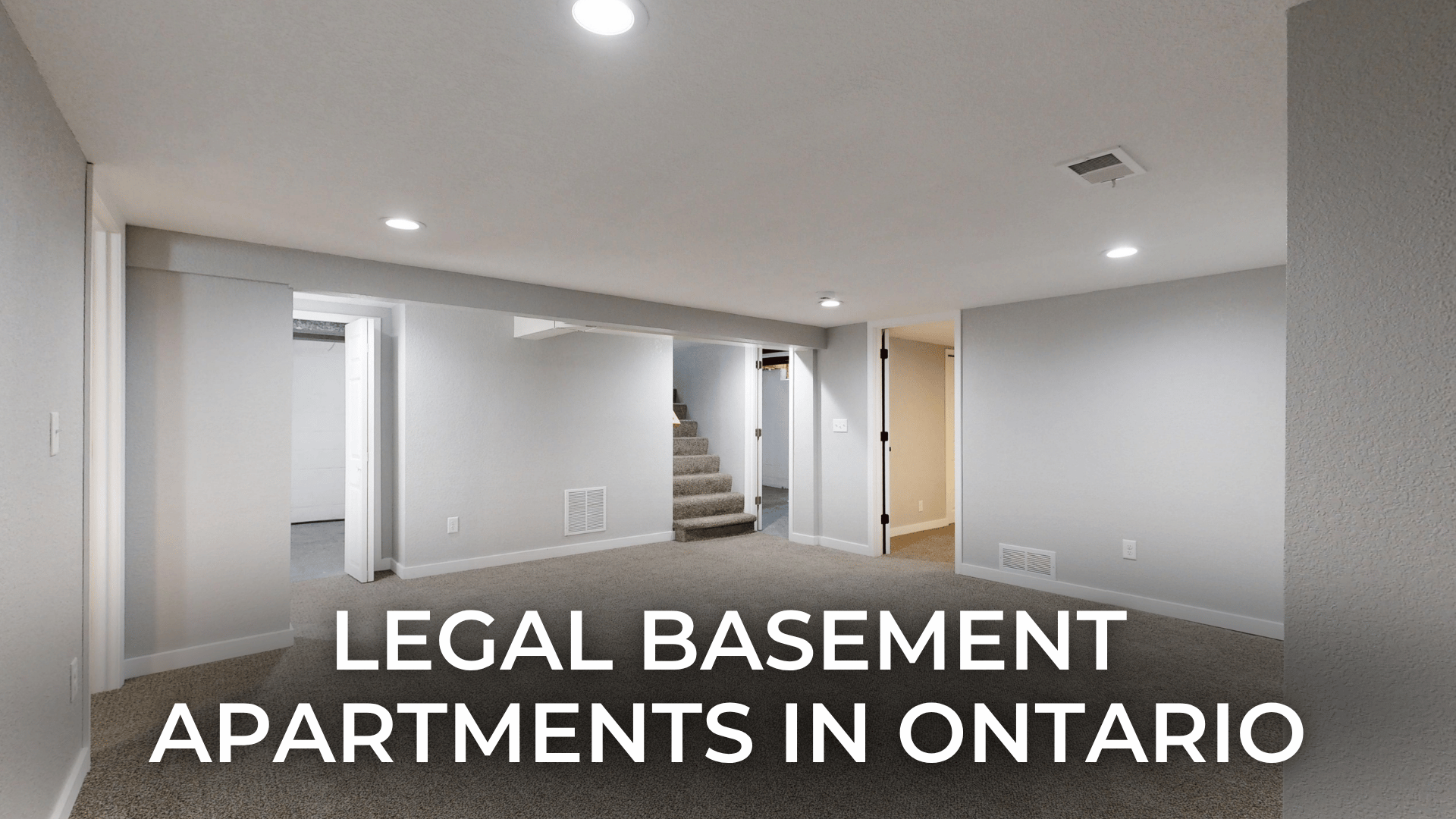
Legal Basement Apartments in Ontario: Buyer and Investor Guide

Legal basement apartments have become one of the most popular real estate topics in Ontario. With housing affordability pressure, higher mortgage payments, strong rental demand, and buyers looking for extra income potential, homes with legal secondary suites can be attractive for both end users and investors.

For buyers, a legal basement apartment may help offset monthly carrying costs. For investors, it can create an additional income stream and improve long-term property value. For sellers, a properly legal and well-documented basement apartment can make a home more appealing to buyers who are looking for rental potential.

However, not every finished basement is legal. A basement with a bedroom, kitchen, and washroom does not automatically qualify as a legal apartment. In Ontario, buyers and investors must review zoning, building permits, fire separation, ceiling height, exits, windows, electrical safety, parking, municipal registration where required, and landlord-tenant responsibilities.

The Government of Ontario advises homeowners to check municipal zoning, building permits, Building Code requirements, and inspections before adding a second unit to a house. Source: Ontario.ca — Add a Second Unit in Your House.

This guide explains what legal basement apartments are, why they matter, what buyers should verify, what investors should calculate, and how Team Arora can help clients make informed decisions across Brampton, Mississauga, Etobicoke, Toronto, the GTA, and other Ontario markets.

Table of Contents

A legal basement apartment is a self-contained residential unit located inside the lower level of a home. It usually includes its own sleeping area, kitchen, washroom, living space, and a separate entrance or approved access. In Ontario, these units are often called secondary suites, second units, additional residential units, basement apartments, accessory apartments, or additional dwelling units.

The City of Toronto describes a secondary suite as a second dwelling unit, smaller in area than the primary unit, located in an existing detached house, semi-detached house, or townhouse. Toronto also notes that a common example of a secondary suite is a basement apartment. Source: City of Toronto — Secondary Suites.

In simple terms, a legal basement apartment must be more than just a finished basement. It must be approved, safe, and compliant with the rules that apply to the property.

Practical rule: A finished basement is not automatically a legal basement apartment. Legal status depends on zoning, permits, inspections, safety requirements, and municipal rules.

A legal basement apartment usually includes:

  • A separate living area
  • A kitchen or cooking facilities
  • A washroom
  • A sleeping area
  • Proper exits or egress
  • Fire separation between units
  • Smoke and carbon monoxide alarms
  • Safe electrical work
  • Required building permits and inspections
  • Compliance with local zoning and municipal rules

Legal basement apartments are popular because they solve several real estate problems at once. They can create more rental housing, help homeowners manage mortgage payments, and give investors another income source.

Ontario’s housing market has become more affordability-sensitive. Many buyers are looking for properties that can help reduce monthly expenses. A legal basement apartment may provide rental income that helps with the mortgage, property taxes, utilities, and other carrying costs.

For investors, a home with a legal basement apartment can create a stronger income profile than a single-family home with no rental unit. For multigenerational families, a basement apartment can also create private space for parents, adult children, or extended family members.

Why buyers like legal basement apartments:

  • Potential rental income to help with mortgage payments
  • Flexibility for extended family living
  • More usable space in the home
  • Possible stronger resale appeal
  • Better use of an existing property
  • Potential support for long-term affordability

Why investors like legal basement apartments:

  • Additional rental income stream
  • Better cash-flow potential
  • Higher rental flexibility
  • Potentially stronger tenant demand
  • Improved property utility
  • Potentially stronger long-term value if properly legalized

One of the biggest mistakes buyers make is assuming that a finished basement is the same as a legal basement apartment. They are very different.

A finished basement may have flooring, drywall, pot lights, a washroom, and a bedroom. It may look beautiful in photos. But if it does not have permits, inspections, proper fire safety, egress, and municipal compliance, it may not be legal as a separate rental unit.

A legal basement apartment, on the other hand, should have documentation that supports its status. This may include permits, inspection records, municipal registration where required, ESA-related electrical documentation, fire safety compliance, and proof that the unit meets applicable zoning and Building Code requirements.

Feature Finished Basement Legal Basement Apartment
Can look renovated Yes Yes
Has kitchen or washroom May have Usually required for a self-contained unit
Building permit Not always Should be confirmed
Fire separation Not always Must meet applicable requirements
Legal rental use Not guaranteed Must comply with zoning, permits, and safety rules
Best for rental income Risky if not legal More reliable if properly approved

Practical rule: Buyers should ask for proof, not just photos. A basement apartment should be verified through documents, permits, and professional due diligence.

Common Requirements for Legal Basement Apartments

Requirements can vary depending on the municipality, property type, age of the home, zoning, building design, and the specific work being completed. Buyers and owners should always confirm requirements with the local municipality and qualified professionals.

The Government of Ontario advises homeowners to consider municipal zoning requirements, building permits, Building Code compliance, and building inspections when adding a second unit. Source: Ontario.ca — Add a Second Unit in Your House.

Ontario Regulation 462/24 also addresses additional residential units, including circumstances where additional units may be permitted in detached houses, semi-detached houses, rowhouses, and ancillary buildings, subject to the regulation and applicable rules. Source: Ontario Regulation 462/24 — Additional Residential Units.

Common areas reviewed for legal basement apartments:

  • Zoning: The property must be permitted to have an additional residential unit under applicable municipal rules.
  • Building permit: Construction or conversion usually requires a building permit before work begins.
  • Inspections: Municipal inspections are typically required during and after construction.
  • Fire separation: The units must be properly separated to slow the spread of fire and smoke.
  • Smoke alarms: Smoke alarms must be installed as required by applicable rules.
  • Carbon monoxide alarms: Carbon monoxide alarms may be required depending on fuel-burning appliances, attached garages, and applicable rules.
  • Egress: Occupants must have safe ways to exit in an emergency.
  • Windows: Bedrooms and living areas may have specific window and ventilation requirements.
  • Ceiling height: Minimum height requirements may apply depending on the design and code path.
  • Electrical safety: Electrical work should be completed and inspected as required.
  • Plumbing and HVAC: Heating, ventilation, drainage, and plumbing must be reviewed for compliance.
  • Parking: Some municipalities have parking rules or registration requirements.
  • Registration or licensing: Some cities require registration or licensing of second units.

Buyer Guide: What to Check Before Buying

If you are buying a home with a basement apartment, your first question should be: “Is it legal, and can the seller prove it?”

Do not rely only on MLS remarks, verbal statements, or the existence of a tenant. Buyers should ask for supporting documents and confirm details with the municipality, lawyer, realtor, lender, home inspector, insurance provider, and other qualified professionals.

Documents buyers should request:

  • Building permits related to the basement apartment
  • Final inspection reports or occupancy confirmation, where available
  • Municipal registration or licensing confirmation, if applicable
  • Fire inspection or fire safety documentation, if applicable
  • ESA or electrical inspection documentation, if applicable
  • Floor plans or permit drawings
  • Proof of legal second-unit status from the municipality, where available
  • Lease agreement if the unit is currently tenanted
  • Rental income records
  • Utility separation details
  • Insurance information

Important buyer questions:

  • Is the basement apartment registered or recognized by the municipality?
  • Were permits obtained for the basement conversion?
  • Were final inspections completed?
  • Is the current use permitted under zoning?
  • Does the unit meet fire safety and Building Code requirements?
  • Is the unit currently rented?
  • Does the tenant have a valid lease?
  • Is rent controlled or exempt from rent control?
  • Are utilities separate or shared?
  • Does the lender accept the rental income for qualification?
  • Will the insurance company insure the property as a two-unit dwelling?

Investor Guide: Rental Income and ROI Considerations

For investors, a legal basement apartment can be a strong income feature. However, the property still needs to make financial sense. Do not assume that rental income automatically means positive cash flow.

Investors should calculate the full cost of ownership, including mortgage payments, property taxes, insurance, repairs, utilities, maintenance, vacancy, property management, and future capital expenses.

Investor costs to review:

  • Purchase price
  • Down payment
  • Mortgage payment
  • Interest rate and renewal risk
  • Property taxes
  • Insurance for a rental or two-unit property
  • Utilities
  • Repairs and maintenance
  • Vacancy allowance
  • Property management fees, if applicable
  • Legal and accounting costs
  • Renovation or legalization costs
  • Future capital repairs such as roof, furnace, windows, and appliances

Investor income questions:

  • What is the realistic market rent for the basement apartment?
  • Is the unit already rented?
  • Is the current rent below market?
  • Are utilities included in rent?
  • Is there separate laundry?
  • Does the basement have a separate entrance?
  • Does the unit have parking?
  • Is the tenant profile strong in the area?
  • What is the vacancy risk?
  • Will the rent support the carrying costs?

Practical rule: A legal basement apartment can improve income potential, but investors should buy based on verified numbers, not optimistic rent assumptions.

Risks of Buying a Non-Legal Basement Apartment

A non-legal basement apartment can create serious problems for buyers and investors. Even if the unit is currently rented, the municipality may not recognize it as a legal rental unit.

If a basement apartment is not legal, the owner may face orders to comply, expensive renovations, tenant issues, insurance problems, financing challenges, and resale concerns. In some cases, the owner may need to remove the kitchen, stop renting the unit, or complete major work to bring the space into compliance.

Common risks of non-legal basement apartments:

  • Municipal enforcement or compliance orders
  • Unsafe fire separation or exit conditions
  • Insurance coverage issues
  • Lender concerns about using rental income
  • Difficulty selling later
  • Unexpected renovation costs
  • Tenant disputes
  • Possible inability to legally rent the unit
  • Higher liability risk for the owner
  • Lower buyer confidence at resale

This does not mean every home with an unfinished or non-legal basement should be avoided. It means buyers must price the risk correctly and understand what work may be needed to legalize the unit.

Financing and Mortgage Considerations

Legal basement apartments can affect financing in several ways. Some lenders may consider rental income when qualifying a buyer, but the rules vary by lender, mortgage product, documentation, and whether the unit is legal and properly documented.

Buyers should speak with a mortgage professional before assuming that basement rental income will increase their approved mortgage amount. Lenders may require lease agreements, market rent appraisals, proof of legality, income statements, tax documentation, or other verification.

CMHC has a refinance program designed to help eligible homeowners refinance their existing property to create self-contained secondary suites. CMHC notes that the secondary suite must be self-contained and cannot be used as a short-term rental. Source: CMHC — Refinance for Building Secondary Suites.

Mortgage questions buyers should ask:

  • Will the lender include rental income in qualification?
  • What documents are required to use rental income?
  • Does the basement apartment need to be legal and registered?
  • Is a lease required?
  • Can projected market rent be used?
  • Does the property qualify as owner-occupied or investment?
  • Will insurance costs be higher?
  • How will future rate changes affect cash flow?

Landlord Responsibilities in Ontario

Owning a legal basement apartment also means becoming a landlord if the unit is rented. In Ontario, most residential rental relationships are governed by the Residential Tenancies Act, 2006.

Ontario’s renting rights page explains that the Landlord and Tenant Board is the tribunal with authority to resolve disagreements between landlords and tenants and provide information about rights and responsibilities under the Residential Tenancies Act, 2006. Source: Ontario.ca — Renting in Ontario: Your Rights.

The Landlord and Tenant Board also provides a guide explaining that the Residential Tenancies Act sets out the rights and responsibilities of landlords and tenants who rent residential properties. Source: Landlord and Tenant Board — Guide to the Residential Tenancies Act.

Landlords should understand:

  • Ontario standard lease requirements
  • Rent deposit rules
  • Rent increase guidelines
  • Maintenance and repair responsibilities
  • Privacy and entry notice rules
  • Eviction procedures
  • Tenant rights and responsibilities
  • Landlord and Tenant Board processes
  • Human rights and discrimination rules
  • Municipal property standards

Practical rule: Buying a home with a legal basement apartment is not only a real estate decision. It can also make you a landlord, which comes with legal responsibilities.

City Examples: Brampton, Mississauga, Toronto, and GTA

Legal basement apartment rules are shaped by both provincial and municipal requirements. Ontario provides the broader framework, but municipalities may have their own zoning, registration, licensing, parking, and inspection processes.

Brampton

Brampton has strong demand for homes with legal basement apartments because many buyers are family-focused and mortgage-conscious. Buyers should verify whether a second unit is registered and legal through the City of Brampton before relying on rental income.

Mississauga

Mississauga buyers often look for flexible housing options, especially in family neighbourhoods. A properly approved basement apartment can increase buyer interest, but documentation matters. Buyers should confirm legal status directly with the City of Mississauga and their lawyer.

Toronto and Etobicoke

Toronto’s secondary suite guidance confirms that a building permit is required for an interior alteration to add a second dwelling unit in an existing detached house, semi-detached house, or townhouse. A basement apartment is listed as a common example. Source: City of Toronto — Secondary Suites.

Other Ontario Markets

In markets such as Cambridge, Kitchener-Waterloo, Hamilton, Halton Hills, Niagara, and Fort Erie, legal basement apartments may also be attractive to buyers and investors. However, each municipality has its own rules and process. Buyers should verify everything locally.

Legal Basement Apartment Buyer Checklist

Before buying a home with a basement apartment, use this checklist as a starting point.

  • Confirm whether the basement apartment is legal.
  • Ask for building permits and final inspection documents.
  • Verify municipal registration or licensing if applicable.
  • Confirm zoning permits the additional residential unit.
  • Review fire separation and safety features.
  • Confirm smoke and carbon monoxide alarm requirements.
  • Ask about ESA or electrical inspection documentation.
  • Review separate entrance and egress details.
  • Confirm whether the unit is currently tenanted.
  • Review the lease agreement and rent amount.
  • Check whether utilities are separate or shared.
  • Ask whether parking is included or required.
  • Speak with a mortgage professional about rental income use.
  • Confirm insurance coverage for a two-unit property.
  • Have your lawyer review all documentation before firming up the deal.
  • Complete a home inspection with attention to basement safety and quality.
  • Review landlord responsibilities under Ontario rental rules.

How Team Arora Can Help

Team Arora helps buyers, sellers, and investors understand the real value and risks of homes with basement apartments. These properties can be powerful opportunities, but they require careful review.

For buyers, Team Arora can help identify homes with legal basement potential, review listing claims, compare rental income opportunities, and connect clients with the right professionals for due diligence. For sellers, Team Arora can help position a legal basement apartment properly in marketing, highlight income potential, and ensure buyers understand the value of proper documentation.

Team Arora can help with:

  • Finding homes with legal basement apartments
  • Identifying properties with basement potential
  • Reviewing listing information and seller disclosures
  • Comparing rental income potential
  • Connecting clients with mortgage professionals
  • Connecting clients with lawyers and inspectors
  • Helping sellers market legal basement features
  • Pricing homes with income potential
  • Supporting investors with property comparisons
  • Guiding clients across Brampton, Mississauga, Etobicoke, Toronto, the GTA, and other Ontario markets

If you are planning to buy, sell, or invest in a home with a basement apartment, Team Arora can help you ask the right questions and move forward with confidence.

Frequently Asked Questions

What is a legal basement apartment in Ontario?

A legal basement apartment is a self-contained residential unit in the lower level of a home that meets applicable zoning, building, safety, permit, and municipal requirements. It usually includes a kitchen, washroom, living area, sleeping area, and approved exits or access.

Is every finished basement apartment legal?

No. A finished basement is not automatically legal. Even if it has a kitchen, washroom, bedroom, and separate entrance, it still needs to comply with zoning, Building Code requirements, permits, inspections, fire safety, electrical safety, and municipal rules.

How do I know if a basement apartment is legal?

Ask for permits, final inspections, municipal registration or licensing if applicable, fire safety documentation, ESA or electrical documentation where applicable, and confirmation from the local municipality. Your lawyer, realtor, inspector, and municipality can help verify the status.

Can rental income from a basement apartment help with mortgage qualification?

Sometimes, yes. Some lenders may consider rental income, but requirements vary. The lender may ask for proof of legal status, lease documents, market rent estimates, or income history. Buyers should confirm with a mortgage professional before relying on rental income.

Is a legal basement apartment good for investors?

A legal basement apartment can be attractive for investors because it may create additional rental income. However, investors should calculate full carrying costs, vacancy risk, repairs, insurance, taxes, rent rules, financing, and resale value before buying.

What are the risks of buying a house with an illegal basement apartment?

Risks can include municipal enforcement, renovation costs, insurance issues, financing challenges, inability to rent legally, tenant disputes, safety concerns, and lower resale confidence. Buyers should verify legality before relying on rental income.

Do legal basement apartments need a permit?

Creating a legal basement apartment usually requires building permits and inspections. Requirements depend on the municipality and scope of work. Buyers and owners should contact the local building department before starting or relying on any conversion.

Do municipalities have different rules for basement apartments?

Yes. Ontario provides a broader framework, but municipalities may have their own zoning, parking, registration, licensing, inspection, and property standards rules. Always confirm locally.

Can I rent out a basement apartment on Airbnb?

Short-term rental rules vary by municipality and may be different from long-term rental rules. Some financing or housing programs may also restrict short-term rental use. Owners should confirm local short-term rental regulations, condo rules if applicable, insurance requirements, and tax implications.

How can Team Arora help with legal basement apartment properties?

Team Arora can help buyers find suitable properties, review income potential, compare neighbourhoods, ask the right due-diligence questions, and connect clients with mortgage, legal, inspection, and municipal resources. For sellers, Team Arora can help market legal basement features and position the property effectively.

Professional Disclaimer

This article is provided for general informational and real estate marketing purposes only. It should not be treated as legal, financial, mortgage, tax, investment, appraisal, insurance, construction, building-code, landlord-tenant, or real estate advice.

Legal basement apartment requirements can vary by municipality, property type, zoning, building age, construction details, permit history, fire safety requirements, electrical work, parking rules, licensing requirements, and provincial or municipal law changes. Buyers, sellers, landlords, and investors should verify all information directly with the local municipality, building department, fire department, Electrical Safety Authority where applicable, lender, insurer, lawyer, accountant, home inspector, and other qualified professionals.

This article does not guarantee that any specific basement apartment is legal, rentable, insurable, financeable, or compliant. Rental income, property value, resale demand, cash flow, and return on investment are not guaranteed.

Landlord-tenant rules in Ontario can be complex. Before renting a unit, increasing rent, ending a tenancy, buying a tenanted property, or making investment decisions, readers should seek proper legal and professional advice.

Sources and Citations

Legal basement apartments can be a smart opportunity for Ontario buyers and investors, but only when the unit is properly verified. The right property can support affordability, rental income, and resale value. The wrong property can create legal, financial, safety, and insurance problems. Before buying or selling, work with experienced professionals and confirm every detail carefully.


Peace Towns Fort Erie: A Modern Townhome Community Near the Peace Bridge

Peace Towns is a new townhome community in Fort Erie, Ontario, created for buyers who want modern living, functional space, and a convenient Niagara Region location. Positioned near Walden Boulevard and Garrison Road, this community brings together everyday convenience, new-home comfort, and access to one of Fort Erie’s most recognizable landmarks: the Peace Bridge.

According to the official Peace Towns website, the project includes 36 luxury townhomes at Walden Boulevard and Garrison Road, just minutes from the Peace Bridge and close to everyday conveniences such as Walmart, Canadian Tire, Sobeys, TD Bank, and Shoppers Drug Mart.

For buyers coming from the GTA, Niagara Region, or cross-border communities, Peace Towns offers a practical lifestyle story: more space, modern design, nearby shopping, and a location connected to both Fort Erie and Buffalo. For families, professionals, downsizers, and investors, this project is worth exploring carefully.

If you have project videos, this blog is a strong place to use them. A well-placed video can help buyers understand the location, visualize the floor plan, experience the community, and spend more time on the page before registering for more details.

Table of Contents

Peace Towns Community Overview

Peace Towns is designed as a limited collection of new 2-storey townhomes in Fort Erie. The project is positioned as a modern residential community with a focus on space, comfort, and convenience.

The official Peace Towns website highlights a 36-unit site plan, priority registration, pricing updates, early floor plan access, and exclusive offers. The project’s presentation centre is listed at U-9, 315 Garrison Road, Fort Erie, ON L2A 0G2.

Livabl identifies Peace Towns as a new townhouse community by Trident Builders and Prahant Construction Company, currently under construction at Garrison Road and Concession Road in Fort Erie. Livabl lists the project as having 36 total homes and available units from $500,000. Source: Livabl — Peace Towns.

Practical rule: Peace Towns should be reviewed as both a lifestyle opportunity and a financial decision. The floor plan, final price, deposit structure, closing costs, location, and long-term use all matter.

Quick Project Highlights

  • Project name: Peace Towns
  • Property type: New 2-storey townhomes
  • Location: Walden Boulevard and Garrison Road, Fort Erie
  • Community size: 36 townhomes, according to the official project website
  • Presentation centre: U-9, 315 Garrison Road, Fort Erie, ON L2A 0G2
  • Nearby landmark: Peace Bridge
  • Nearby conveniences: Walmart, Canadian Tire, Sobeys, TD Bank, and Shoppers Drug Mart
  • Advertised living area: 2,408 sq. ft. across three levels, according to the official floor plan page
  • Warranty reference: Tarion Warranty Certified, according to the official project website

Start With a Project Video for Stronger Engagement

Because you already have videos related to Peace Towns, the first video should appear near the top of the blog, right after the introduction. This gives visitors an immediate visual understanding of the project before they begin reading the full details.

The best first video should be a short overview video, ideally 30 to 60 seconds long. It should show the project exterior, surrounding area, Garrison Road convenience, Peace Bridge proximity, floor plan visuals, and a clear call to action.

Why the Fort Erie Location Matters

Location is one of the strongest parts of the Peace Towns story. The project sits near Garrison Road, one of Fort Erie’s important commercial corridors. For residents, that means daily essentials are close by, including grocery stores, shopping, pharmacy needs, banking, and household services.

The official Peace Towns website highlights the community’s proximity to the Peace Bridge, which connects Fort Erie, Ontario, with Buffalo, New York. For residents who travel cross-border, visit family, work with U.S. connections, or enjoy quick access to Western New York, this location may be especially appealing.

Fort Erie is also planning for long-term growth. The Town of Fort Erie announced that its new Official Plan establishes a framework to guide growth and development through 2051, covering priorities such as housing, employment, agriculture, natural heritage, climate resilience, and economic development. Source: Town of Fort Erie — Official Plan Growth to 2051.

Nearby Location Benefits

  • Minutes from the Peace Bridge, according to the official project website
  • Close to the Garrison Road commercial corridor
  • Nearby Walmart, Canadian Tire, Sobeys, TD Bank, and Shoppers Drug Mart
  • Convenient for daily errands and family needs
  • Useful for buyers who travel between Fort Erie and Buffalo
  • Part of the broader Niagara Region lifestyle market
  • Located in a town with long-term growth planning to 2051

Floor Plans and Living Space

The official Peace Towns floor plan page shows 2,408 sq. ft. of thoughtfully designed living space across three levels. The layout includes a 796 sq. ft. ground floor, an 812 sq. ft. first floor, and a 799 sq. ft. basement level.

This three-level layout is one of the strongest selling features of the project. It gives buyers more usable space than many compact townhomes or condo apartments, while still offering a practical townhome lifestyle.

Ground Floor

The ground floor is designed around everyday living. The official floor plan page describes an open-concept layout connecting the living room, dining area, and modern kitchen with an island countertop. It also includes an attached garage, uncovered deck, and covered porch.

  • Ground floor area: 796 sq. ft.
  • Living room: 20′-6″ x 11′-5″
  • Dining area: 10′-1″ x 12′-6″
  • Modern kitchen: 10′-5″ x 12′-6″
  • Attached garage: 10′-2″ x 21′-11″
  • Uncovered deck: 13′-0″ x 21′-4″
  • Covered porch: 11′-0″ x 7′-0″

First Floor

The first floor is focused on privacy and bedroom space. The official floor plan page shows three bedrooms, including a primary bedroom with a walk-in closet and en-suite bathroom.

  • First floor area: 812 sq. ft.
  • Primary bedroom: 10′-2″ x 13′-1″
  • Bedroom 2: 10′-5″ x 10′-0″
  • Bedroom 3: 10′-2″ x 11′-8″
  • Walk-in closet: 6′-5″ x 5′-0″
  • En-suite bathroom with shower
  • Full shared bathroom

Basement Level

The basement adds flexibility for modern families. The official floor plan page lists a 799 sq. ft. basement with a recreation room, optional office or den, optional bathroom rough-in, and laundry room.

  • Basement area: 799 sq. ft.
  • Recreation room: 19′-6″ x 10′-2″
  • Optional office or den: 10′-3″ x 10′-0″
  • Optional bathroom rough-in
  • Laundry room: 9′-10″ x 6′-6″
  • Flexible space for work, guests, hobbies, storage, or recreation

Key Features and Finishes

Peace Towns is designed for buyers who want a modern new-home feel without immediately planning major renovations. The official floor plan page references a premium appliance package, including three stainless steel kitchen appliances and a top-load white washer and dryer set.

The official Peace Towns website also references Tarion Warranty Certified status. Tarion explains that, by law, all new homes built in Ontario are provided with a warranty by the builder, and Tarion’s role is to ensure buyers receive the coverage they are entitled to under that warranty. Source: Tarion — What Is the New Home Warranty?.

Notable Peace Towns Features

  • Open-concept living, dining, and kitchen layout
  • Modern kitchen with island countertop
  • Premium appliance package referenced on the official floor plan page
  • Three stainless steel kitchen appliances
  • Top-load white washer and dryer set
  • Three bedrooms on the first floor
  • Primary bedroom with walk-in closet and en-suite bathroom
  • Attached garage
  • Covered porch and uncovered deck
  • Basement recreation room and optional office or den
  • Optional bathroom rough-in in the basement
  • Tarion Warranty Certified reference on the official project website

Lifestyle Around Peace Towns

Peace Towns is not only about the home itself. The surrounding lifestyle is a major part of the project’s appeal. Fort Erie offers a quieter pace than larger urban centres, while still giving residents access to shopping, services, parks, trails, waterfront areas, and the Canada-U.S. border connection.

For families, the Garrison Road corridor can help simplify daily errands. For professionals, the location can support remote work, cross-border travel, or a more relaxed lifestyle outside the GTA. For downsizers, Peace Towns may offer new-home comfort in a manageable townhome format. For investors, the location story may create long-term interest from buyers or tenants looking for Niagara Region value.

Lifestyle Benefits to Highlight in Video Content

  • Driving shots along Garrison Road
  • Nearby shopping plazas and daily conveniences
  • Peace Bridge exterior or nearby road signage
  • Fort Erie waterfront or parks
  • Exterior project visuals or site progress
  • Short clips of the presentation centre
  • Floor plan overlays with room labels
  • Team Arora agent explaining the opportunity

Who Peace Towns Is Best Suited For

Peace Towns may appeal to several buyer groups, depending on budget, lifestyle, and long-term plans.

First-Time Buyers

First-time buyers priced out of larger GTA markets may find Peace Towns attractive because it offers a new townhome format with more living space than many condo options. Buyers should still review mortgage qualification, deposit structure, closing costs, taxes, insurance, and maintenance fees before moving forward.

Growing Families

The three-level layout may work well for families that need bedrooms, a recreation area, storage, garage parking, and flexible basement use. The open-concept ground floor and bedroom-focused upper level create a practical layout for daily living.

Remote Workers and Professionals

The optional office or den in the basement can be useful for remote workers, entrepreneurs, or professionals who need a dedicated work area at home.

Downsizers

Some downsizers may appreciate new construction, modern finishes, and Fort Erie’s quieter lifestyle. However, because Peace Towns is a multi-level townhome community, buyers should consider stairs and long-term accessibility needs before purchasing.

Investors

Investors may be interested in Peace Towns because of its new-build format, Garrison Road location, proximity to amenities, and Fort Erie’s long-term growth planning. However, investment decisions should be based on verified rental demand, expected carrying costs, resale comparables, taxes, maintenance fees, and financing.

Investment and Long-Term Value Considerations

Peace Towns may be worth reviewing for buyers looking at long-term value in the Niagara Region. Fort Erie’s updated Official Plan was approved in 2026 and provides a framework to guide growth and development to 2051. Source: Environmental Registry of Ontario — Fort Erie Official Plan Approval.

That said, long-term planning does not guarantee investment returns. Buyers should look closely at the numbers before treating any project as an investment.

Investment Factors to Review

  • Final purchase price after premiums, upgrades, and options
  • Deposit structure and payment schedule
  • Mortgage qualification at current interest rates
  • Estimated monthly carrying costs
  • Expected property taxes
  • Insurance costs
  • Maintenance fees, if applicable
  • Potential rental income based on current local comparables
  • Vacancy risk and tenant demand in Fort Erie
  • Assignment rules and resale restrictions
  • Occupancy and final closing timelines
  • Comparable new-build and resale townhome prices in the area

Practical rule: Peace Towns may offer strong lifestyle and location appeal, but buyers should confirm the full numbers before treating it as an investment opportunity.

How to Add Videos in the Blog for Better Engagement

Videos can make this Peace Towns blog much stronger because buyers often want to see the project before they read every detail. The goal is to place videos where they naturally support the section being discussed.

Best Video Placement Plan

  • Top of blog: Add a short project overview video after the intro to immediately capture attention.
  • Location section: Add a neighbourhood video showing Garrison Road, shopping, services, and the Peace Bridge area.
  • Floor plan section: Add a floor plan walkthrough or animated layout video.
  • Features section: Add a video showing finishes, kitchen, bedrooms, basement, or sample visuals.
  • Buyer CTA section: Add a short Team Arora video explaining why buyers should register or book a consultation.

Recommended Video Types

  • 30-second teaser: Best for the top of the page and social sharing.
  • 60 to 90-second project overview: Best for explaining the full opportunity.
  • Location video: Best for showing nearby amenities and the Peace Bridge.
  • Floor plan video: Best for helping buyers understand layout and space.
  • Agent explanation video: Best for building trust and creating leads.
  • FAQ video: Best for answering common buyer questions quickly.

Best Practices for Adding Videos

  • Upload videos to YouTube or Vimeo, then embed them in the blog.
  • Use descriptive video titles with keywords such as “Peace Towns Fort Erie Townhomes”.
  • Add captions or subtitles so people can watch without sound.
  • Place a short paragraph before each video explaining what the viewer will see.
  • Add a short caption below the video for context.
  • Keep the first video short so visitors do not leave before reading.
  • Use a strong thumbnail with the project name and location.
  • Add a call-to-action after the video, such as “Register for pricing details” or “Contact Team Arora”.
  • Do not auto-play videos with sound because it can hurt user experience.
  • Compress self-hosted videos if you do not use YouTube or Vimeo, so the page loads quickly.

YouTube


Buyer Checklist Before Registering

Before registering for Peace Towns or signing any purchase documents, buyers should review the project carefully with a licensed real estate professional, mortgage advisor, and Ontario real estate lawyer.

  • Confirm current price list and unit availability.
  • Ask which lots, elevations, and layouts are available.
  • Review the full floor plan and confirm included square footage.
  • Confirm what is included in the base price.
  • Ask which appliances and finishes are included.
  • Review upgrade costs and design selection deadlines.
  • Confirm whether the basement is finished, optional, or unfinished.
  • Ask about optional bathroom rough-in and basement upgrade costs.
  • Confirm deposit structure and payment deadlines.
  • Ask about occupancy date, closing date, and possible delay clauses.
  • Review taxes, fees, adjustments, and closing costs.
  • Ask about assignment rules and resale restrictions.
  • Review Tarion Warranty coverage and builder obligations.
  • Compare Peace Towns with resale and new-build alternatives in Fort Erie.
  • Have the Agreement of Purchase and Sale reviewed by a real estate lawyer before signing.

Frequently Asked Questions

What is Peace Towns in Fort Erie?

Peace Towns is a new townhome community located near Walden Boulevard and Garrison Road in Fort Erie, Ontario. The official project website describes it as a 36-townhome community minutes from the Peace Bridge and close to everyday conveniences.

Where is Peace Towns located?

Peace Towns is located near Walden Boulevard and Garrison Road in Fort Erie. The official project website lists the presentation centre at U-9, 315 Garrison Road, Fort Erie, ON L2A 0G2.

How many homes are planned at Peace Towns?

The official Peace Towns website identifies the project as a 36-unit townhome community. Buyers should confirm current inventory and availability directly with the sales team or through their real estate representative.

How large are the Peace Towns homes?

The official floor plan page shows a total advertised area of 2,408 sq. ft., including a 796 sq. ft. ground floor, 812 sq. ft. first floor, and 799 sq. ft. basement.

Is Peace Towns close to the Peace Bridge?

Yes. The official Peace Towns website highlights the project as being minutes from the Peace Bridge, which connects Fort Erie, Ontario, with Buffalo, New York.

Is Peace Towns good for first-time buyers?

Peace Towns may be suitable for first-time buyers who want more space than a condo and are comfortable buying in Fort Erie. However, first-time buyers should review mortgage qualification, deposit requirements, closing costs, taxes, maintenance fees, insurance, and long-term affordability before purchasing.

Is Peace Towns a good investment?

Peace Towns may appeal to investors because of its new-build format, Fort Erie location, proximity to Garrison Road amenities, and access to the Peace Bridge. However, investment decisions should be based on verified rental demand, carrying costs, resale comparables, financing, vacancy risk, taxes, and final purchase price.

How should videos be used in a Peace Towns blog?

Videos should be placed near the top of the blog, in the location section, in the floor plan section, and near the final call-to-action. The best video types include a project overview, neighbourhood video, floor plan walkthrough, feature showcase, and agent explanation video.

Should videos autoplay in the blog?

No. Autoplay with sound can hurt user experience. It is better to use a strong thumbnail, clear title, and visible play button so visitors choose to watch the video.

How can buyers get more information about Peace Towns?

Buyers can register through the official Peace Towns website or contact Team Arora to review current pricing, availability, floor plans, incentives, and next steps before making a decision.

Professional Disclaimer

This article is provided for general informational and marketing purposes only. It should not be treated as legal, financial, mortgage, tax, investment, appraisal, construction, warranty, or real estate advice. Project details, pricing, availability, square footage, floor plans, features, finishes, incentives, deposits, maintenance fees, taxes, occupancy dates, closing costs, and builder information can change without notice.

All buyers should verify current project information directly with the developer, builder, sales representative, brokerage, Tarion, municipality, lender, and lawyer before making a purchase decision. Any investment discussion in this article is general in nature and does not guarantee rental income, resale value, appreciation, occupancy timing, assignment approval, or financial return.

Pre-construction and new-build real estate agreements can include important clauses related to delays, development charges, closing adjustments, cancellations, assignments, warranty coverage, construction changes, and final costs. Buyers should have all documents reviewed by an experienced Ontario real estate lawyer before signing.

Any videos added to this blog should be owned by you, licensed for your use, or used with written permission. Avoid using copyrighted music, drone footage, third-party clips, or project visuals unless you have the legal right to publish them.

Sources and Citations

Peace Towns offers a compelling opportunity for buyers who want modern townhome living, flexible interior space, and a Fort Erie location close to everyday conveniences and the Peace Bridge. With the right videos added throughout the blog, buyers can better understand the community, visualize the layout, and feel more confident taking the next step.

If you are considering Peace Towns in Fort Erie, contact Team Arora to review current pricing, availability, floor plans, incentives, and the best next steps for your buying goals.

Top 5 Schools Near Peace Towns Fort Erie: A Family Buyer’s Guide

For families considering Peace Towns in Fort Erie, schools are often one of the most important parts of the home-buying decision. A beautiful floor plan matters, but so does the daily routine around it: morning drop-offs, school bus eligibility, after-school activities, commute times, nearby parks, and the overall neighbourhood environment.

Peace Towns is located near Walden Boulevard and Garrison Road in Fort Erie. According to the official Peace Towns website, the project includes 36 luxury townhomes near the Peace Bridge and close to daily conveniences such as Walmart, Canadian Tire, Sobeys, TD Bank, and Shoppers Drug Mart.

For buyers with children, this location creates a natural question: which schools are nearby, and what should families research before choosing a home? This guide highlights five schools in the Fort Erie area that families may want to review when considering Peace Towns.

This article is not a school ranking. School boundaries, programs, transportation eligibility, and registration rules can change. Families should always confirm details directly with the District School Board of Niagara, Niagara Catholic District School Board, the Ontario Ministry of Education School Information Finder, and the individual school before making a real estate decision.

Table of Contents

Why Schools Matter When Buying Near Peace Towns

For many families, choosing a home is not just about bedrooms, bathrooms, and square footage. It is also about the community around the home. Schools can influence daily convenience, family routine, resale appeal, and long-term neighbourhood confidence.

When buyers look at a new townhome project like Peace Towns, they often want to understand how nearby schools fit into their lifestyle. Is there an elementary school close by? What secondary school serves the area? Are Catholic school options available? Is transportation provided? Are school boundaries confirmed? These questions matter before signing an agreement.

The Town of Fort Erie provides an education and learning page that connects residents with public, Catholic, secondary, adult learning, and local education resources. Families can review that page here: Town of Fort Erie — Education and Learning.

Practical rule: Never assume that the closest school is automatically the assigned school. Always confirm boundaries and eligibility directly with the school board before buying.

1. Garrison Road Public School

Copyright-free school exterior image representing Garrison Road Public School near Peace Towns Fort Erie

Image note: This is a copyright-free representative school image, not an official photo of Garrison Road Public School. 

Garrison Road Public School is one of the most relevant schools to research because Peace Towns is located in the Garrison Road area. The Ontario Ministry of Education School Information Finder lists Garrison Road Public School at 1110 Garrison Road, Fort Erie, Ontario, L2A 1N9. It also lists the school as part of the District School Board of Niagara, with JK to Grade 8 available and preliminary 2024–2025 enrolment of 470 students. Source: Ontario School Information Finder — Garrison Road Public School.

For families considering Peace Towns, this school may be one of the first public elementary options to review because of its Garrison Road location. Parents should confirm whether Peace Towns falls within the school’s current boundary, whether transportation is available, and what registration documents are required.

Families should also review the school’s official website for bell times, calendars, family updates, school cash online, reporting absences, and contact information. Source: Garrison Road Public School — Official Website.

Why families may research this school:

  • Located on Garrison Road in Fort Erie
  • Public elementary school option
  • JK to Grade 8 listed by the Ontario Ministry of Education
  • Part of the District School Board of Niagara
  • Relevant for families buying in the Garrison Road area

2. Greater Fort Erie Secondary School

Copyright-free school campus image representing Greater Fort Erie Secondary School near Peace Towns Fort Erie

Image note: This is a copyright-free representative school image, not an official photo of Greater Fort Erie Secondary School. Replace with your own original school photo or permission-approved image before publishing if you want the actual building shown.

Greater Fort Erie Secondary School is an important school for families with older children. The Ontario Ministry of Education School Information Finder lists Greater Fort Erie Secondary School at 1640 Garrison Road, Fort Erie, Ontario, L2A 5M4. It also lists preliminary 2024–2025 enrolment of 1,090 students. Source: Ontario School Information Finder — Greater Fort Erie Secondary School.

The school’s official website provides information about academics, athletics, guidance, student services, registration, clubs, and school updates. Families with children approaching high school age may want to review course pathways, graduation requirements, extracurricular activities, transportation details, and student supports. Source: Greater Fort Erie Secondary School — Official Website.

For Peace Towns buyers, having a secondary school along Garrison Road may be a practical advantage. It can make the neighbourhood feel more complete for families planning several years ahead.

Why families may research this school:

  • Secondary school option in Fort Erie
  • Located at 1640 Garrison Road
  • Part of the District School Board of Niagara
  • Offers academic, guidance, athletics, student services, and registration information online
  • Relevant for families with older children or long-term school planning needs

3. Peace Bridge Public School

Copyright-free classroom image representing Peace Bridge Public School Fort Erie

Image note: This is a copyright-free representative classroom image, not an official photo of Peace Bridge Public School. Replace with your own original school photo or permission-approved image before publishing if you want the actual building shown.

Peace Bridge Public School is another Fort Erie public elementary school that families may want to research. The Ontario Ministry of Education School Information Finder lists Peace Bridge Public School at 105 Torrance Street, Fort Erie, Ontario, L2A 2C1. It also lists the school as part of the District School Board of Niagara, with JK to Grade 8 available and preliminary 2024–2025 enrolment of 415 students. Source: Ontario School Information Finder — Peace Bridge Public School.

The school’s name connects naturally with Fort Erie’s identity and the nearby Peace Bridge corridor. For Peace Towns buyers, it may be useful to understand where Peace Bridge Public School sits in relation to the broader Fort Erie school network.

Parents should not rely on distance alone when researching this school. They should confirm current catchment boundaries, transportation eligibility, registration timelines, and school-specific programs directly with the District School Board of Niagara and the school office.

Why families may research this school:

  • Public elementary school in Fort Erie
  • JK to Grade 8 listed by the Ontario Ministry of Education
  • Part of the District School Board of Niagara
  • Located at 105 Torrance Street
  • Relevant for families comparing public elementary options in Fort Erie

4. Our Lady of Victory Catholic Elementary School

Copyright-free education image representing Our Lady of Victory Catholic Elementary School Fort Erie

Image note: This is a copyright-free representative education image, not an official photo of Our Lady of Victory Catholic Elementary School. Replace with your own original school photo or permission-approved image before publishing if you want the actual building shown.

Our Lady of Victory Catholic Elementary School is a Catholic elementary school option in Fort Erie. The Ontario Ministry of Education School Information Finder lists the school at 300 Central Avenue, Fort Erie, Ontario, L2A 3T3. It also lists the school as part of Niagara Catholic District School Board, with JK to Grade 8 available and preliminary 2024–2025 enrolment of 280 students. Source: Ontario School Information Finder — Our Lady of Victory Catholic Elementary School.

For families interested in Catholic education near Peace Towns, Our Lady of Victory may be one of the key schools to review. Catholic school registration may involve additional eligibility, documentation, and board-specific requirements, so parents should confirm details directly with Niagara Catholic District School Board.

Families may also want to research school programs, faith-based learning environment, school community, transportation, and parish-related requirements where applicable.

Why families may research this school:

  • Catholic elementary school option in Fort Erie
  • JK to Grade 8 listed by the Ontario Ministry of Education
  • Part of Niagara Catholic District School Board
  • Located at 300 Central Avenue
  • Relevant for families seeking Catholic education near Peace Towns

5. St. Philomena Catholic Elementary School

Copyright-free student learning image representing St. Philomena Catholic Elementary School Fort Erie

Image note: This is a copyright-free representative learning image, not an official photo of St. Philomena Catholic Elementary School. Replace with your own original school photo or permission-approved image before publishing if you want the actual building shown.

St. Philomena Catholic Elementary School is another Catholic elementary option in Fort Erie. The Ontario Ministry of Education School Information Finder lists St. Philomena Catholic Elementary School at 1332 Phillips Street, Fort Erie, Ontario, L2A 3C2. It also lists the school as part of Niagara Catholic District School Board, with JK to Grade 8 available and preliminary 2024–2025 enrolment of 265 students. Source: Ontario School Information Finder — St. Philomena Catholic Elementary School.

Families considering Peace Towns may want to compare St. Philomena with other Catholic and public options in Fort Erie. Depending on a family’s needs, school choice may involve faith-based education, distance, transportation, childcare needs, extracurricular activities, and long-term planning for secondary school.

As with every school, parents should verify current boundaries and registration requirements before making decisions based on proximity.

Why families may research this school:

  • Catholic elementary school option in Fort Erie
  • JK to Grade 8 listed by the Ontario Ministry of Education
  • Part of Niagara Catholic District School Board
  • Located at 1332 Phillips Street
  • Relevant for families comparing Catholic elementary options in Fort Erie

School Overview Table

School Board Grades Listed Address Why Families May Research It
Garrison Road Public School District School Board of Niagara JK-8 1110 Garrison Road, Fort Erie Public elementary option located along the Garrison Road corridor.
Greater Fort Erie Secondary School District School Board of Niagara Secondary 1640 Garrison Road, Fort Erie Key secondary school option for older students in Fort Erie.
Peace Bridge Public School District School Board of Niagara JK-8 105 Torrance Street, Fort Erie Public elementary option connected to the broader Fort Erie school network.
Our Lady of Victory Catholic Elementary School Niagara Catholic District School Board JK-8 300 Central Avenue, Fort Erie Catholic elementary option for families seeking faith-based education.
St. Philomena Catholic Elementary School Niagara Catholic District School Board JK-8 1332 Phillips Street, Fort Erie Catholic elementary option serving families in Fort Erie.

School Research Checklist for Peace Towns Buyers

Before buying a home near any school, families should complete their own research. This is especially important for new-build communities, where school boundaries and future enrolment patterns may change as the area grows.

  • Confirm the current school boundary for the Peace Towns address.
  • Ask whether your child is eligible for school bus transportation.
  • Review registration requirements and required documents.
  • Check grade availability for each school.
  • Ask about before-school and after-school childcare options.
  • Review bell times and daily schedules.
  • Check whether French Immersion or special programs are available nearby.
  • Ask about secondary school pathways for elementary students.
  • Review school calendars, events, and parent resources.
  • Confirm Catholic school eligibility requirements if considering Niagara Catholic schools.
  • Visit the area at school drop-off and pick-up times to understand traffic patterns.
  • Speak directly with the school board before making a purchase decision based on schools.

Practical rule: A school can be nearby without being assigned to your address. Always verify school eligibility before relying on a school in your home-buying decision.

Why Peace Towns May Appeal to Families

Peace Towns may appeal to families because it combines new townhome living with access to everyday conveniences. The official Peace Towns website describes the project as 36 luxury townhomes near Walden Boulevard and Garrison Road, minutes from the Peace Bridge and close to shopping, financial services, pharmacy needs, and grocery options.

For families, this type of location can simplify daily life. Groceries, banking, pharmacy stops, school runs, and commuting all become part of the same neighbourhood routine. The project’s position near Garrison Road also places it within a practical corridor for researching local schools and services.

Peace Towns may be especially appealing to buyers who want:

  • A new townhome community in Fort Erie
  • Access to public and Catholic school options in the area
  • Nearby shopping and daily services
  • A location close to the Peace Bridge
  • More space than a typical condo
  • A family-friendly layout with multi-level living
  • Potential long-term value in the Niagara Region

Still, buyers should look at the full picture. Schools are important, but they are only one part of the decision. Families should also review the floor plan, price, mortgage approval, closing costs, property taxes, maintenance fees, commute needs, transportation, and long-term lifestyle goals.

Frequently Asked Questions

What are the top schools near Peace Towns Fort Erie?

Families considering Peace Towns may want to research Garrison Road Public School, Greater Fort Erie Secondary School, Peace Bridge Public School, Our Lady of Victory Catholic Elementary School, and St. Philomena Catholic Elementary School. These are not ranked schools. They are nearby Fort Erie schools that may be relevant for family buyers to review.

Is Garrison Road Public School near Peace Towns?

Garrison Road Public School is located at 1110 Garrison Road in Fort Erie, according to the Ontario Ministry of Education School Information Finder. Because Peace Towns is located in the Garrison Road area, families may want to review whether this school applies to the property address. School boundaries should be confirmed directly with the District School Board of Niagara.

What high school is near Peace Towns Fort Erie?

Greater Fort Erie Secondary School is a key secondary school option in Fort Erie. The Ontario Ministry of Education lists it at 1640 Garrison Road. Families should confirm secondary school eligibility and transportation directly with the District School Board of Niagara.

Are there Catholic schools near Peace Towns Fort Erie?

Yes. Our Lady of Victory Catholic Elementary School and St. Philomena Catholic Elementary School are Catholic elementary schools in Fort Erie listed by the Ontario Ministry of Education as part of Niagara Catholic District School Board. Families should confirm Catholic school registration requirements, boundaries, and eligibility directly with Niagara Catholic.

Does living near a school guarantee admission?

No. Living near a school does not always guarantee that a child can attend that school. School boundaries, capacity, special programs, transportation rules, and registration policies can affect eligibility. Buyers should confirm directly with the school board before purchasing.

Should families buy a home based only on schools?

Schools are important, but they should not be the only factor. Families should also consider budget, floor plan, commute, daily amenities, parks, childcare, transportation, resale potential, and long-term lifestyle needs.

Can school boundaries change?

Yes. School boundaries and enrolment policies can change over time. This is especially important in growing communities or areas with new residential development. Families should verify the most current information directly with the applicable school board.

Are the school images in this blog actual school photos?

No. The images included in this draft are representative copyright-free education images. They are not official photos of the schools. If you want to show the actual school buildings, use original photos taken by your team or images approved in writing by the school board or photographer.

Professional Disclaimer

This article is provided for general informational and real estate marketing purposes only. It should not be treated as school-board advice, legal advice, real estate advice, financial advice, or a guarantee of school eligibility. School boundaries, programs, enrolment, transportation eligibility, registration rules, school availability, and catchment areas can change without notice.

This article does not rank schools or guarantee admission to any specific school. Proximity to a school does not always mean a property is located within that school’s boundary. Families should verify all school-related information directly with the District School Board of Niagara, Niagara Catholic District School Board, Ontario Ministry of Education School Information Finder, the Town of Fort Erie, and the individual schools before making a real estate decision.

Images used in this draft are representative copyright-free education images and should not be described as actual photos of the schools unless replaced with original or permission-approved images of the specific buildings. Do not use school website images, Google Images, map listing photos, or social media photos unless you have verified reuse rights or received written permission.

Sources and Citations

For families considering Peace Towns in Fort Erie, nearby schools can be an important part of the decision. The best approach is to research early, confirm boundaries directly, compare public and Catholic options, and choose a home that supports both your family’s lifestyle and long-term plans.

Housing Affordability in Canada: What Buyers and Sellers Should Know

Housing affordability in Canada has become one of the most important conversations for buyers, sellers, renters, investors, and policymakers. For many families, the question is no longer simply, “Can I buy a home?” It is also, “Can I comfortably afford the monthly payment, property taxes, insurance, utilities, maintenance, and future mortgage renewal?”

Across Canada, affordability pressure is being shaped by high home prices, elevated borrowing costs, limited supply in many desirable areas, rental demand, population changes, construction costs, and slower income growth compared with housing costs in several markets. CMHC’s Housing Market Outlook 2026 notes that resale markets are expected to show signs of recovery while remaining below long-term averages, and that housing starts are expected to slow in 2026 with a more significant decline expected in 2027 and 2028.

At the same time, CMHC’s Spring 2026 Housing Supply Report explains that short-term conditions may look more relaxed in some markets, but deeper imbalances remain between rental and ownership supply, and between the homes being built now and the homes Canadians will need later.

For Ontario buyers and sellers, this means affordability is not just a national headline. It directly affects what buyers can qualify for, how sellers should price, where families choose to live, and how investors evaluate long-term opportunities.

Table of Contents

What Housing Affordability Really Means

Housing affordability is often discussed as if it only means the price of a home. In reality, affordability is much broader. A home may appear affordable based on the listing price, but the monthly cost may still be difficult once mortgage payments, taxes, utilities, insurance, condo fees, repairs, and daily living costs are included.

For buyers, affordability usually comes down to monthly comfort. Can the household afford the home without becoming financially stretched? Can they handle future rate changes? Can they still save for emergencies, retirement, children’s expenses, transportation, and lifestyle needs?

For sellers, affordability matters because buyers do not shop based on price alone. They shop based on what they can qualify for and what monthly payment feels manageable. If a seller prices too aggressively in an affordability-sensitive market, buyers may hesitate, negotiate harder, or move to a different property type or location.

Practical rule: Housing affordability is not just about the purchase price. It is about the full cost of owning or renting a home every month.

Main Factors That Affect Housing Affordability

  • Home prices
  • Mortgage interest rates
  • Household income
  • Mortgage qualification rules
  • Down payment size
  • Property taxes
  • Condo or maintenance fees
  • Insurance costs
  • Utilities and monthly bills
  • Repair and maintenance costs
  • Rental prices
  • Housing supply and inventory
  • Location and commute costs

Why Housing Affordability Is Still Challenging in Canada

Housing affordability remains difficult because several pressures are happening at the same time. Many Canadian households are dealing with the combined effect of higher shelter costs, groceries, transportation, borrowing costs, and general cost-of-living pressure.

Statistics Canada reported that 45% of Canadians said rising prices were greatly affecting their ability to meet day-to-day expenses in spring 2024, up 12 percentage points from two years earlier. Statistics Canada also reported that the all-items Consumer Price Index rose 17.1% from January 2021 to October 2024, creating ongoing affordability challenges for many families. Source: Statistics Canada — Perspectives on Affordability and Inequality.

Even when home prices soften in some markets, affordability may not improve enough if mortgage rates, taxes, utilities, insurance, and living expenses remain high. This is why many buyers feel that homes are less accessible than before, even when there are more listings or slightly lower prices.

Why affordability pressure continues:

  • Home prices remain high compared with many household incomes.
  • Mortgage rates affect monthly payment and qualification.
  • Rental costs make saving for a down payment harder.
  • Construction costs make new housing more expensive to deliver.
  • Some markets still have limited family-sized housing options.
  • First-time buyers often compete with investors, downsizers, and move-up buyers.
  • Population growth and household formation continue to support demand in many areas.

The Role of Housing Supply and Demand

Housing affordability cannot be solved only by lower interest rates or short-term incentives. Supply matters. If there are not enough homes in the right locations, at the right price points, and in the right property types, affordability remains difficult.

CMHC’s Spring 2026 Housing Supply Report notes that Canada made meaningful gains in housing construction in 2025, with housing construction increasing 6% year over year to 259,000 units. However, the same report warns that ownership-oriented construction weakened overall, unsold inventories in some segments suggest today’s supply may not match buyer needs, and tighter financing conditions and project cancellations may threaten future supply. Source: CMHC — Spring 2026 Housing Supply Report.

This is important because housing affordability is not only about building more units. Canada also needs the right mix of housing: starter homes, townhomes, family-sized condos, purpose-built rentals, seniors’ housing, missing-middle homes, and communities close to transit, schools, jobs, and services.

Practical rule: More housing helps, but the right housing in the right places is what improves affordability for real families.

How Interest Rates Affect Affordability

Interest rates are one of the biggest affordability factors for buyers. When rates are higher, monthly mortgage payments rise and borrowing power falls. A buyer who could qualify for one price range at a lower rate may qualify for less at a higher rate, even if their income has not changed.

Higher rates also affect sellers. If buyers qualify for less, sellers may face fewer showings, more conditional offers, longer days on market, and stronger negotiation from buyers. On the other hand, when rates stabilize or decline, buyer confidence can improve, but competition may increase again for well-priced homes.

CREA’s April 2026 forecast noted that pent-up demand from first-time buyers was expected to support future activity, but higher mortgage-rate pressure could dampen activity by causing buyers to wait for rates to come down. CREA forecast 474,972 residential sales through Canadian MLS® Systems in 2026, a 1% increase from 2025, and a national average price of $688,955, up 1.5% annually. Source: CREA — Quarterly Forecasts.

How higher interest rates affect buyers:

  • Monthly mortgage payments become higher.
  • Mortgage qualification becomes more difficult.
  • Buying power may decrease.
  • Some buyers shift to smaller homes or different cities.
  • Some buyers delay purchasing.
  • Buyers become more selective and payment-conscious.

How higher interest rates affect sellers:

  • Buyer demand may become more cautious.
  • Overpriced homes may sit longer.
  • Buyers may negotiate harder.
  • Condition, presentation, and pricing become more important.
  • Homes with strong value and good locations may still perform well.

Why Renters Are Feeling Pressure Too

Housing affordability is not only a buyer issue. Renters also face pressure when rental supply is tight, rents rise faster than income, or moving to a new rental becomes significantly more expensive.

Statistics Canada’s housing portal highlights the Canadian Housing Survey, conducted by Statistics Canada and CMHC, as a source for understanding housing needs, conditions, and experiences of Canadian households. It also includes research on renters, shelter costs, housing need, and housing instability. Source: Statistics Canada — Housing Statistics.

For many renters, the challenge is double-sided. Rent can take up a large share of monthly income, making it difficult to save for a down payment. At the same time, home prices and mortgage qualification rules can make ownership feel further away.

Common renter affordability challenges:

  • High monthly rent makes saving harder.
  • New rental listings may be more expensive than older leases.
  • Moving can increase monthly housing costs.
  • Competition for affordable rentals can be strong.
  • Families may struggle to find larger rental units.
  • Renters may delay homeownership longer than planned.

What Affordability Means for Buyers

For buyers, affordability should be treated as a planning exercise, not just a mortgage approval number. Just because a lender approves a certain amount does not always mean the buyer should spend that full amount.

A smart buyer looks at the full monthly cost and asks: Can I afford this home comfortably? What happens if my mortgage payment increases at renewal? What if property taxes rise? What if I need repairs? What if my income changes?

In affordability-sensitive markets, buyers may also need to adjust expectations. That could mean considering a townhouse instead of a detached home, a different neighbourhood, a longer timeline, a larger down payment, a home with rental potential, or a market outside the most expensive urban core.

Buyer affordability checklist:

  • Get mortgage pre-approval before serious shopping.
  • Review monthly payment at different interest rates.
  • Include property tax, insurance, utilities, and maintenance.
  • Set a realistic comfort budget, not just a maximum approval budget.
  • Compare neighbourhoods based on value and lifestyle.
  • Understand closing costs before making an offer.
  • Keep emergency savings after closing.
  • Review recent comparable sales before deciding on price.
  • Work with a realtor who understands local affordability pressure.

Practical rule: The right home is not only the one you can buy. It is the one you can afford to keep comfortably.

What Affordability Means for Sellers

For sellers, affordability shapes buyer behaviour. When buyers are stretched, they compare properties carefully and make decisions based on total value. A home that is overpriced, poorly presented, or difficult to show may be ignored, even if the market has active buyers.

Sellers need to understand that today’s buyers often calculate monthly costs before falling in love with a home. They are thinking about mortgage payments, utilities, taxes, renovation costs, and future resale value. This means sellers should focus on making the home feel worth the price.

Seller strategies in an affordability-sensitive market:

  • Price the home using recent comparable sales.
  • Review active competition before listing.
  • Prepare the home to reduce buyer objections.
  • Use professional photography and strong listing copy.
  • Highlight practical features such as parking, basement potential, transit, schools, and upgrades.
  • Make showings convenient.
  • Respond quickly to buyer feedback.
  • Review offers based on price, conditions, deposit, closing date, and buyer strength.

In this type of market, the best-performing homes are often the ones that show clear value from the beginning.

Ontario and GTA Affordability Context

Ontario’s housing affordability story varies by city and property type. Toronto, Mississauga, Brampton, Etobicoke, Cambridge, Halton Hills, and other GTA communities each have different price points, buyer profiles, supply conditions, and lifestyle advantages.

In higher-priced GTA markets, affordability pressure may push buyers toward condos, townhomes, smaller detached homes, or communities farther from the downtown core. In growing suburban and regional markets, buyers may search for more space, better value, or family-friendly neighbourhoods while still trying to stay connected to jobs, transit, schools, and amenities.

What affordability can mean across local markets:

  • Brampton: Family buyers often focus on space, parking, basement potential, schools, and monthly payment comfort.
  • Mississauga: Buyers compare condos, townhomes, detached homes, transit access, and lifestyle neighbourhoods such as Port Credit, City Centre, and Churchill Meadows.
  • Etobicoke: Buyers may compare Toronto convenience with west-end value, waterfront condos, family homes, and transit-connected locations.
  • Toronto: Affordability often depends on property type, commute, condo fees, neighbourhood demand, and access to transit.
  • Cambridge: Some buyers look for more space and relative affordability compared with the GTA.
  • Halton Hills: Buyers may value larger homes, community feel, and western GTA access.

Practical rule: Affordability is local. A national headline cannot replace neighbourhood-level pricing, property comparison, and buyer-demand analysis.

Practical Strategies for Buyers and Sellers

For Buyers

Buyers should treat affordability as a long-term decision. The goal is not only to enter the market, but to buy a home that supports financial stability and lifestyle needs.

  • Start with a realistic budget.
  • Speak with a mortgage professional early.
  • Compare fixed and variable mortgage options.
  • Review total monthly ownership cost.
  • Consider different property types.
  • Compare more than one neighbourhood.
  • Do not ignore commute costs.
  • Keep savings for repairs and emergencies.
  • Use comparable sales before making an offer.
  • Avoid stretching your budget only because of market pressure.

For Sellers

Sellers should understand that affordability-sensitive buyers need clarity and confidence. The listing should show value quickly and reduce hesitation.

  • Price based on current market data.
  • Prepare the home before listing.
  • Fix small issues that may create buyer objections.
  • Highlight value-added features.
  • Use professional marketing.
  • Be realistic about buyer affordability.
  • Review showing feedback carefully.
  • Stay flexible with closing dates where possible.
  • Compare offers beyond the purchase price.
  • Work with an experienced realtor who understands your local market.

How Team Arora Can Help

Housing affordability can feel overwhelming, especially when buyers and sellers are trying to make decisions in a changing market. Team Arora helps clients understand local pricing, buyer demand, property value, and strategy across Brampton, Mississauga, Toronto, Etobicoke, Cambridge, Halton Hills, and the broader GTA.

For buyers, Team Arora can help compare neighbourhoods, review recent comparable sales, understand property value, and create an offer strategy based on budget and goals. For sellers, Team Arora can help price the home correctly, prepare it for market, highlight the right features, and negotiate with affordability-conscious buyers.

Team Arora can help with:

  • Current home evaluations
  • Neighbourhood comparisons
  • Buyer affordability planning
  • Seller pricing strategy
  • Comparable sales review
  • Marketing and listing preparation
  • Offer negotiation
  • Pre-construction and investment guidance
  • Residential and commercial real estate support
  • Connections to mortgage, legal, and professional resources

If you are trying to understand whether now is the right time to buy or sell, Team Arora can help you compare your options and move forward with a clear plan.

Frequently Asked Questions

What does housing affordability mean?

Housing affordability means the ability of a household to pay for housing without becoming financially strained. It includes more than the purchase price or rent. For homeowners, it includes mortgage payments, property taxes, insurance, utilities, maintenance, condo fees, and future renewal risk. For renters, it includes monthly rent, utilities, moving costs, and the ability to save for future goals.

Why is housing affordability a problem in Canada?

Housing affordability is a challenge because home prices remain high in many markets, mortgage rates affect monthly payments, rents have increased, construction costs are high, and housing supply does not always match what families need. Statistics Canada has also reported that rising prices have made day-to-day expenses more difficult for many Canadians.

How does housing supply affect affordability?

When there are not enough homes available, especially in the right locations and property types, buyers and renters face more competition. This can put upward pressure on prices and rents. More supply can help, but it must include the right mix of housing, such as starter homes, rentals, townhomes, family-sized units, and transit-connected housing.

How do interest rates affect affordability?

Interest rates affect affordability by changing monthly mortgage payments and borrowing power. Higher rates usually make payments more expensive and reduce how much buyers can qualify for. Lower rates can improve affordability, but they can also bring more buyers into the market and increase competition.

Is it better to buy now or wait for better affordability?

There is no single answer. Waiting may help if prices or rates improve, but it may also mean facing more competition later. Buying may make sense if the home fits your budget, lifestyle, and long-term plans. The best approach is to review your finances, get professional mortgage advice, and compare local market conditions before deciding.

How can sellers succeed when buyers are affordability-conscious?

Sellers can succeed by pricing realistically, preparing the home well, using strong marketing, and highlighting value. Buyers in affordability-sensitive markets compare homes carefully, so sellers should reduce objections and make the property easy to understand and easy to choose.

Are condos more affordable than detached homes?

Condos often have a lower purchase price than detached homes, but buyers should also consider condo fees, building condition, reserve fund health, parking, storage, insurance, and future resale value. A condo may be more affordable for some buyers, but the full monthly cost should always be reviewed.

How does rent affect homeownership affordability?

High rent can make it harder for renters to save for a down payment. If rent takes up a large share of monthly income, renters may need more time to build savings, pay down debt, or improve mortgage qualification before buying.

What should first-time buyers do in an affordability-sensitive market?

First-time buyers should get pre-approved, create a realistic monthly budget, compare different property types and locations, understand closing costs, and avoid stretching beyond their comfort level. Working with an experienced realtor and mortgage professional can help them make a more informed decision.

How can Team Arora help with housing affordability decisions?

Team Arora can help buyers compare neighbourhoods, review property values, understand recent sales, and build realistic offer strategies. For sellers, Team Arora can help price correctly, prepare the home, market effectively, and negotiate with today’s affordability-conscious buyers.

Professional Disclaimer

This article is provided for general informational and marketing purposes only. It should not be treated as legal, financial, mortgage, tax, investment, appraisal, accounting, or real estate advice. Housing affordability, home prices, mortgage rates, rental costs, buyer demand, construction activity, government policy, and market conditions can change quickly.

Before buying, selling, renting, investing, refinancing, or making any real estate decision, readers should speak with qualified professionals, including a licensed real estate agent, mortgage broker or lender, real estate lawyer, accountant, financial planner, insurance advisor, and home inspector where appropriate.

Any references to market conditions, forecasts, affordability pressure, supply trends, or buyer behaviour are based on publicly available information at the time this article was prepared. Readers should verify current data and seek personalized advice before making decisions.

Sources and Citations

Housing affordability is one of the most important real estate issues in Canada. For buyers, it affects what is possible. For sellers, it affects how buyers behave. For investors, it affects demand and long-term strategy. The key is to understand the numbers, compare local options carefully, and work with professionals who can help you make confident decisions.

“`

No.1 Real Estate Agent in Etobicoke: Your Expert Guide to Choosing the Right Realtor

Searching for the No.1 Real Estate Agent in Etobicoke usually means you are preparing for an important decision. You may be selling a family home, buying your first condo, upgrading to a detached property, downsizing near the waterfront, or investing in one of Toronto’s most established west-end communities.

Etobicoke is not a one-size-fits-all market. A condo in Humber Bay Shores, a detached home in The Kingsway, a family property in Princess-Rosethorn, a bungalow in Alderwood, or an investment property near Kipling Station will each need a different pricing, marketing, and negotiation strategy.

That is why choosing the right real estate agent matters. The best realtor in Etobicoke should understand local neighbourhoods, Toronto market conditions, buyer psychology, property presentation, offer strategy, and the financial importance of every decision.

Team Arora’s official website states that the team includes over 40 dedicated real estate professionals, fluency in 10 languages, more than 20 years of industry experience, more than 4,500 completed transactions, and recognition as the #1 RE/MAX Team in Canada in 2018. You can review Team Arora’s public profile here: Team Arora — Official Website.

This guide explains what “No.1 Real Estate Agent in Etobicoke” should really mean, how buyers and sellers can compare agents, and why Team Arora is a strong choice for clients looking for trusted real estate guidance in Etobicoke and across the GTA.

Table of Contents

What “No.1 Real Estate Agent in Etobicoke” Really Means

When people search for the No.1 Real Estate Agent in Etobicoke, they are usually looking for confidence. They want a realtor who can protect their money, guide them through the process, and help them make a smart decision in a competitive Toronto market.

However, “No.1” should not be judged only by a slogan. The best real estate agent for your situation should be measured by real value: local knowledge, honest advice, strong marketing, negotiation skill, communication, market data, and the ability to create a strategy that fits your goals.

The Real Estate Council of Ontario explains that all Ontario real estate agents must be registered with RECO to trade in real estate. RECO also recommends that consumers shop around, interview agents, understand their experience, and ask about their knowledge of a specific neighbourhood or property type before hiring. Source: RECO — How Do I Choose a Real Estate Agent?

For Etobicoke buyers and sellers, the strongest agent is one who can answer questions such as:

  • What are similar Etobicoke homes selling for right now?
  • How does this neighbourhood compare with nearby Toronto communities?
  • Which buyers are most likely to compete for this property?
  • How should a condo, townhouse, detached home, or luxury property be marketed differently?
  • What pricing strategy fits the seller’s timeline?
  • What offer conditions should a buyer or seller review carefully?
  • How does transit, school access, lot size, condo fees, or waterfront proximity affect value?

Practical rule: The No.1 real estate agent is not simply the person who makes the biggest promise. It is the professional who can support the strategy with market knowledge, data, negotiation skill, and clear communication.

Why Etobicoke Is a Unique Toronto Real Estate Market

Etobicoke is one of Toronto’s most desirable west-end areas because it offers a rare combination of established neighbourhoods, larger lots, waterfront communities, condo growth, transit access, parks, schools, and convenient connections to downtown Toronto, Mississauga, Pearson Airport, and major highways.

Unlike some parts of Toronto where the housing stock is more uniform, Etobicoke has many different property types. Buyers can find waterfront condos, family townhomes, post-war bungalows, custom luxury homes, detached houses on mature streets, and investment properties near transit corridors.

The City of Toronto provides official ward profiles for Etobicoke North, Etobicoke Centre, and Etobicoke-Lakeshore, using 2021 Census data for population, households, dwelling types, immigration, income, education, and other local indicators. Source: City of Toronto — Ward Profiles

The City of Toronto also provides neighbourhood profiles for Toronto’s 158 neighbourhoods, helping residents understand local demographics and community characteristics. Source: City of Toronto — Neighbourhood Profiles

This matters because Etobicoke real estate decisions should be made at the neighbourhood level, not only at the city-wide level. A detached home in The Kingsway does not trade the same way as a condo in Mimico. A bungalow in Alderwood does not attract the same buyer as a luxury property in Edenbridge-Humber Valley.

Why Local Etobicoke Expertise Matters

Etobicoke buyers are not all looking for the same thing. Some want quick access to downtown Toronto. Some want larger homes and quiet streets. Some want waterfront lifestyle. Some want GO Transit, TTC subway access, or highway convenience. Some want long-term investment value near growth corridors.

Local expertise helps connect these buyer motivations to the right property strategy.

For sellers, this means understanding how to position the home. A luxury property may need premium photography, staging, video, privacy-sensitive marketing, and targeted buyer outreach. A condo may need strong digital presentation, building-specific data, maintenance-fee explanation, and investor-friendly positioning. A family home may need school, park, layout, and neighbourhood lifestyle storytelling.

For buyers, local expertise helps prevent costly mistakes. A buyer should know how similar properties have sold, what competing inventory looks like, whether the asking price is realistic, what upgrades matter, and what risks should be reviewed before submitting an offer.

TRREB’s Market Watch provides current Greater Toronto Area market data, including sales, listings, benchmark pricing, and market commentary. Because GTA conditions can change quickly, buyers and sellers should review current data before making pricing or offer decisions. Source: TRREB — Market Watch

Practical rule: Etobicoke is part of Toronto, but it behaves like several smaller markets inside one area. The right realtor should understand the difference between south Etobicoke condos, central Etobicoke family homes, north Etobicoke opportunities, and premium west-end luxury properties.

How the Right Agent Helps Etobicoke Sellers

Selling a home in Etobicoke requires more than listing it online. A strong sale starts with strategy. The right agent should help a seller understand the property’s true position in the market before choosing a price.

The first step is pricing. A skilled Etobicoke realtor reviews recent comparable sales, current competition, buyer demand, property condition, lot size, upgrades, school access, transit access, condo fees, days on market, and neighbourhood trends. The goal is not just to pick a number. The goal is to create the right buyer response.

The second step is preparation. Not every property needs a major renovation before listing. In many cases, sellers can improve buyer perception through decluttering, cleaning, small repairs, paint touch-ups, lighting, landscaping, furniture placement, and professional staging.

The third step is marketing. Etobicoke homes often need strong digital presentation because buyers compare listings quickly online. Professional photography, video, virtual tours, listing copy, MLS exposure, social media, email marketing, agent network promotion, and open house strategy can all affect showing activity.

The fourth step is negotiation. The highest price is not always the best offer if the conditions, deposit, financing, or closing timeline create risk. A strong agent helps sellers compare the full offer, not just the headline number.

A strong Etobicoke selling strategy should include:

  • Neighbourhood-specific pricing analysis
  • Recent comparable sales review
  • Active competition review
  • Pre-listing preparation recommendations
  • Decluttering and staging guidance
  • Professional photography and video
  • MLS, social media, and digital exposure
  • Buyer-targeted listing copy
  • Showing and open house strategy
  • Offer review and negotiation
  • Closing coordination

RECO explains that agents can advise sellers on market conditions, marketing, showings, competing offers, buyer vetting, negotiation, paperwork, and closing. Source: RECO — Working With a Real Estate Agent

How the Right Agent Helps Etobicoke Buyers

Buying in Etobicoke can feel exciting because the area offers so many choices. But that variety can also make the search more complicated. A condo buyer near Humber Bay Shores has different concerns than a family buying in Sunnylea, Markland Wood, or Princess-Rosethorn.

A strong buyer agent helps clients compare neighbourhoods, property types, price ranges, commute options, schools, parks, renovation needs, condo fees, future resale value, and offer strategy.

For first-time buyers, the right agent explains the process clearly: mortgage pre-approval, deposit requirements, closing costs, home inspections, condo status certificates, legal review, insurance, land transfer tax, and offer conditions.

For move-up buyers, timing becomes important. They may need to sell and buy within the same period, coordinate closing dates, manage financing, and avoid unnecessary pressure.

For investors, the focus may be rental demand, building quality, cash flow, maintenance fees, transit access, long-term appreciation potential, and exit strategy.

A smart Etobicoke buyer strategy should include:

  • Mortgage pre-approval before serious shopping
  • Clear budget and closing-cost review
  • Neighbourhood comparison
  • Property-type comparison
  • Recent sales analysis
  • Condo status certificate review, where applicable
  • Home inspection strategy
  • Offer condition planning
  • Negotiation strategy based on competition
  • Long-term resale value discussion

Practical rule: A good buyer agent does not simply find listings. They help buyers understand value, risk, timing, and the long-term fit of the property.

Top Etobicoke Neighbourhoods Buyers and Sellers Should Know

Etobicoke includes many established neighbourhoods, each with its own market personality. The best real estate agent in Etobicoke should understand how these areas differ and how buyer demand changes from one community to another.

Humber Bay Shores

Humber Bay Shores is known for waterfront condo living, lake views, trails, restaurants, and access to downtown Toronto. Buyers often compare buildings, layouts, condo fees, views, parking, amenities, and long-term maintenance quality.

Mimico

Mimico offers a mix of condos, older homes, townhomes, and waterfront lifestyle. It attracts buyers who want a Toronto address with a west-end community feel, access to the lake, and convenient transit options.

The Kingsway

The Kingsway is one of Etobicoke’s most recognized premium neighbourhoods. It is known for mature streets, character homes, strong family appeal, and access to Bloor Street West amenities.

Edenbridge-Humber Valley

Edenbridge-Humber Valley attracts luxury and move-up buyers who want larger homes, ravine settings, mature lots, and a quieter residential environment while remaining connected to Toronto.

Princess-Rosethorn

Princess-Rosethorn is popular with families looking for detached homes, established streets, schools, parks, and a strong neighbourhood atmosphere.

Markland Wood

Markland Wood offers a suburban feel within Toronto, with detached homes, green space, and access to west-end routes. Buyers often value lot size, layout, renovation potential, and quiet streets.

Alderwood

Alderwood is attractive to buyers looking for bungalows, detached homes, renovation opportunities, and access to south Etobicoke amenities. It can appeal to first-time detached-home buyers, builders, and families.

Long Branch

Long Branch offers lakeside character, townhomes, detached homes, and a community feel near Lake Ontario. Buyers may value walkability, waterfront access, and GO Transit convenience.

Islington-City Centre West

Islington-City Centre West is important because of its transit access, condos, redevelopment activity, and proximity to Kipling and Islington stations. It can appeal to commuters, condo buyers, and investors.

Rexdale and Etobicoke North

Etobicoke North offers more affordable entry points in some segments, along with employment lands, transit routes, and access to highways and Pearson Airport. Buyers and investors should review property condition, location, zoning, and long-term plans carefully.

Marketing, Negotiation, and Communication

The difference between an average result and a strong result often comes down to execution. A top Etobicoke realtor should bring a complete process, not just a listing appointment.

Marketing matters because buyers make quick decisions online. If the property does not look strong in the first few seconds, buyers may move on. The right agent should know how to present the home so it stands out among competing listings.

Strong real estate marketing may include:

  • Professional photography
  • Video walkthroughs
  • Drone visuals, where appropriate
  • Virtual tours
  • Floor plans
  • Staging guidance
  • Strong listing copywriting
  • MLS exposure
  • Social media campaigns
  • Email and database marketing
  • Open houses
  • Agent-to-agent promotion

Negotiation is just as important. Sellers need help reviewing not only price, but also deposit, closing date, conditions, financing strength, buyer motivation, and risk. Buyers need help knowing when to compete, when to negotiate, and when to walk away.

Communication ties the entire process together. A client should never feel confused about showings, feedback, pricing adjustments, offer terms, closing steps, or next decisions.

Practical rule: A top realtor does not disappear after the listing goes live or after the offer is submitted. They guide the client through every stage until closing is complete.

Why Many Clients Choose Team Arora

Team Arora is a GTA real estate team serving buyers, sellers, investors, and property owners across residential, pre-construction, commercial, and land development real estate. The team’s public website highlights more than 40 real estate professionals, 10 languages spoken, more than 20 years of experience, more than 4,500 completed transactions, and recognition as the #1 RE/MAX Team in Canada in 2018. Source: Team Arora — Official Website

For clients searching for the No.1 Real Estate Agent in Etobicoke, Team Arora offers the advantage of a team-based approach. Real estate transactions involve many moving parts, including pricing, marketing, photography, staging, showings, paperwork, negotiation, financing timelines, inspections, lawyer coordination, and closing details. A well-organized team can help manage these steps efficiently while keeping clients informed.

For sellers, Team Arora can help with pricing strategy, home preparation, professional marketing, buyer exposure, offer review, and negotiation support. For buyers, the team can help compare neighbourhoods, understand property value, review comparable sales, and create an offer strategy. For investors, Team Arora can help evaluate property type, location, rental potential, and long-term market fit.

Team Arora’s Etobicoke real estate support may include:

  • Etobicoke buyer consultations
  • Home valuation and pricing strategy
  • Listing preparation and staging guidance
  • Professional marketing plans
  • Neighbourhood and comparable sales review
  • Offer preparation and negotiation
  • Investment property analysis
  • Pre-construction and new-build guidance
  • Residential and commercial real estate support
  • Closing coordination with lawyers, lenders, and other professionals

If you are planning to buy, sell, or invest in Etobicoke, Team Arora can help you compare your options and create a strategy based on your property, timeline, budget, and goals.

What to Compare Before Hiring an Etobicoke Realtor

Factor Why It Matters What to Ask
Local Knowledge Etobicoke neighbourhoods have different buyer profiles, price points, and property types. Which Etobicoke neighbourhoods have you recently helped clients buy or sell in?
Pricing Strategy The wrong price can reduce showings, weaken negotiation power, or leave money behind. How will you use comparable sales and active listings to price my property?
Marketing Plan Better marketing can attract more qualified buyers and stronger offers. What photos, videos, online campaigns, and exposure tools will you use?
Negotiation Skill The final result depends on price, conditions, deposit, closing date, and buyer strength. How do you evaluate and negotiate offers?
Communication Clients need clear updates and honest guidance during major decisions. How often will I receive updates, and who will be my main contact?
Client Fit The right agent should understand your timeline, comfort level, and financial goals. How would you customize your strategy for my situation?

Checklist: How to Choose the Best Realtor in Etobicoke

Before choosing your agent, compare your options carefully. Use this checklist as a practical guide:

  • Choose an agent with Etobicoke neighbourhood knowledge, not only general Toronto experience.
  • Ask how they determine property value using recent comparable sales and current listings.
  • Review their marketing plan, including photos, video, digital promotion, and buyer targeting.
  • Ask how they handle multiple offers, conditions, deposits, and closing timelines.
  • Confirm they understand your property type, whether condo, townhome, detached, luxury, investment, or commercial.
  • Ask for a clear explanation of current market conditions.
  • Look for honest communication instead of vague promises.
  • Ask about their process for preparing a home before listing.
  • Review their support team and availability.
  • Ask what happens after an offer is accepted and before closing.
  • Verify registration and professional standing through RECO’s public register.
  • Choose a realtor or team that gives you confidence before, during, and after the transaction.

Frequently Asked Questions

Who is the No.1 real estate agent in Etobicoke?

The No.1 real estate agent in Etobicoke should be the professional or team that best understands your goals, your property type, your neighbourhood, and the current market. Many buyers and sellers look for strong local knowledge, a proven process, professional marketing, negotiation skill, and clear communication. Team Arora is a strong option for Etobicoke clients because of its GTA experience, team-based support, multilingual service, and public track record.

What should I look for in an Etobicoke real estate agent?

You should look for local Etobicoke knowledge, honest pricing advice, strong communication, professional marketing, negotiation experience, and a clear plan. The agent should be able to explain recent comparable sales, buyer demand, active competition, property-type trends, and the best strategy for your specific situation.

Why is Etobicoke real estate different from other Toronto markets?

Etobicoke offers a wide range of property types and neighbourhood styles. It includes waterfront condos, mature detached-home communities, luxury areas, family neighbourhoods, transit-connected hubs, and investment opportunities. Because of this variety, pricing and marketing strategies should be customized at the neighbourhood and property-type level.

Is Team Arora a good choice for Etobicoke buyers and sellers?

Team Arora is a strong choice for many Etobicoke buyers and sellers because the team offers GTA market experience, multilingual support, residential and commercial real estate services, pre-construction guidance, and a team-based process. Team Arora’s official website highlights more than 40 professionals, 10 languages, more than 20 years of experience, more than 4,500 completed transactions, and recognition as the #1 RE/MAX Team in Canada in 2018.

How can a realtor help me sell my Etobicoke home for a better price?

A strong realtor helps with accurate pricing, property preparation, staging guidance, professional marketing, showing strategy, buyer follow-up, offer comparison, and negotiation. The goal is to create stronger buyer interest while protecting the seller’s timeline and closing security.

How do I know if my Etobicoke home is priced correctly?

Your home is priced correctly when the number reflects recent comparable sales, active competition, property condition, upgrades, lot size, condo fees if applicable, neighbourhood demand, days on market, and current buyer behaviour. A good agent should show the data and explain the pricing logic clearly.

Should I interview more than one real estate agent?

Yes. RECO recommends interviewing agents before hiring and asking about their experience, services, neighbourhood knowledge, and approach to buying or selling. It is also wise to understand fees, contracts, and representation terms before signing.

Which Etobicoke neighbourhoods are popular with buyers?

Popular Etobicoke neighbourhoods include Humber Bay Shores, Mimico, Long Branch, The Kingsway, Edenbridge-Humber Valley, Princess-Rosethorn, Markland Wood, Alderwood, Sunnylea, Islington-City Centre West, and parts of Etobicoke North. The best neighbourhood depends on budget, lifestyle, commute, property type, and long-term goals.

Can a real estate agent help me buy and sell at the same time?

Yes. Buying and selling at the same time requires careful planning. Your agent can help you decide whether to sell first or buy first, coordinate closing dates, review financing timelines, manage offer conditions, and reduce unnecessary pressure.

How do I get started with Team Arora?

The best first step is to request a consultation or home evaluation. During that conversation, you can discuss your Etobicoke real estate goals, timeline, property type, budget, preferred neighbourhoods, and concerns. Team Arora can then help you compare options and create a strategy that fits your needs.

Professional Disclaimer

This article is provided for general informational and marketing purposes only. It should not be treated as legal, financial, mortgage, tax, investment, appraisal, or real estate advice. Real estate market conditions, property values, mortgage rules, buyer demand, inventory, interest rates, and local neighbourhood trends can change quickly.

Any use of the phrase “No.1 Real Estate Agent in Etobicoke” in this article is intended as an SEO keyword and consumer-search phrase. Readers should verify any ranking, award, sales-performance claim, brokerage status, registration status, commission structure, representation terms, and service details directly before hiring any real estate professional.

Buyers and sellers should speak with qualified professionals, including a licensed real estate agent, mortgage advisor, lawyer, accountant, home inspector, insurance advisor, or financial planner, before making real estate decisions.

Any references to Team Arora’s services, experience, awards, team size, transaction history, or market positioning are based on publicly available information from Team Arora’s website at the time this article was prepared. Clients should verify current credentials, services, representation terms, commissions, brokerage agreements, and all transaction details directly before entering into any real estate relationship.

Sources and Citations

If you are planning to buy, sell, or invest in Etobicoke, Team Arora can help you compare your options, understand your local market, and move forward with a strategy that fits your timeline, budget, and goals.

FIFA World Cup 2026 in Toronto: Complete Guide to Matches, Fan Festival, Travel, and GTA Real Estate Impact

The FIFA World Cup 2026 in Toronto is one of the biggest sporting moments in Canadian history. For the first time, Toronto will host men’s FIFA World Cup matches on Canadian soil, bringing world-class football, international visitors, cultural celebrations, and major city-wide activity to the Greater Toronto Area.

The FIFA World Cup 2026 is being hosted across Canada, Mexico, and the United States from June 11 to July 19, 2026. The expanded tournament features 48 teams and 104 matches, making it the largest FIFA World Cup in history, according to FIFA’s tournament format overview.

Toronto is one of the official host cities and will host six matches at Toronto Stadium at Exhibition Place, commonly known as BMO Field. The City of Toronto confirms that Toronto’s games begin on June 12, 2026, with Canada’s Men’s National Team playing the first-ever men’s FIFA World Cup match on Canadian soil, and conclude with a Round of 32 match on July 2, 2026. Source: City of Toronto — FIFA World Cup 2026 Toronto.

For residents, visitors, business owners, investors, and real estate clients, the FIFA World Cup in Toronto is more than a sports event. It is a major city moment that will affect travel, tourism, neighbourhood activity, short-term demand, hospitality, local businesses, and Toronto’s global visibility.

Table of Contents

FIFA World Cup 2026 Toronto Overview

The FIFA World Cup 2026 will be a historic tournament for North America and for Canada. With Canada, Mexico, and the United States hosting together, the event will welcome fans from around the world across 16 host cities.

Toronto’s role is especially meaningful because the city will host Canada’s first men’s FIFA World Cup match on home soil. The City of Toronto describes the host city theme as “The World in a City”, reflecting Toronto’s multicultural identity, football passion, and global character. Source: City of Toronto — Official Host City Information.

Toronto will host:

  • Six FIFA World Cup 2026 matches
  • Five group-stage matches
  • One Round of 32 knockout match
  • Canada’s first match of the tournament
  • FIFA Fan Festival Toronto at Fort York and The Bentway
  • City-wide match broadcasts, community events, and cultural celebrations

Practical rule: The FIFA World Cup in Toronto is not only a stadium event. It is a city-wide celebration involving transit, tourism, culture, neighbourhoods, businesses, and the broader GTA community.

Toronto Match Schedule

All Toronto matches will take place at Toronto Stadium at Exhibition Place, located at 170 Princes’ Boulevard, Toronto, ON M6K 3C3. The official Toronto FIFA World Cup 26 schedule lists six matches between June 12 and July 2, 2026. Source: Toronto FIFA World Cup 26 — Tickets & Schedule.

Date Time Match Stage
Friday, June 12, 2026 3 p.m. ET Canada vs Bosnia and Herzegovina Group B
Wednesday, June 17, 2026 7 p.m. ET Ghana vs Panama Group L
Saturday, June 20, 2026 4 p.m. ET Germany vs Côte d’Ivoire Group E
Tuesday, June 23, 2026 7 p.m. ET Croatia vs Panama Group L
Friday, June 26, 2026 3 p.m. ET Senegal vs Iraq Group I
Thursday, July 2, 2026 7 p.m. ET Group K vs Group L — Teams TBD Round of 32

The most historic Toronto match will be Canada vs Bosnia and Herzegovina on June 12. This game marks the first-ever men’s FIFA World Cup match played in Canada, making it one of the most important sporting events Toronto has ever hosted.

Toronto Stadium at Exhibition Place

Toronto Stadium at Exhibition Place is the official FIFA World Cup 2026 venue in Toronto. The stadium is located at Exhibition Place, one of the city’s major event districts near Liberty Village, Fort York, the waterfront, and downtown Toronto.

BMO Field confirms that stadium enhancements for FIFA World Cup 2026 include an additional 17,756 seats, bringing the total capacity to 45,736 seats. Source: BMO Field — FIFA World Cup 2026.

Toronto Stadium Quick Facts

  • Official FIFA venue name: Toronto Stadium
  • Common venue name: BMO Field
  • Location: Exhibition Place
  • Address: 170 Princes’ Boulevard, Toronto, ON M6K 3C3
  • Expanded tournament capacity: 45,736 seats
  • Nearby areas: Liberty Village, Fort York, King West, Parkdale, Waterfront, and downtown Toronto

Practical rule: Fans attending Toronto Stadium should plan transportation before matchday. Public transit, walking, and cycling will be the preferred ways to access the venue.

Canada’s Opening Ceremony in Toronto

Canada will host its FIFA World Cup 2026 opening ceremony in Toronto on Friday, June 12, 2026, before Canada’s opening match. FIFA states that the ceremony begins at 1:30 p.m. local time, 90 minutes before kickoff, and will celebrate Canada’s communities, diversity, and the unifying power of football. Source: FIFA — Canada’s Opening Ceremony.

FIFA’s official opening ceremony announcement lists performers including:

  • Alanis Morissette
  • Alessia Cara
  • Elyanna
  • Jessie Reyez
  • Michael Bublé
  • Nora Fatehi
  • Sanjoy
  • Vegedream
  • William Prince

This ceremony will place Toronto on the global stage before one of the most watched sporting events in the world.

FIFA Fan Festival Toronto

The FIFA Fan Festival Toronto will run from June 11 to July 19, 2026 at Fort York and The Bentway, located at 250 Fort York Boulevard. The official Fan Festival page describes the event as an all-ages celebration with live entertainment, match broadcasts, interactive experiences, and more than 30 food vendors. Source: FIFA Fan Festival Toronto.

Fan Festival Highlights

  • Official FIFA Fan Festival location for Toronto
  • Dates: June 11 to July 19, 2026
  • Location: Fort York and The Bentway
  • Address: 250 Fort York Boulevard, Toronto
  • Live FIFA World Cup match broadcasts
  • Live music and entertainment
  • Interactive fan experiences
  • More than 30 food vendors
  • Family-friendly programming
  • Premium ticket experiences available, subject to availability

At the time this article was prepared, the official Fan Festival page stated that general admission tickets had been claimed and that premium experiences were available. Ticket availability can change, so fans should always check the official page before making plans.

Opening Fan Festival Programming

The official Toronto Fan Festival schedule lists opening-day programming on June 11, including Wyclef Jean & AHI, Ballet Folklórico Puro México with Mariachi Vientos del Norte, a Mexico vs South Africa match broadcast, Walk off the Earth, and Skratch Bastid. The June 12 Toronto matchday schedule includes programming before and after Canada vs Bosnia and Herzegovina. Source: Toronto FIFA World Cup 26 — Fan Festival Schedule.

Tickets, Hospitality, and Match Access

FIFA World Cup match tickets are handled through official FIFA ticketing channels. The City of Toronto directs fans to FIFA.com/tickets for tournament ticket information.

Fans should be careful when purchasing tickets. Always use official platforms or verified channels. Avoid third-party sellers that cannot guarantee ticket validity, especially for high-demand matches such as Canada’s opener in Toronto.

Ticket Planning Tips

  • Check official FIFA ticket availability regularly.
  • Confirm the match date, time, and venue before purchasing.
  • Review refund, transfer, and resale rules carefully.
  • Plan transportation before buying tickets for matchday.
  • Use only official or verified ticketing platforms.
  • Arrive early because security, transit, and crowd movement will take extra time.

Where to Watch Matches in Toronto

Fans who do not have stadium tickets will still have many ways to enjoy the tournament. The FIFA Fan Festival Toronto will broadcast matches, and the City of Toronto is also offering select match broadcasts at Nathan Phillips Square.

The City’s Nathan Phillips Square broadcast schedule includes select FIFA World Cup 2026 matches throughout the tournament, including Canada vs Bosnia-Herzegovina and other group-stage and knockout matches. Source: City of Toronto — Match Broadcasts at Nathan Phillips Square.

Popular Match-Watching Options

  • FIFA Fan Festival Toronto at Fort York and The Bentway
  • Nathan Phillips Square broadcasts
  • Local restaurants and sports bars
  • Neighbourhood community celebrations
  • Private watch parties with family and friends
  • Official Canadian broadcast and streaming options

For Canadian viewers, Bell Media announced that TSN and RDS are the exclusive home for complete coverage of all 104 matches, with select matches available on CTV, Noovo, and Crave. Source: Bell Media — FIFA World Cup 2026 Coverage.

Getting Around Toronto During the World Cup

Transportation will be one of the most important planning details during the FIFA World Cup in Toronto. The official Toronto FIFA World Cup travel page advises fans to walk, bike, or take public transit, and states that there is no parking at or near the venue. Source: Toronto FIFA World Cup 26 — Getting Around.

The City of Toronto’s Mobility Plan also states that public transit will be the primary way to travel to and from matches and events, with no public parking available at Toronto Stadium, Exhibition Place, or surrounding neighbourhoods such as Liberty Village and Fort York. Source: City of Toronto — FIFA World Cup 2026 Mobility Plan.

Transit Options for Toronto Stadium

  • GO Transit to Exhibition GO Station
  • TTC 29 Dufferin bus to Dufferin Gate Loop
  • TTC 504 King streetcar to Strachan Avenue
  • Union Station transfer to GO Transit Lakeshore West
  • Walking routes from downtown Toronto
  • Bike Share Toronto and temporary bike parking options

Metrolinx announced increased GO Transit and UP Express service for the tournament period. The agency stated that Lakeshore West and Lakeshore East service would increase to frequent 15-minute service through much of the day, with added service before and after Toronto matches and late-night service on GO Transit and UP Express. Source: Metrolinx — Increasing GO Transit and UP Express Service.

Practical rule: Do not drive to Toronto Stadium or the Fan Festival unless you have an approved access plan. Transit, walking, and cycling will be the safest and most reliable options.

Neighbourhoods Visitors Should Know

Toronto’s World Cup activity will be centred around Exhibition Place, Fort York, The Bentway, Liberty Village, and the downtown core. Visitors may also explore many nearby neighbourhoods before or after matches.

Neighbourhoods Near Toronto Stadium and Fan Festival

  • Liberty Village: Close to Exhibition Place, with restaurants, condos, offices, and nightlife.
  • Fort York: Home of the FIFA Fan Festival Toronto and close to downtown waterfront communities.
  • CityPlace: Condo-heavy downtown neighbourhood near Rogers Centre, CN Tower, and Union Station.
  • King West: Popular for restaurants, nightlife, and urban living.
  • Queen West: Known for culture, shops, galleries, and entertainment.
  • Parkdale: West-end neighbourhood with food, culture, and quick access to Exhibition Place.
  • Waterfront Communities: Convenient for visitors who want lakefront access and downtown amenities.
  • Etobicoke Lakeshore: A practical west-end option for visitors using transit or regional travel routes.

For GTA visitors, communities such as Mississauga, Brampton, Vaughan, Oakville, Burlington, Markham, and Scarborough may also be practical bases depending on hotel availability, family connections, transit access, and driving routes.

What the World Cup Means for GTA Real Estate

Major global events often increase attention on a host city. During the FIFA World Cup, Toronto will be seen by international visitors, media, investors, businesses, and families from around the world. While a sporting event does not guarantee changes in property values, it can increase visibility for neighbourhoods, transit corridors, hospitality areas, and lifestyle-focused communities.

For real estate clients, the World Cup creates a useful moment to look at how Toronto and the GTA function as a connected region. Visitors may stay downtown, travel through Pearson Airport, use GO Transit, explore Mississauga or Brampton, and experience the broader Greater Toronto Area beyond the stadium.

Real Estate Areas to Watch During the World Cup

  • Downtown Toronto condos: Especially near transit, entertainment, and waterfront areas.
  • Liberty Village and Fort York: Close to Toronto Stadium and Fan Festival activity.
  • Waterfront communities: Attractive for lifestyle buyers and visitors exploring the city.
  • Mississauga and Pearson Airport corridor: Important for travel, business, and visitor access.
  • Brampton and west GTA communities: Relevant for families, investors, and buyers seeking more space while staying connected to Toronto.
  • GO Transit-connected areas: Valuable for buyers who want regional access without living downtown.

The City of Toronto reported that a Deloitte Canada economic impact assessment estimated the FIFA World Cup 2026 could generate up to $940 million in positive economic output for the Greater Toronto Area, including GDP growth, labour income, government revenue, and job creation. Source: City of Toronto — Mobility Plan and Economic Impact.

Practical rule: The World Cup should not be treated as a guaranteed real estate value driver. It should be viewed as a global visibility event that may increase attention on Toronto, transit-connected neighbourhoods, and the broader GTA lifestyle.

Business and Tourism Impact

Toronto’s FIFA World Cup activity will bring opportunities for restaurants, hotels, retailers, tourism operators, transportation providers, local vendors, event companies, and small businesses. The Fan Festival alone will include food vendors, cultural programming, entertainment, and interactive experiences.

For local businesses, preparation matters. Matchdays and festival days may bring higher foot traffic in some areas, while road restrictions and transit crowds may affect operations in others.

Business Owners Should Review:

  • Match dates and fan festival operating days
  • Road closures and local access restrictions
  • Staff scheduling and commute planning
  • Customer parking and delivery changes
  • Extended hours or event-day promotions
  • Neighbourhood watch-party opportunities
  • Short-term visitor demand
  • Public safety and crowd-management updates

Visitor and Resident Checklist

Whether you are attending a match, visiting the Fan Festival, hosting guests, or living near the event area, preparation will make the experience smoother.

For Matchday Visitors

  • Confirm your ticket through official FIFA channels.
  • Download the official FIFA World Cup 2026 app for stadium rules and updates.
  • Plan your transit route before leaving.
  • Arrive early for security screening and crowd movement.
  • Check bag policies and prohibited items.
  • Bring weather-appropriate clothing.
  • Use public transit, walking, or cycling where possible.
  • Expect heavy crowds near Exhibition Place, Liberty Village, and Fort York.

For Toronto Residents

  • Check road restrictions before travelling downtown.
  • Allow extra time on matchdays.
  • Use transit alerts from TTC, GO Transit, and Metrolinx.
  • Plan grocery, delivery, and appointment timing around major match days.
  • Stay updated through City of Toronto and Toronto FWC26 channels.
  • Be prepared for larger crowds in downtown neighbourhoods.

For GTA Homeowners and Investors

  • Monitor local activity in high-traffic neighbourhoods.
  • Understand short-term rental rules before hosting visitors.
  • Do not make investment decisions based only on World Cup excitement.
  • Review long-term market fundamentals, not just event-based demand.
  • Speak with a licensed real estate professional before buying, selling, or renting property.

How Team Arora Can Help

As Toronto welcomes the world, many residents, visitors, and investors may look more closely at the GTA real estate market. Some may be relocating for work. Some may be comparing downtown Toronto with Mississauga, Brampton, Oakville, Vaughan, or other GTA communities. Others may be reviewing investment opportunities near transit, commercial corridors, or growing neighbourhoods.

Team Arora serves clients across Brampton, Mississauga, Toronto, Cambridge, Halton Hills, and the broader GTA, with expertise in residential, pre-construction, commercial, and land development real estate. Source: Team Arora — Official Website.

Team Arora Can Help With:

  • Buying a home in Toronto, Mississauga, Brampton, or the GTA
  • Selling a property during a high-visibility market period
  • Understanding neighbourhood trends and buyer demand
  • Comparing condos, townhomes, detached homes, and investment properties
  • Exploring pre-construction and new-build opportunities
  • Reviewing commercial real estate opportunities
  • Creating a real estate strategy based on your timeline and goals

If the FIFA World Cup inspires you to explore Toronto and the GTA more seriously, Team Arora can help you compare your options and make an informed decision based on real market data, lifestyle needs, and long-term goals.

Frequently Asked Questions

Is Toronto hosting the FIFA World Cup 2026?

Yes. Toronto is one of the official FIFA World Cup 2026 host cities. The city will host six matches at Toronto Stadium at Exhibition Place, including Canada’s first match of the tournament and one Round of 32 match.

When is the first FIFA World Cup match in Toronto?

The first Toronto match is on Friday, June 12, 2026, at 3 p.m. ET. Canada will play Bosnia and Herzegovina in Group B. This will be the first-ever men’s FIFA World Cup match played on Canadian soil.

Where will FIFA World Cup matches be played in Toronto?

Toronto matches will be played at Toronto Stadium at Exhibition Place, commonly known as BMO Field. The stadium is located at 170 Princes’ Boulevard in Toronto.

How many FIFA World Cup matches will Toronto host?

Toronto will host six matches: five group-stage matches and one Round of 32 knockout match.

What is the FIFA Fan Festival Toronto?

The FIFA Fan Festival Toronto is the official fan celebration site for the World Cup in Toronto. It runs from June 11 to July 19, 2026, at Fort York and The Bentway, with match broadcasts, entertainment, food vendors, and interactive experiences.

Are FIFA Fan Festival Toronto tickets free?

The official Fan Festival page states that general admission tickets are free but must be reserved online in advance. At the time this article was prepared, the page stated that general admission tickets had been claimed and premium experiences were available. Fans should check the official Fan Festival page for current availability.

Can I drive to Toronto Stadium for World Cup matches?

Driving is strongly discouraged. The official Toronto FIFA World Cup travel page states that fans should walk, bike, or take public transit, and that there is no parking at or near the venue.

What is the best transit option for Toronto Stadium?

GO Transit to Exhibition GO Station is one of the closest regional transit options for Toronto Stadium. Fans can also use TTC routes such as the 29 Dufferin bus and 504 King streetcar, depending on their starting point.

Will the World Cup affect Toronto real estate?

The FIFA World Cup may increase global attention on Toronto and the GTA, especially neighbourhoods near transit, downtown, and major event areas. However, it should not be treated as a guaranteed property value driver. Buyers, sellers, and investors should make decisions based on long-term fundamentals, not event hype.

How can Team Arora help during the FIFA World Cup period?

Team Arora can help buyers, sellers, investors, and relocating families understand the GTA real estate market, compare neighbourhoods, evaluate property types, and create a strategy based on their goals.

Professional Disclaimer

This article is provided for general informational and marketing purposes only. FIFA World Cup schedules, event programming, ticket availability, transportation plans, road restrictions, broadcast details, and city operations can change without notice. Readers should verify all event details through official FIFA, City of Toronto, Toronto FWC26, Metrolinx, TTC, GO Transit, and venue sources before making travel or ticket decisions.

This article should not be treated as legal, financial, investment, tax, travel, hospitality, insurance, zoning, short-term rental, or real estate advice. Any discussion of real estate or business impact is general in nature and does not guarantee property value increases, rental income, resale demand, business revenue, tourism results, or investment returns.

Before buying, selling, leasing, renting, investing, or operating short-term accommodations, readers should consult qualified professionals, including a licensed real estate agent, lawyer, accountant, mortgage advisor, insurance advisor, and municipal authority where appropriate.

Sources and Citations

The FIFA World Cup 2026 in Toronto will bring unforgettable matches, global attention, cultural celebration, and major activity across the city. Whether you are attending a game, visiting the Fan Festival, hosting family, exploring neighbourhoods, or thinking about your next real estate move in the GTA, preparation is the key.

If you are planning to buy, sell, invest, or relocate in Toronto, Mississauga, Brampton, or the Greater Toronto Area, Team Arora can help you understand your options and move forward with a strategy that fits your goals.

Peace Towns Fort Erie: Your Expert Guide to Modern Townhome Living Near the Peace Bridge

Peace Towns is a new townhome community in Fort Erie, Ontario, designed for buyers who want modern living space, practical layouts, and a convenient Niagara Region location. With spacious 2-storey townhomes, an advertised total living area of 2,408 sq. ft., and pricing promoted from the high $499K range, Peace Towns offers an appealing option for families, professionals, downsizers, and investors looking beyond the Greater Toronto Area.

Located near Walden Boulevard and Garrison Road, Peace Towns places residents close to daily essentials, local shopping, services, and the Canada-U.S. Peace Bridge. For buyers who value space, connectivity, and long-term lifestyle potential, this Fort Erie project deserves serious attention.

Fort Erie continues to attract interest from buyers looking for value in the Niagara Region. The town offers access to the Peace Bridge, local retail corridors, waterfront amenities, and a quieter lifestyle while still keeping residents connected to major regional routes. Ontario’s Environmental Registry also notes that Fort Erie’s updated Official Plan is intended to guide growth and development to 2051, making planning context an important part of the local real estate conversation.

In this guide, Team Arora explains what buyers should know about Peace Towns, including the project overview, location benefits, floor plan details, features, buyer profiles, investment considerations, and key questions to ask before registering or purchasing.

Table of Contents

Peace Towns Project Overview

Peace Towns is presented as an exclusive collection of 2-storey townhomes in Fort Erie, Ontario. The official project website describes the homes as being built for modern family living, with a focus on comfort, functionality, and style.

The project website advertises 2,408 sq. ft. of total living area across three levels: ground floor, first floor, and basement. It also promotes pricing from the high $499K range and states that the project is now selling in Fort Erie.

According to Livabl, Peace Towns is a new townhouse community by Trident Builders and Prahant Construction Company, currently under construction at Garrison Road and Concession Road in Fort Erie. Livabl lists the community as having 36 total homes.

Practical rule: Peace Towns is best understood as a space-and-value opportunity. Its main appeal is the combination of a larger townhome layout, a Fort Erie location, and proximity to everyday conveniences and the Peace Bridge.

Quick Project Highlights

  • Project name: Peace Towns
  • Property type: 2-storey townhomes
  • Location: Fort Erie, Ontario
  • Nearby intersection: Walden Boulevard and Garrison Road
  • Presentation centre: U-9, 315 Garrison Road, Fort Erie, ON L2A 0G2, according to the official project website
  • Advertised total living area: 2,408 sq. ft.
  • Advertised starting price: From the high $499K range
  • Project size: 36 townhomes, according to Livabl and Pangea Investment Group
  • Nearby landmark: Canada-U.S. Peace Bridge
  • Warranty reference: Tarion Warranty is referenced on the official Peace Towns website

Why the Fort Erie Location Matters

Location is one of the strongest reasons buyers may consider Peace Towns. The project is positioned near Garrison Road, one of Fort Erie’s important commercial corridors. The official Peace Towns website highlights nearby access to Walmart, Canadian Tire, Sobeys, TD Bank, Shoppers Drug Mart, and the Peace Bridge.

The Buffalo and Fort Erie Public Bridge Authority describes the Peace Bridge as a major international toll crossing over the Niagara River between Fort Erie, Ontario, and Buffalo, New York. For residents, this location may be useful for cross-border travel, regional access, shopping, employment connections, and visiting family or business contacts in the U.S.

Peace Towns is also located in a community with ongoing planning activity. The Environmental Registry of Ontario notes that Fort Erie’s Official Plan provides a framework for growth and development to 2051. For buyers, this is useful context because long-term municipal planning can influence housing, infrastructure, employment lands, transportation, and community services.

Practical rule: Peace Towns should be evaluated not only as a townhome project, but also as a location choice near Fort Erie’s retail corridor and the Canada-U.S. border connection.

Nearby Location Benefits

  • Minutes from the Peace Bridge, according to the official project website
  • Close to everyday shopping and services along Garrison Road
  • Convenient access to Walmart, Canadian Tire, Sobeys, TD Bank, and Shoppers Drug Mart
  • Located within Fort Erie’s broader Niagara Region lifestyle market
  • Potential appeal for buyers who want more space outside the GTA
  • Potential appeal for residents who travel between Fort Erie and Buffalo

Floor Plan and Living Space

The official Peace Towns floor plan page shows 2,408 sq. ft. of thoughtfully designed living space across three levels: 796 sq. ft. on the ground floor, 812 sq. ft. on the first floor, and 799 sq. ft. in the basement.

This three-level layout is one of the main selling points of Peace Towns. It gives buyers more flexibility than many compact townhomes or condo apartments, especially for families, remote workers, multi-use households, and buyers who want recreation or office space.

Ground Floor

The ground floor is designed around everyday living. The official floor plan page describes an open-concept layout connecting the living room, dining area, and modern kitchen with island countertop. It also includes an attached garage and covered porch.

  • Ground floor area: 796 sq. ft.
  • Living room: 20′-6″ x 11′-5″
  • Dining area: 10′-1″ x 12′-6″
  • Modern kitchen: 10′-5″ x 12′-6″
  • Attached garage: 10′-2″ x 21′-11″
  • Uncovered deck: 13′-0″ x 21′-4″
  • Covered porch: 11′-0″ x 7′-0″

First Floor

The first floor is focused on privacy and bedroom space. The official floor plan page shows three bedrooms on this level, including a primary bedroom with walk-in closet and en-suite bathroom.

  • First floor area: 812 sq. ft.
  • Primary bedroom: 10′-2″ x 13′-1″
  • Bedroom 2: 10′-5″ x 10′-0″
  • Bedroom 3: 10′-2″ x 11′-8″
  • Walk-in closet: 6′-5″ x 5′-0″
  • En-suite bathroom with shower
  • Full shared bathroom

Basement Level

The basement level adds important flexibility. The official floor plan page lists a 799 sq. ft. basement with a recreation room, optional office or den, optional bathroom rough-in, and laundry room. The Peace Towns website states that the optional finished basement is covered by Tarion Warranty when built by the builder.

  • Basement area: 799 sq. ft.
  • Recreation room: 19′-6″ x 10′-2″
  • Optional office or den: 10′-3″ x 10′-0″
  • Optional bathroom rough-in
  • Laundry room: 9′-10″ x 6′-6″
  • Potential fourth-bedroom-style flexibility, depending on selected layout, building rules, and permitted use

Practical rule: The basement is a key value feature. Buyers should confirm whether it is included, optional, unfinished, finished by the builder, and how it affects final price, warranty coverage, and usable space.

Key Features and Finishes

Peace Towns promotes features that may appeal to buyers looking for new construction, modern design, and practical day-to-day functionality. The official website highlights an upgraded kitchen, stainless steel appliances, large-format tile flooring, triple-pane windows, PEX manifold plumbing, attached garage space, and optional finished basement space.

Notable Features Mentioned by the Project

  • Premium kitchen with island countertop
  • Stainless steel kitchen appliances
  • 24″ x 48″ large-format tile flooring in selected areas
  • Open-concept living, dining, and kitchen layout
  • Generous bedroom layout
  • Triple-pane windows with argon gas cavity
  • Insulated uPVC window frames
  • Warm edge spacer bars and thermal break technology
  • PEX manifold plumbing system
  • Optional finished basement with recreation room and office or den
  • Attached garage
  • Tarion Warranty reference on the official project website

For buyers who want a newer home without planning major renovations immediately after closing, these features can be meaningful. The optional finished basement may also help families create a dedicated media room, guest area, home office, hobby space, or children’s play area.

Tarion explains that, by law, all new homes built in Ontario are provided with a warranty by the builder, and that Tarion’s role is to ensure buyers receive the coverage they are entitled to under the builder’s warranty. Buyers should still review warranty details directly with the builder, lawyer, and Tarion before signing.

Who Peace Towns Is Best Suited For

Peace Towns may appeal to several different types of buyers. The right fit depends on budget, lifestyle, commute needs, space requirements, investment goals, and comfort with pre-construction or new-build purchasing.

First-Time Buyers

First-time buyers who are priced out of larger GTA markets may find Peace Towns attractive because of its advertised starting price and larger total living area. Instead of choosing a smaller condo closer to Toronto, some buyers may prefer a townhome with more space in Fort Erie.

However, first-time buyers should review the full cost carefully. The advertised starting price is only one part of the decision. Buyers should also confirm deposit requirements, upgrades, closing adjustments, maintenance fees, property taxes, mortgage qualification, insurance, legal fees, and occupancy timelines.

Growing Families

The three-level layout may work well for families that need bedrooms, recreation space, storage, and home office flexibility. The open-concept ground floor, bedroom-focused upper level, attached garage, and optional finished basement can support a practical family lifestyle.

Professionals and Remote Workers

Professionals who work remotely or hybrid may value the optional office or den space in the basement. The location may also interest buyers who want Niagara Region living while staying connected to major road networks and the Peace Bridge.

Downsizers

Some downsizers may be attracted to Fort Erie’s quieter lifestyle and the appeal of new construction. However, because Peace Towns is a multi-level townhome, downsizers should consider stairs, long-term mobility, bedroom placement, and accessibility needs before purchasing.

Investors

Investors may see potential in the project’s new-build format, location near commercial services, and proximity to the Peace Bridge. Still, investment decisions should be based on actual numbers, not only project appeal. Buyers should review rent comparables, carrying costs, vacancy risk, assignment rules, closing costs, condo or maintenance fees, and resale competition.

Investment and Long-Term Value Considerations

Peace Towns may interest investors and long-term buyers because of its location, new construction format, and Fort Erie growth-planning context. Pangea Investment Group describes Peace Towns as a 36-unit upscale residential community planned directly behind Fort Erie’s primary commercial corridor on Garrison Road, with direct access to retail and proximity to the Peace Bridge.

That said, no real estate investment should be judged only by a brochure, rendering, or starting price. A smart buyer should review the complete financial picture before moving forward.

Investment Factors to Review

  • Final purchase price after lot premiums, upgrades, and optional finishes
  • Deposit structure and payment schedule
  • Mortgage qualification at current interest rates
  • Estimated monthly carrying costs
  • Potential rental income based on current Fort Erie comparables
  • Estimated property taxes
  • Condominium or maintenance fee details, if applicable
  • Insurance costs
  • Occupancy and final closing timelines
  • Assignment policy and related fees
  • Comparable new-build and resale townhome pricing in Fort Erie
  • Long-term resale demand for townhomes in the area

Practical rule: Peace Towns may offer lifestyle and value appeal, but buyers should confirm the full cost picture before treating it as an investment opportunity.

Peace Towns Compared With Other Housing Options

Peace Towns sits between several common buyer choices: resale homes in Fort Erie, GTA townhomes, Niagara detached homes, and condo apartments. Comparing these options can help buyers decide whether Peace Towns fits their goals.

Housing Option Best For Main Advantage Key Consideration
Peace Towns Buyers wanting new construction, modern space, and Fort Erie convenience Advertised 2,408 sq. ft. total living area across three levels Confirm final pricing, fees, availability, occupancy, and included finishes
Resale Fort Erie Home Buyers wanting established neighbourhoods or larger lots May offer mature surroundings, private yard space, or immediate occupancy May require repairs, updates, or inspection-related work
GTA Townhome Buyers needing closer access to Toronto-area employment Closer to many GTA employment centres and transit networks Often higher pricing and potentially smaller layouts
Condo Apartment Buyers wanting lower maintenance and simpler ownership May offer easier upkeep and building amenities Less private space and less flexibility than a townhome
Niagara Detached Home Buyers wanting detached living and outdoor space More separation, yard potential, and privacy May involve higher maintenance and renovation costs

How Team Arora Can Help Buyers

Buying a pre-construction or new-build townhome is different from buying a resale property. Buyers need to understand pricing, deposits, builder paperwork, incentives, development charges, closing adjustments, upgrades, occupancy timelines, assignment terms, warranty coverage, and resale potential.

Team Arora helps buyers compare opportunities across residential real estate, pre-construction, commercial real estate, and land development. The Team Arora website highlights more than 20 years in the industry, a team of 45+ full-time agents, and more than 4,500 completed transactions across residential, commercial listings sold, buyers, and leases.

For Peace Towns buyers, Team Arora can help you ask the right questions before making a decision. That includes reviewing the project information, comparing similar options, understanding the neighbourhood, discussing your budget, and helping you connect with the right legal, mortgage, and real estate professionals.

Team Arora Can Help You Review:

  • Current Peace Towns availability and pricing
  • Deposit structure and important payment dates
  • Floor plan options and layout suitability
  • Included features versus upgrade costs
  • Potential closing adjustments
  • Fort Erie and Niagara Region market context
  • Comparable resale and new-build townhome options
  • Investment and rental considerations
  • Assignment and resale strategy
  • Questions to review with your real estate lawyer before signing

Practical rule: A good pre-construction advisor does not simply show the project. They help you understand the numbers, the paperwork, the risks, and the long-term fit.

Buyer Checklist Before Registering

Before registering for Peace Towns or signing a purchase agreement, buyers should review the project carefully with a licensed real estate professional, mortgage advisor, and Ontario real estate lawyer.

  • Confirm current price list and unit availability.
  • Ask which lots, elevations, and layouts are still available.
  • Review the full floor plan and confirm included square footage.
  • Confirm whether the basement is finished, optional, or unfinished.
  • Ask which appliances and finishes are included in the base price.
  • Review upgrade costs and design selection timelines.
  • Confirm deposit structure and payment deadlines.
  • Ask about maintenance fees, taxes, and estimated closing adjustments.
  • Review development charges and any capped or uncapped costs.
  • Confirm occupancy date, final closing date, and possible delay clauses.
  • Ask about assignment rights, assignment fees, and rental rules.
  • Review Tarion Warranty coverage and builder obligations.
  • Compare Peace Towns with resale and new-build alternatives in Fort Erie.
  • Have the Agreement of Purchase and Sale reviewed by an Ontario real estate lawyer before signing.

Frequently Asked Questions

What is Peace Towns in Fort Erie?

Peace Towns is a new townhome community in Fort Erie, Ontario. The official project website describes it as an exclusive, limited collection of 2-storey townhomes built for luxurious family living, with an advertised total living area of 2,408 sq. ft.

Where is Peace Towns located?

The official Peace Towns website describes the project as being near Walden Boulevard and Garrison Road in Fort Erie, Ontario. The project website lists the presentation centre at U-9, 315 Garrison Road, Fort Erie, ON L2A 0G2.

How many homes are planned at Peace Towns?

Livabl and Pangea Investment Group identify Peace Towns as a 36-unit townhome community in Fort Erie. Buyers should confirm current inventory and availability directly with the sales team or through their real estate representative.

What is the starting price for Peace Towns?

The official Peace Towns website advertises pricing from the high $499K range. Livabl lists available units from $500,000. Pricing can change without notice, so buyers should confirm current pricing, lot premiums, upgrades, deposits, and closing costs before making a decision.

How large are the Peace Towns homes?

The official project website advertises 2,408 sq. ft. of total living area. The official floor plan page breaks this down into 796 sq. ft. on the ground floor, 812 sq. ft. on the first floor, and 799 sq. ft. in the basement.

Are Peace Towns homes covered by Tarion Warranty?

The official Peace Towns website references Tarion Warranty and states that the optional finished basement is covered by Tarion Warranty when built by the builder. Tarion also explains that new homes built in Ontario are provided with a warranty by the builder. Buyers should confirm all warranty details, coverage limits, exclusions, and timelines directly through Tarion, the builder, and their lawyer.

Is Peace Towns a good option for first-time buyers?

Peace Towns may appeal to first-time buyers who want more space than a condo and are comfortable purchasing in Fort Erie. However, first-time buyers should review mortgage qualification, deposit requirements, closing costs, commute needs, maintenance fees, taxes, and long-term lifestyle plans before purchasing.

Is Peace Towns a good option for investors?

Peace Towns may appeal to investors because of its new construction format, location near Garrison Road, proximity to retail services, and access to the Peace Bridge. However, investors should verify rental demand, expected rent, carrying costs, vacancy risk, assignment rules, and resale comparables before purchasing.

What amenities are near Peace Towns?

The official Peace Towns website highlights proximity to Walmart, Canadian Tire, Sobeys, TD Bank, Shoppers Drug Mart, and the Peace Bridge. Buyers should personally verify distances, travel times, schools, parks, healthcare access, and transit options based on their needs.

How can Team Arora help with Peace Towns?

Team Arora can help buyers review the project, compare nearby options, understand the purchase process, ask the right questions, and connect with trusted professionals for mortgage, legal, and due diligence support. For buyers considering Peace Towns as a home or investment, Team Arora can help evaluate whether the project fits your budget, timeline, and long-term goals.

Professional Disclaimer

This article is provided for general informational and marketing purposes only. It should not be treated as legal, financial, mortgage, investment, tax, appraisal, construction, warranty, or real estate advice. Project details, prices, floor plans, square footage, features, finishes, incentives, deposits, taxes, maintenance fees, occupancy dates, and availability can change without notice.

All buyers should verify current project information directly with the developer, builder, sales representative, brokerage, Tarion, municipality, lender, and lawyer before making a purchase decision. Any investment discussion in this article is general in nature and does not guarantee rental income, resale value, appreciation, occupancy timing, assignment approval, or financial return.

Pre-construction and new-build real estate agreements can include important clauses related to delays, development charges, closing adjustments, assignments, cancellations, warranty coverage, and construction changes. Buyers should have all documents reviewed by an experienced Ontario real estate lawyer before signing.

Any references to Team Arora’s services, experience, team size, transaction history, or market positioning are based on publicly available information from Team Arora’s website at the time this article was prepared. Clients should verify current credentials, representation terms, fees, commissions, and brokerage agreements directly before entering into any real estate relationship.

Sources and Citations

Peace Towns offers a compelling option for buyers who want modern townhome living, generous interior space, and a Fort Erie location close to everyday conveniences and the Canada-U.S. border. The key is to review the full numbers, confirm what is included, understand the contract, and compare the project against your lifestyle or investment goals before moving forward.

If you are considering Peace Towns in Fort Erie, Team Arora can help you compare your options, understand the buying process, and move forward with a strategy that fits your timeline, budget, and long-term plans.

Best Real Estate Agent in Mississauga: Your Expert Guide to Choosing the Right Realtor

Finding the Best Real Estate Agent in Mississauga is not only about choosing someone with a real estate licence. It is about choosing a professional who understands Mississauga’s neighbourhoods, property types, buyer behaviour, pricing trends, marketing strategy, and negotiation pressure.

Mississauga is one of the most important real estate markets in the Greater Toronto Area. The City of Mississauga describes it as Canada’s seventh largest city and a key economic centre that attracts international talent, global investment, and business growth. You can review the city’s overview here: City of Mississauga — Why Choose Mississauga.

Statistics Canada reported Mississauga’s 2021 population at 717,961, with 244,575 occupied private dwellings and a population density of 2,452.5 people per square kilometre. This size, density, and variety of housing create a market where local expertise matters. Source: Statistics Canada — Mississauga 2021 Census Profile.

From condos near Square One to waterfront homes in Port Credit, luxury properties in Mineola and Lorne Park, family homes in Churchill Meadows, established communities in Meadowvale, and central properties in Cooksville, every part of Mississauga has its own buyer demand and pricing pattern.

This guide explains what makes a real estate agent truly valuable in Mississauga, how to compare your options, and why many buyers, sellers, and investors look for a trusted local team such as Team Arora when planning their next move.

Table of Contents

Why Choosing the Right Real Estate Agent in Mississauga Matters

Buying or selling real estate in Mississauga is a major financial decision. The city has a wide range of property types, including condos, townhomes, semi-detached homes, detached homes, luxury properties, investment units, and pre-construction opportunities. A strategy that works for a Square One condo may not work for a detached home in Lorne Park or a family home in Churchill Meadows.

The right real estate agent helps you understand the market before you make a move. For sellers, that means pricing correctly, preparing the home properly, marketing to the right buyers, managing showings, and negotiating the strongest offer. For buyers, that means comparing neighbourhoods, reviewing recent sales, understanding value, spotting risks, and writing an offer that protects your interests.

The Real Estate Council of Ontario explains that real estate agents provide buyers and sellers with information, advice, and guidance through the complexity of real estate transactions. RECO also states that Ontario agents must be registered and carry required insurance. Source: RECO — Working With a Real Estate Agent.

Practical rule: The best real estate agent is not simply the one who promises the highest price. It is the one who can explain the market, support the strategy with data, and guide you through the decision with confidence.

What “Best Real Estate Agent in Mississauga” Really Means

When people search for the Best Real Estate Agent in Mississauga, they are usually looking for confidence. They want to know that the person guiding them understands their goals, their property, their neighbourhood, and the current market.

But “best” should not be measured by one factor alone. The best agent for your situation should combine local knowledge, honest advice, strong marketing, skilled negotiation, clear communication, and a practical plan based on your timeline.

Some clients want to sell quickly. Some want the highest possible exposure. Some are buying their first home. Some are upgrading for more space. Some are downsizing. Some are investing in condos, rental properties, or pre-construction opportunities. A strong Mississauga realtor understands that each client needs a different strategy.

A qualified local agent should be able to answer questions such as:

  • What are similar homes selling for in this neighbourhood?
  • How much competition is currently on the market?
  • Which property types are moving faster right now?
  • Which upgrades matter most to Mississauga buyers?
  • Should the home be staged before listing?
  • What pricing strategy fits the seller’s timeline?
  • What offer conditions should a buyer or seller review carefully?
  • Which neighbourhoods fit the client’s lifestyle, budget, and long-term goals?

RECO recommends that buyers and sellers shop around, interview agents, understand their services and fees, and ask about their neighbourhood experience before choosing representation. Source: RECO — How Do I Choose a Real Estate Agent?.

Why Local Mississauga Market Knowledge Is So Important

Mississauga is not one single real estate market. A condo near City Centre attracts a different buyer profile than a detached home in Mineola, a townhome in Erin Mills, a family home in Meadowvale, or a waterfront property near Port Credit.

Local knowledge matters because buyers compare properties based on lifestyle, transit, school access, commute routes, lot size, parking, renovation potential, condo fees, building condition, nearby amenities, and long-term resale value.

TRREB’s May 2026 Market Watch reported that the Greater Toronto Area resale housing market tightened compared with the previous year, with sales increasing year over year while new listings declined. In a changing market, a Mississauga-specific strategy is important because GTA-wide headlines do not always explain what is happening in a specific neighbourhood or property type. Source: TRREB — Market Watch.

Examples of Mississauga neighbourhood differences:

  • City Centre / Square One: Strong condo activity, urban lifestyle, transit access, and investor interest.
  • Port Credit: Waterfront lifestyle, walkability, boutique shops, restaurants, and strong lifestyle-driven demand.
  • Mineola and Lorne Park: Luxury homes, mature lots, custom builds, and premium buyer expectations.
  • Churchill Meadows: Family-friendly housing, newer communities, schools, parks, and move-up buyer demand.
  • Meadowvale: Established neighbourhoods, transit access, parks, and practical family housing options.
  • Cooksville: Central location, redevelopment interest, mixed housing options, and strong connectivity.
  • Clarkson: Mature neighbourhood feel, GO access, and proximity to the lake and west Mississauga amenities.
  • Malton: Transit access, airport employment proximity, and entry-level housing opportunities in some segments.

Practical rule: In Mississauga, the right strategy depends on more than the city name. It depends on the neighbourhood, building type, condition, layout, lot, condo fees, transit access, buyer profile, and current competition.

How the Right Agent Helps Mississauga Sellers

Selling a home in Mississauga requires more than placing a listing on MLS. A strong sale starts with preparation, pricing, marketing, and negotiation.

The first step is pricing. The right agent studies recent comparable sales, active listings, days on market, property condition, upgrades, neighbourhood trends, buyer demand, lot size, condo status, building condition, and market timing. The goal is not just to choose a number. The goal is to choose a number that creates the right buyer response.

The second step is presentation. Many Mississauga buyers begin their search online, so first impressions matter. Professional photography, staging, decluttering, fresh paint, lighting, minor repairs, and strong listing copy can make a property stand out.

The third step is exposure. A strong listing strategy may include MLS, professional photos, video, social media, email marketing, agent-to-agent networking, open houses, and targeted digital promotion.

The fourth step is negotiation. The best offer is not always the highest offer on paper. Sellers should review price, deposit, conditions, financing strength, closing date, buyer flexibility, and the risk of the deal not closing.

A strong Mississauga selling strategy should include:

  • Recent comparable sales review
  • Neighbourhood-specific pricing strategy
  • Pre-listing preparation recommendations
  • Decluttering and staging guidance
  • Professional photography and video
  • MLS and digital marketing exposure
  • Social media and database promotion
  • Showing and open house strategy
  • Offer review and negotiation
  • Closing coordination

For sellers, the best real estate agent in Mississauga should protect both the price and the process.

How the Right Agent Helps Mississauga Buyers

Buying in Mississauga can feel exciting and overwhelming at the same time. The city offers many choices, but not every property is right for every buyer.

A strong buyer agent helps narrow the search based on budget, lifestyle, commute, school preferences, transit access, property type, future family needs, and long-term resale value. They also help buyers understand what they are seeing, not just what they are feeling.

For first-time buyers, the process may include mortgage pre-approval, deposit planning, offer conditions, home inspections, condo status certificate review, closing costs, land transfer tax, insurance, legal review, and moving timelines.

For move-up buyers, timing becomes more important. They may need to buy and sell within the same period, coordinate closing dates, review equity, and avoid unnecessary pressure.

For investors, the focus may shift toward rental demand, condo fees, building rules, maintenance costs, tenant profile, cash flow, and future resale potential.

A smart Mississauga buyer strategy should include:

  • Mortgage pre-approval before serious shopping
  • Clear budget and closing-cost review
  • Neighbourhood comparison
  • Recent comparable sales analysis
  • Property condition review
  • Condo fee and status certificate review, where applicable
  • Offer strategy based on competition
  • Careful review of conditions and closing dates
  • Long-term resale value discussion

Practical rule: A good buyer agent does not just help you find a home. They help you avoid the wrong home.

Mississauga Property Types Need Different Strategies

Mississauga has a wide mix of housing, and each property type requires a different approach. A condo buyer may care about maintenance fees, building amenities, reserve fund health, and transit access. A detached home buyer may focus on lot size, renovation potential, school zones, and parking. A luxury buyer may care about privacy, architecture, custom finishes, and neighbourhood prestige.

Common Mississauga property types include:

  • Condos: Common around City Centre, Square One, Cooksville, and major transit corridors.
  • Townhomes: Popular with first-time buyers, young families, and move-up buyers seeking practical space.
  • Semi-detached homes: Often attractive to buyers who want more space than a condo but a lower price point than detached homes.
  • Detached homes: Common across established family neighbourhoods and premium communities.
  • Luxury homes: Often found in areas such as Mineola, Lorne Park, Port Credit, and other mature neighbourhoods.
  • Investment properties: May include condos, homes with rental potential, multi-unit opportunities, or pre-construction projects.

The right real estate agent should understand how to market, price, compare, and negotiate each type of property differently.

Marketing, Negotiation, and Communication

Real estate success is not based only on market conditions. Market conditions matter, but execution matters too.

Marketing determines how many qualified buyers notice the property. Negotiation determines how buyer interest turns into results. Communication determines how confident the client feels throughout the process.

For sellers, strong marketing may include:

  • Professional photography
  • Video walkthroughs
  • Virtual tours
  • Staging guidance
  • Strong listing copywriting
  • MLS exposure
  • Social media promotion
  • Email and database marketing
  • Open house strategy
  • Agent network promotion

For buyers, negotiation is about more than offering a price. It includes understanding seller motivation, reading competing-offer pressure, using conditions wisely, selecting the right closing date, and knowing when to be firm or flexible.

Communication is equally important. A client should never feel lost after listing a home or submitting an offer. A strong realtor explains what is happening, what the numbers mean, what the risks are, and what the next step should be.

Practical rule: A great agent does not only communicate when there is good news. They communicate clearly through every stage, especially when decisions become difficult.

Why Many Clients Choose Team Arora

Team Arora presents itself as a real estate team serving Brampton, Mississauga, Cambridge, Halton Hills, Toronto, and other GTA communities. Its website highlights residential real estate, pre-construction, commercial real estate, land development, and other real estate services. Source: Team Arora — Official Website.

The Team Arora website states that the team includes over 40 real estate professionals, fluency in 10 languages, more than 20 years in the industry, and more than 4,500 completed transactions across residential, commercial, listings sold, buyers, and leases. Source: Team Arora — About Team Arora.

Team Arora’s Mississauga page highlights services for sellers, buyers, and investors, including strategic pricing, staging guidance, professional photography and video marketing, MLS and digital exposure, personalized home searches, offer strategy, investment property analysis, pre-construction opportunities, and rental income evaluation. Source: Team Arora — Best Realtor in Mississauga.

The page also lists Mississauga neighbourhoods served, including Port Credit, Mineola, Cooksville, Churchill Meadows, Meadowvale, and City Centre / Square One. Source: Team Arora — Mississauga Neighbourhoods Served.

For sellers, Team Arora’s value comes from market positioning, preparation advice, professional marketing, buyer exposure, and negotiation support. For buyers, the team can help compare neighbourhoods, understand property value, review options, and structure offers. For investors, the team can help evaluate property type, location, rental potential, and long-term value.

If you are searching for the Best Real Estate Agent in Mississauga, the goal should be to choose a realtor or team that can combine experience with a clear plan. Team Arora’s Mississauga presence, local market knowledge, and structured real estate process make it a strong option for homeowners, buyers, and investors who want professional guidance.

What to Compare Before Hiring a Realtor

Factor Why It Matters What to Ask
Local Knowledge Mississauga neighbourhoods perform differently based on location, property type, and buyer demand. Which Mississauga areas have you recently helped clients buy or sell in?
Pricing Strategy The wrong price can lead to low interest, longer days on market, or money left behind. How will you price my home using current comparable sales?
Marketing Plan Better exposure can attract more qualified buyers and stronger offers. What photos, videos, online ads, and digital campaigns will you use?
Negotiation Skill The final result depends on more than price. Conditions, deposits, and closing terms matter too. How do you compare and negotiate offers?
Communication Clients need clear updates, honest advice, and fast responses during important decisions. How often will you update me, and who will be my main contact?
Client Fit The right agent should understand your timeline, goals, budget, and comfort level. How would you customize the strategy for my situation?

Checklist: How to Choose the Best Realtor in Mississauga

Before choosing your agent, compare your options carefully. Use this checklist as a practical guide:

  • Choose an agent with strong Mississauga neighbourhood knowledge, not just general GTA experience.
  • Ask how they determine property value using recent comparable sales and active listings.
  • Review their marketing plan, including photography, video, online exposure, and social media promotion.
  • Ask how they handle negotiations, multiple offers, deposits, conditions, and closing timelines.
  • Confirm that they understand your property type, whether it is a condo, townhouse, semi-detached, detached, luxury, or investment-focused property.
  • Look for clear communication and honest advice instead of vague promises.
  • Ask about their process for preparing a home before listing.
  • Make sure they can explain current market conditions in simple, practical language.
  • Ask whether they understand condo status certificates, maintenance fees, and building-specific risks if you are buying or selling a condo.
  • Choose someone who understands your goal, whether that is price, speed, privacy, investment return, or a smooth family move.
  • Work with a realtor or team that gives you confidence before, during, and after the transaction.

Frequently Asked Questions

Who is the best real estate agent in Mississauga?

The best real estate agent in Mississauga is the one who understands your goals, knows the local market, communicates clearly, and has a proven strategy for buying or selling. For many clients, the best fit is an agent or team with strong Mississauga experience, professional marketing, skilled negotiation, and a clear process from consultation to closing.

What should I look for in a Mississauga real estate agent?

You should look for local market knowledge, honest pricing advice, professional marketing, negotiation experience, strong communication, and a clear plan. A strong agent should be able to explain recent comparable sales, buyer demand, neighbourhood trends, and the best strategy for your specific situation.

Why is local Mississauga experience important?

Local experience matters because Mississauga neighbourhoods do not all behave the same way. A condo near Square One may attract different buyers than a detached home in Lorne Park, Mineola, Port Credit, Meadowvale, or Churchill Meadows. Schools, transit, building condition, parking, lot size, amenities, and buyer demand can all influence value.

How can a real estate agent help me sell my Mississauga home for a better price?

A strong agent helps by pricing your home correctly, recommending the right improvements, arranging professional marketing, creating buyer interest, managing showings, and negotiating offers carefully. The goal is not only to attract buyers but to attract qualified buyers who understand the value of the property.

Is Team Arora a good choice for selling a home in Mississauga?

Team Arora is a strong option for Mississauga homeowners who want local guidance, marketing support, and negotiation experience. The team’s website highlights Mississauga services for sellers, buyers, and investors, including strategic pricing, staging guidance, photography, video marketing, MLS exposure, digital campaigns, and negotiation support. Source: Team Arora — Mississauga Real Estate Services.

How do I know if my Mississauga home is priced correctly?

Your home is priced correctly when the number reflects recent comparable sales, current competition, property condition, location, upgrades, lot size, building condition, condo fees, buyer demand, and market timing. A good agent should show you the data, explain the competition, and help you choose a pricing strategy that fits your goals.

Should I interview more than one real estate agent?

Yes. RECO recommends interviewing agents and understanding their experience, services, fees, and neighbourhood knowledge before hiring. Source: RECO — Choosing a Real Estate Agent. When comparing agents, do not choose only based on the highest suggested listing price. Compare strategy, communication, marketing, negotiation skill, and local expertise.

What makes Mississauga real estate different from other GTA markets?

Mississauga has a unique mix of condo buyers, move-up families, luxury buyers, investors, commuters, and downsizers. Many buyers focus on transit access, schools, waterfront lifestyle, highways, shopping, community amenities, condo fees, parking, and long-term resale value. Because of these factors, a Mississauga real estate strategy should be built around local buyer behaviour, not generic GTA assumptions.

Can a real estate agent help me buy and sell at the same time?

Yes. Buying and selling at the same time requires careful planning. Your agent can help you decide whether to sell first or buy first, coordinate closing dates, review your equity position, understand financing timelines, and reduce unnecessary pressure.

How do I get started with Team Arora?

The best first step is to request a consultation or home evaluation. During that conversation, you can discuss your goals, timeline, property type, budget, preferred neighbourhoods, and concerns. Team Arora’s Mississauga office is listed at 268 Derry Rd W Unit 101, Mississauga, ON L5W 0H6. Source: Team Arora — Mississauga Location.

Professional Disclaimer

This article is provided for general informational and marketing purposes only. It should not be treated as legal, financial, mortgage, tax, investment, appraisal, or real estate advice. Real estate market conditions, property values, mortgage rules, buyer demand, and local inventory can change quickly.

Buyers and sellers should speak with qualified professionals, including a licensed real estate agent, mortgage advisor, lawyer, accountant, home inspector, insurance advisor, or financial planner, before making real estate decisions.

Any references to Team Arora’s services, experience, team size, transaction history, neighbourhood coverage, or market positioning are based on publicly available information from Team Arora’s website at the time this article was prepared. Clients should verify current credentials, services, representation terms, commissions, brokerage agreements, and all transaction details directly before entering into any real estate relationship.

Sources and Citations

If you are planning to buy, sell, or invest in Mississauga, Team Arora can help you compare your options, understand your local market, and move forward with a strategy that fits your timeline and goals.

Best Real Estate Agent in Brampton: Your Expert Guide to Choosing the Right Realtor

Finding the Best Real Estate Agent in Brampton is not just about choosing someone with a real estate licence. It is about choosing a professional who understands Brampton’s neighbourhoods, buyer behaviour, pricing trends, negotiation pressure, and the emotional weight of a major real estate decision.

Brampton is one of the most important real estate markets in the Greater Toronto Area. The City of Brampton reports a 2024 population of 791,486 and describes Brampton as Canada’s 7th largest city, Ontario’s 3rd largest city, and the 2nd largest city in the GTA. The city also highlights its diverse community, representing 250 cultures and 171 languages. :contentReference[oaicite:0]{index=0}

That level of growth and diversity creates a real estate market where local knowledge matters. A home in Castlemore may attract a different buyer than a townhouse in Mount Pleasant, a detached property in Credit Valley, or an investment-focused home near transit and major roads. For sellers, this affects pricing and marketing. For buyers, it affects value, lifestyle, and long-term decision-making.

This guide explains what makes a realtor truly valuable in Brampton, how to compare your options, and why many buyers, sellers, and investors look for a trusted local team such as Team Arora when making their next move.

Table of Contents

Why Choosing the Right Real Estate Agent in Brampton Matters

Real estate is one of the largest financial decisions most families will ever make. In Brampton, that decision becomes even more important because the market is not one-dimensional. Different neighbourhoods attract different buyers, and each property type has its own pricing, marketing, and negotiation strategy.

A good agent opens doors. A great agent helps you understand what is behind those doors.

For sellers, the right realtor can help determine the correct listing price, prepare the property for maximum buyer appeal, build strong marketing exposure, manage showings, and negotiate serious offers. For buyers, the right realtor can help compare neighbourhoods, evaluate property value, identify red flags, structure a competitive offer, and avoid emotional overpaying.

The Real Estate Council of Ontario explains that Ontario real estate agents must be registered and that agents provide buyers and sellers with information, advice, and guidance through real estate transactions. :contentReference[oaicite:1]{index=1} That guidance becomes especially valuable in a competitive and fast-moving market like Brampton.

Practical rule: The best real estate agent is not simply the one who promises the highest price. It is the one who can explain the market, defend the strategy, and guide you through the decision with confidence.

What “Best Real Estate Agent in Brampton” Really Means

When people search for the Best Real Estate Agent in Brampton, they are usually looking for confidence. They want to know they are choosing the right person to protect their money, their time, and their goals.

But “best” should not be measured by one factor alone. The best realtor for your situation should combine local experience, honest pricing advice, professional marketing, strong negotiation skills, clear communication, and a practical understanding of your personal timeline.

Some clients need to sell quickly. Some want the highest possible exposure. Some are buying their first home. Some are upgrading for more space. Some are investors comparing rental potential, basement opportunities, and resale value. A strong Brampton realtor understands that each client needs a different strategy.

A qualified local agent should be able to answer questions such as:

  • What are similar homes selling for in this neighbourhood?
  • How much competition is currently on the market?
  • Which upgrades actually matter to Brampton buyers?
  • Should the home be staged before listing?
  • What pricing strategy fits the seller’s timeline?
  • Which offer conditions should a buyer or seller review carefully?
  • Which neighbourhoods fit the client’s lifestyle, budget, and long-term goals?

These answers cannot come from guesswork. They require current market knowledge, local experience, and a clear process.

Top Ranked Realtors in Brampton | Powered by RateMyAgent & RankMyAgent

The following realtors have been recognized as the top-performing agents in Brampton based on verified ratings and rankings from the RateMyAgent and RankMyAgent platforms.

#1 — Parveen Arora. The top spot in Brampton, consistently delivering outstanding results for clients across the region. Her performance on both RateMyAgent and RankMyAgent reflects a strong track record of client satisfaction and successful transactions.

#2 — Sarah Mitchell. Sarah Mitchell secures second place among Brampton’s best realtors, earning high praise from clients for her professionalism, market knowledge, and dedication throughout the buying and selling process.

#3 — James Thornton. James Thornton rounds out the top three in Brampton, known for his deep understanding of the local market and his ability to guide clients through every step of their real estate journey.

#4 — Priya Sharma. Priya Sharma earns fourth place, building a strong reputation in Brampton through consistent client reviews and a results-driven approach to real estate.

#5 — David Nguyen. David Nguyen completes the top five, recognized by clients in Brampton for his responsive communication and commitment to finding the right property at the right price.

Disclaimer: This ranking has been sourced from RateMyAgent and RankMyAgent based on verified client reviews and agent performance data within the Brampton area. All ratings and rankings reflect authentic feedback collected directly through both platforms. The information is intended for general informational purposes only and is subject to change.

Why Local Brampton Market Knowledge Is So Important

Brampton’s real estate market is shaped by population growth, family demand, commuting patterns, cultural diversity, schools, transit, parks, shopping, and access to major employment areas. The city’s size and diversity mean that two homes with similar square footage can perform very differently depending on location, layout, condition, parking, basement potential, and buyer demand.

For example, buyers looking in Northwest Brampton may focus on newer subdivisions and family-friendly layouts. Buyers in Mount Pleasant may care about GO Transit access and community amenities. Buyers in Castlemore or Credit Valley may compare larger detached homes, premium lots, and luxury finishes. Investors may look more closely at rental demand, basement apartments, and long-term resale potential.

TRREB’s April 2026 market update reported that GTA home sales increased year over year while new listings were lower, suggesting tighter overall market conditions in the first full month of spring. :contentReference[oaicite:2]{index=2} In a changing market, local interpretation matters. A city-wide or GTA-wide headline does not always explain what is happening on a specific street, in a specific price range, or with a specific property type.

Practical rule: In Brampton, location is not just the city name. It is the neighbourhood, street, layout, basement potential, parking, schools, transit access, and the type of buyer most likely to compete for that home.

How the Right Agent Helps Brampton Sellers

Selling a home in Brampton requires more than uploading photos to MLS. A strong sale starts with strategy.

The first step is pricing. The right agent studies recent comparable sales, active competition, property condition, upgrades, lot size, basement status, buyer demand, and days on market. The goal is not just to choose a number. The goal is to choose a number that creates the right buyer response.

The second step is preparation. Not every home needs a major renovation before selling. In many cases, small improvements can make a meaningful difference. Decluttering, deep cleaning, fresh paint, lighting improvements, minor repairs, landscaping, and staging can change how buyers feel within the first few seconds of viewing the home.

The third step is exposure. A Brampton listing needs strong online visibility, professional photos, video, social media promotion, listing copywriting, database marketing, and agent-to-agent networking. Buyers compare homes quickly. If a listing does not stand out online, fewer buyers may book showings.

The fourth step is negotiation. The strongest offer is not always the highest number on paper. A seller should also review the deposit, closing date, conditions, financing strength, buyer flexibility, and risk of the deal not closing.

A strong Brampton selling strategy should include:

  • Comparable sales review
  • Neighbourhood-specific pricing strategy
  • Pre-listing preparation advice
  • Professional photography and video
  • Online and social media marketing
  • Showing strategy
  • Offer review and negotiation
  • Closing coordination

For sellers, the best real estate agent in Brampton should protect both the price and the process.

How the Right Agent Helps Brampton Buyers

Buying in Brampton can feel exciting and overwhelming at the same time. There are many choices, but not every home is the right choice for every buyer.

A strong buyer agent helps narrow the search based on lifestyle, budget, commute, family needs, school preferences, property type, and long-term resale potential. They also help buyers understand what they are seeing, not just what they are feeling.

For first-time buyers, the process may include mortgage pre-approval, deposit planning, offer conditions, inspections, closing costs, land transfer tax, insurance, legal review, and moving timelines. For move-up buyers, timing becomes even more important because they may need to buy and sell within the same period. For investors, the focus may shift toward rental potential, legal basement status, cash flow, maintenance costs, and exit strategy.

RECO recommends that consumers shop around, interview agents, and understand an agent’s experience, services, and knowledge of the specific neighbourhood or property type before hiring. :contentReference[oaicite:3]{index=3} That advice is especially useful in Brampton, where neighbourhoods and property types can vary significantly.

A smart Brampton buyer strategy should include:

  • Mortgage pre-approval before serious shopping
  • Clear budget and closing-cost review
  • Neighbourhood comparison
  • Recent comparable sales analysis
  • Property condition review
  • Offer strategy based on competition
  • Careful review of conditions and closing dates
  • Long-term resale value discussion

Practical rule: A good buyer agent does not just help you find a house. They help you avoid the wrong house.

Marketing, Negotiation, and Communication

Many people think real estate success depends only on market conditions. Market conditions matter, but execution matters too.

Marketing determines how many buyers notice the property. Negotiation determines how well buyer interest is converted into results. Communication determines how confident the client feels throughout the process.

For sellers, strong marketing may include:

  • Professional photography
  • Video walkthroughs
  • Virtual tours
  • Staging guidance
  • Social media promotion
  • Email and database marketing
  • Open house strategy
  • MLS exposure
  • Agent network promotion

For buyers, negotiation is about more than offering a price. It includes understanding seller motivation, reading competing-offer pressure, using conditions wisely, selecting the right closing date, and knowing when to be firm or flexible.

Communication is equally important. A client should never feel lost after listing a home or submitting an offer. A strong realtor explains what is happening, what the numbers mean, what the risks are, and what the next step should be.

Practical rule: A great agent does not only communicate when there is good news. They communicate clearly through every stage, especially when decisions become difficult.

Why Many Clients Choose Team Arora

Team Arora presents itself as a real estate team serving Brampton, Mississauga, Cambridge, Halton Hills, and other GTA communities. Its website highlights services across residential real estate, pre-construction, commercial real estate, and land development. :contentReference[oaicite:4]{index=4}

The Team Arora website also states that the team has over 40 real estate professionals, fluency in 10 languages, more than 20 years in the industry, and more than 4,500 completed transactions across residential, commercial, listings sold, buyers, and leases. :contentReference[oaicite:5]{index=5}

For sellers, Team Arora’s value comes from market positioning, preparation advice, professional marketing, buyer exposure, and negotiation support. For buyers, the team can help compare neighbourhoods, understand property value, review options, and structure offers. For investors, the team can help evaluate property type, location, rental demand, and long-term potential.

A team-based approach can also be useful because real estate transactions involve many moving parts: pricing, staging, photography, marketing, showings, paperwork, inspections, mortgage timelines, lawyer coordination, negotiations, and closing details.

If you are searching for the Best Real Estate Agent in Brampton, the goal should be to choose a realtor or team that can combine experience with a clear plan. Team Arora’s Brampton presence, local market knowledge, and structured real estate process make it a strong option for homeowners, buyers, and investors who want professional guidance.

Checklist: How to Choose the Best Realtor in Brampton

Before choosing your agent, compare your options carefully. Use this checklist as a practical guide:

  • Choose an agent with strong Brampton neighbourhood knowledge, not just general GTA experience.
  • Ask how they determine property value using recent comparable sales and active listings.
  • Review their marketing plan, including photography, video, online exposure, and social media promotion.
  • Ask how they handle negotiations, multiple offers, deposits, conditions, and closing timelines.
  • Confirm that they understand your property type, whether it is detached, semi-detached, townhouse, condo, luxury, or investment-focused.
  • Look for clear communication and honest advice instead of vague promises.
  • Ask about their process for preparing a home before listing.
  • Make sure they can explain current market conditions in simple, practical language.
  • Choose someone who understands your goal, whether that is price, speed, privacy, investment return, or a smooth family move.
  • Work with a realtor or team that gives you confidence before, during, and after the transaction.

Frequently Asked Questions

Who is the best real estate agent in Brampton?

The best real estate agent in Brampton is the one who understands your goals, knows the local market, communicates clearly, and has a proven strategy for buying or selling. For many clients, the best fit is an agent or team with strong Brampton experience, professional marketing, skilled negotiation, and a clear process from consultation to closing.

What should I look for in a Brampton real estate agent?

You should look for local market knowledge, honest pricing advice, strong communication, professional marketing, negotiation experience, and a clear plan. A strong agent should be able to explain recent comparable sales, buyer demand, neighbourhood trends, and the best strategy for your specific situation.

Why is local Brampton experience important?

Local experience matters because Brampton neighbourhoods do not all behave the same way. A home in Bram East may attract different buyers than a home in Fletcher’s Meadow, Credit Valley, Castlemore, or Mount Pleasant. Schools, transit, basement potential, parking, lot size, nearby amenities, and buyer demand can all influence value.

How can a real estate agent help me sell my Brampton home for a better price?

A strong agent helps by pricing your home correctly, recommending the right improvements, arranging professional marketing, creating buyer interest, managing showings, and negotiating offers carefully. The goal is not only to attract buyers but to attract qualified buyers who understand the value of the property.

Is Team Arora a good choice for selling a home in Brampton?

Team Arora is a strong option for Brampton homeowners who want local guidance, marketing support, and negotiation experience. The team’s website highlights its experience, team size, multilingual support, and completed transaction volume, which can be helpful for clients looking for a full-service real estate approach. :contentReference[oaicite:6]{index=6}

How do I know if my Brampton home is priced correctly?

Your home is priced correctly when the number reflects recent comparable sales, current competition, property condition, location, upgrades, lot size, basement status, buyer demand, and market timing. A good agent should show you the data, explain the competition, and help you choose a pricing strategy that fits your goals.

Should I interview more than one real estate agent?

Yes. RECO recommends that consumers interview agents and understand their experience, services, and neighbourhood knowledge before hiring. :contentReference[oaicite:7]{index=7} When comparing agents, do not choose only based on the highest suggested listing price. Compare strategy, communication, marketing, negotiation skill, and local expertise.

What makes Brampton real estate different from other GTA markets?

Brampton has a unique mix of first-time buyers, move-up families, investors, commuters, and multi-generational households. Many buyers focus on space, parking, basement potential, schools, transit, community amenities, and long-term value. Because of these factors, a Brampton real estate strategy should be built around local buyer behaviour, not generic GTA assumptions.

Can a real estate agent help me buy and sell at the same time?

Yes. Buying and selling at the same time requires careful planning. Your agent can help you decide whether to sell first or buy first, coordinate closing dates, review your equity position, understand financing timelines, and reduce unnecessary pressure.

How do I get started with Team Arora?

The best first step is to request a consultation or home evaluation. During that conversation, you can discuss your goals, timeline, property type, budget, preferred neighbourhoods, and concerns. Whether you are buying, selling, or investing, Team Arora can help you understand the Brampton market and choose a strategy that fits your needs.

Professional Disclaimer

This article is provided for general informational and marketing purposes only. It should not be treated as legal, financial, mortgage, tax, investment, or appraisal advice. Real estate market conditions, property values, mortgage rules, buyer demand, and local inventory can change quickly. Buyers and sellers should speak with qualified professionals, including a licensed real estate agent, mortgage advisor, lawyer, accountant, home inspector, or financial planner, before making real estate decisions.

Any references to Team Arora’s services, experience, team size, transaction history, or market positioning are based on publicly available information from Team Arora’s website at the time this article was prepared. Clients should verify current credentials, services, representation terms, commissions, and brokerage agreements directly before entering into any real estate relationship.

Sources and Citations

Mississauga Location

268 Derry Rd W Unit 101, Mississauga, ON L5W 0H6