New Housing Legislation Ontario: What It Is and How It Will Impact Home Buyers and Sellers

On Tuesday, the Ontario government announced it would be changing housing-related legislation in order to meet its pledge of building 1.5 million homes in 10 years. If this bill were to pass, here’s what would change:

Municipal zoning laws

  • You will be allowed to have up to three units on one residential lot without needing any additional bylaw amendments or municipal permissions. Municipalities will not have the authority to set minimum unit sizes or require more than one parking space per unit.
  • duplexes, and triplexes will now be allowed on single residential lots.
  • Going forward, site plan reviews will only assess health and safety concerns, not landscaping or exterior architectural design. Therefore, these latter matters will no longer be under site plan control.
  • Zoning changes to allow more near transit

Development charges

Development charges are fees collected from developers that help pay for the cost of municipal services or impacted infrastructure such as roads and transit.

  •  Development charges for additional units built on single residential lots will be waived
  •  Development charges will be waived for affordable housing, non-profit housing and inclusionary zoning units, as well as select attainable housing units. These homes would also be exempt from parkland dedication levies and community benefit charges
  •  Development charges will be reduced up to 25 per cent for family-sized rental units
  •  Any development charges in new bylaws as of June 2022 would be phased-in over five years to make the increases more manageable

Conservation authorities

  •  Conservation Authority fees for development permits and proposals will be temporarily frozen
  •  The regulations of 36 conservation authorities in Ontario will be streamlined into one
  •  When approving permits factors such as pollution and conservation of land will no longer be considered. Instead the only requirements would be the consideration of unstable soil or bedrocks. Permits will also be issued for development in areas “prone to flooding and erosion along rivers and lakes and within wetlands.”

Housing targets

The province identified 29 large municipalities housing targets based on population size and growth. The Greater Toronto Area, as well as Ottawa, will be responsible for more than half a million of the province’s 1.5 million goal.

Each city will be required to develop a “pledge” outlining how they will meet the targets.

Municipal fees and funding

  •  No additional funding has been announced thus far to help with housing targets
  •  Proposal that would require municipalities to spend or allocate at least 60 per cent of their development charge and parkland reserve balances each year ot building infrastructure and parks
  •  Increase maximum penalties to $50,000 for “bad actors” who terminate contracts or cancel projects such as pre-construction homes
  •  Increase the non-resident speculation tax from 20 per cent to 25 per cent

Inclusionary zoning

  •  Make inclusionary zoning rules “more consistent” where they are applied, including a maximum 25-year affordability period, a five per cent cap on the number of affordable units and a standardized approach to determining an “affordable price or rent”

Community involvement in development

  •  Limit third-party appeals at the Ontario Land Tribunal for official plan amendments, zoning bylaw amendments, as well as “minor variances and consents.” This includes appeals made by individuals or community groups not directly involved in the development case
  •  Speeding up decisions at the Ontario Land tribunal by prioritizing cases that will create the most housing, among other things
  •  Municipalities will no longer be required to hold public meetings for drafts of a new development
  •  Reduce parkland requirements for higher density residential developments

Market Watch – Slow Summer season sees fewer Home sales in Ontario

Since August is typically a slower month in the resale market because of summer vacations, and given that buyers are unsure about their purchasing power due to potential interest rate hikes, existing homeowners who will soon need to renew their mortgage may face even higher costs.

While Sales and Listing Activity Fell, Ontario Sees More Quiet Summer Season.

Toronto,01 September 2022 – The Toronto Regional Real Estate Board (TRREB) MLS® System reported 5,627 home sales in August 2022. This number is a 34.2% decrease from the previous year but shows improvement compared to the last few months; there was even a month-over-month increase from July.

The housing market was mainly influenced by supply and demand. Inventory rose for the third consecutive month, representing a larger portion of new listings than in the previous three months. If this pattern persists, it might indicate an interest in selling prices in the months ahead. The MLS® Home Price Index (HPI) increased by 8.9% on an annual basis, while the average selling price for all types of homes combined grew by 0%.

Compared to July, the average selling price in August was slightly higher, while the HPI Composite was lower. This suggests that a greater share of more expensive home types were sold in August.

The recent increase in mortgage borrowing costs has dampened the desire of many homebuyers to purchase. However, existing homeowners near their mortgage renewal period are also facing higher fees. There is space for the federal government to help more people buy homes by eliminating the stress test when borrowers switch lenders, which would allow for greater competition in the housing market.

Furthermore, allowing for longer amortization periods on mortgage renewals would benefit current homeowners in an inflationary environment, according to TRREB President Kevin Crigger.

The Office of the Superintendent of Financial Institutions (OSFI) should give their opinion on whether or not the current stress test is still useful. Should home buyers be tested at a rate two percent higher than the already high rates, or would it make more sense to have a test that adapts based on interest rates?

TRREB CEO John DiMichele said that OSFI should also remove the stress test for people who currently have mortgages and want to shop around for a better rate at renewal. This is especially an issue when they’re not asking for any extra funds, he said.

Aside from borrowing costs, there are other factors that have an impact on housing affordability in the Greater Golden Horseshoe. Longer-term, the capacity to produce more is the challenge. However, we are making progress in this area. The province’s strong mayor idea, as well as Mayor John Tory’s recent commitment to increase home ownership and rental housing choices, are good examples of this. TRREB is hopeful to hear more ideas from the candidates running for office in the upcoming municipal elections, said TRREB Chief Market Analyst Jason Mercer.

Brampton’s Housing Market in 2022

August Resale Sales Are Slowing Down Because of Buyer Uncertainty

Members of the Ottawa Real Estate Board sold 1,137 homes through the Board’s Multiple Listing Service® System in August, compared to 1,565 houses a year ago, a decrease of 27%. In August, 850 residential properties were sold, down 27% from last year and 287 condominium properties were sold this month. The five-year mean for total unit sales in August is 1,603.

“In the resale market in Ottawa, August is usually a less active month as a result of summer vacations. Given impending further interest rate increases, Buyers are worried about their purchasing power.

“The lightning speed at which homes were selling at the start of 2022 is a thing of the past, evidenced by Days on Market (DOMs) inching closer to that 30-day mark. We have also observed a return to standard financing and inspection conditions and fewer multiple offer scenarios,” she adds.

The average sale price for a condo-class residence in August was $421,966, up 4% from 2021.

The median sale price for a residential-class property was $707,712, up 5% from last year.

The average sale prices for residential properties and condominiums are currently $795,978 and $457,771 respectively. These values illustrate a 10% and 9 percent increase from last year.*

In August, 2,093 properties were listed which has increased inventory to nearly 3 months for residential class properties and 2.2 months for condominiums.

“Prices in some areas are still rising, albeit at lower single-digit percentages. This is bringing back the moderate price growth stability that is characteristic of the Ottawa resale market,” says Toronto real estate agent Steve Torontow. “What happened to prices in 2020 and 2021 was unusual. We are moving towards a balanced market state, where Buyers have choices and Sellers need to ensure they are pricing their properties accurately.”

“A licensed REALTOR®’s market knowledge and insight are crucial to both buyers and sellers, especially in today’s changing housing market. Sellers will want to consult their REALTOR® on the best time and price to put their property on the market while also optimizing its days on market. Buyers may use the extra time to collaborate with their Realtor® on diligence, as well as finding a dream house that meets their needs within their financial constraints.”

In addition to helping find rentals, REALTORS® also screen potential tenants. OREB Members have assisted clients with renting 4,172 properties since the beginning of this year–a 29% increase over last year’s numbers.

In the second quarter of this year, there were fewer home buyers and sellers in the British Columbia housing market than there were in July.

Metro Vancouver’s housing market is experiencing a more subdued summer season, with reduced sale and listing activity.

In August 2022, the Real Estate Board of Greater Vancouver (REBGV) stated that residential property sales in the region totaled 1,870 in August, a 40.7% decrease from the 3,152 sales noted in August 2021 and a 0.9% decrease from the 1,887 properties sold in July 2022.

“With inflationary pressure and interest rates on the rise, home buyer and seller activity fell below our long-term seasonal norms this summer. Over the previous four months, prices have declined as a result of this change in market conditions. ”

In August 2022, there were 3,328 detached, attached, and apartment properties newly listed on the Multiple Listing Service® (MLS®) in Metro Vancouver. This is a 17.5% decrease compared to the 4,032 homes put up for sale in August 2021 and a 16% drop compared to July 2022 when 3,960 houses were marketed.

The MLS® system in the region of Metro Vancouver currently has 9,662 properties for sale, a 7.3% increase compared to August 2021 (9,005) and a 6.1% decrease compared to July 2022 (10,288).

“Homebuyers and sellers are spending more time thinking about the impact this changing environment will have on their housing requirements,” said Lis. “Preparation is critical in today’s climate. Assess what current home prices, financing alternatives, and other criteria mean for you with your Realtor.”

The sales-to-active listings ratio for all property types was 19.4% in August 2022. The ratio is 12.2% for detached homes, 25.3 percent for townhomes, and 24.8 percent for apartments, according to analysts . When the percentage drops below 12 over a lengthy period of time, home prices tend to be depressed; when it exceeds 20 percent over several months, home values generally rise.

The MLS Home Price Index composite benchmark price for all residential properties in Metro Vancouver is $1,180,500. This represents a 7.4% increase over August 2021 and a 2.2% decrease from July 2022.

In August 2022, the sales of detached homes reached 517; this number is 45.3% lower than the 945 detached sales recorded in August 2021. Additionally, the benchmark price for a detached home is $1,954,100; note that this figure represents a 7.9% increase from August 2021 but also a 2.3% decrease when compared to July 2022’s numbers.

In August 2022, sales of apartment residences fell to 998, a 38.8% reduction from the 1,631 sales in August 2021. The average price for an apartment home is $740,100. This indicates an 8.7% increase over August 2021 and a 0.9% reduction compared to July 2022.

In August 2022, 355 attached home sales were recorded, a 38.4% decrease from the 576 transactions in August 2021. The typical price of an attached property is $1,069,100. This represents a 12.7% increase from August 2021 and a 2.5% decline compared to July 2022 .

With fewer new listings in August, Alberta’s supply levels ease.

The City of Calgary’s month-over-month sales activity was comparable to last year’s strong levels, and significantly exceed long-term trends for the month. While sales have remained relatively robust, there has been a movement towards cheaper alternatives as the year-over-year reduction in detached sales was just about matched by increases for multi-family product types.

CREB® Chief Economist Ann-Marie Lurie stated that although higher lending rates have decreased activity in the detached market, homebuyers are still choosing more affordable options. This is keeping sales activity steady compared to other large cities where sales have drastically pulled back.” New listings continue to trend down while supply remains unchanged.

Despite year-over-year increases in new listings, the gap between new listings and sales narrowed this month compared to the previous three months. This resulted in total inventory decreasing and preventing any substantial shift in supplies. August’s months of supply remained at roughly two months, not as tight as earlier in the year but still below normal levels seen this time of year.

For the third month consecutively, benchmark prices have slowly decreased to $531,800. While this reduction indicates changing market conditions, it is crucial to remember that any progress made earlier has not vanished–prices are still over 11% better than they were last year.

The number of new home listings to purchasers in the Toronto region was down by 13 per cent year-over-year. This indicates that sellers are being more selective about who they sell to and is a sign of market conditions improving. The good news is that sales have continued to grow, albeit at a slower pace than they were earlier in the year. While the recent drops haven’t offset the strong increases reported throughout 2018, things are changing in this sector of the market. At the same time, we’ve witnessed supply increase in higher-priced homes, which is aiding healthier balance.

The higher demand from buyers has caused prices to trend downward in recent months, though with a benchmark price of $633,000, levels are still over 13% higher than last year.

Semi-Detached – There was a large decline in new listings relative to a slight decrease in sales for semi-detached properties this month. This caused the sales-to-new-listings ratio to rise above 80% for the first time since April, while total inventory decreased compared with levels seen during the previous several months and last year. Price ranges, in particular lower price ranges, continue to exhibit varied market conditions, much like the detached sector.

Although prices this month went down compared to May, they are still over 10% higher than they were last year. The benchmark price is now $569,300. (Source)

Despite sales trends indicating a decline from previous years, the row-home market is still healthy and year-to-date totals are around 50% greater than last year. At the same time, this month saw a significant drop in new listings, resulting in decreased inventory levels. This prevented any big changes to the months of supply, which remained under two months for the fourth consecutive month.

The housing market is continuing to be fairly stable, despite the fact that market conditions are still tough. Overall, the benchmark price for row houses in August was 14% higher than those recorded last year.

The appeal of the condominium market has increased with the national economy, and Apartment Condominium – Sales activity improved in August, contributing to year-to-date sales of 4,576 units, which is a 65% increase over last year. Some of this growth was aided by an increase in supply within this sector. The recent rise in volume relative to new listings has narrowed the gap in supply.

Despite the fact that circumstances have changed in recent months, rental prices continue to be relatively stable when compared to July, but they are more than 10% higher than last year’s rates. Despite the present increases in costs, apartment condominium sales remain well below peak values reached in 2014.

Exploring Some of Canada’s Greenest Cities

Monitoring our carbon footprints is more important now than ever before. As we develop new technologies, learn about greener solutions to past ways of life, and become more aware of the impact our actions have on the planet, more and more people are looking for cities that align with their personal green goals.

GreenScore, a non-profit foundation dedicated to “economic and environmental harmony,” uses their GreenScore City Index to rank cities across Canada based on their environmental footprint. They use more than 20 indicators ranging from city size and recycling percentage, to domestic water usage and natural land percentage. They also use data collected from Environment and Climate Change Canada, Statistics Canada, the Federation of Canadian Municipalities, and individual participation from cities across the country. While there’s no overall target score to reach—it all depends on the size of the city and the measured categories—a higher score is deemed better. The highest-ranking city is at 190…but you’ll have to keep reading to find out which one it is!

We’re going to take a look at the top city in the small, medium, and large categories as well as the number one city in each participating province. Size is based on population density, square kilometres, population growth pressure, and other determining factors. They’re broken out into size categories because smaller cities will automatically have eco-footprints just based on scale, so this way the scores are better represented and contextualized.

Small city: Victoria, British Columbia

Victoria, British Columbia, landed the top spot in the “small city” category with an overall score of 180. The capital of British Columbia, with a population of almost 92,000 people scores well in areas like biking, walking, and transit capabilities for commuting to work, as well as parkland area.

It’s no surprise Victoria scored high in parkland when you consider the outdoor adventures that await in the city. Victoria has also been named the most bike-friendly city in Canada, making it the perfect spot for those whose ideal days are spent pedaling through the downtown core and catching stunning ocean views.

If you’re looking to live in the area, the Victoria housing market remains hot, but is becoming more favourable for buyers..

“The real estate market in Greater Victoria is returning to a steadier pace following the strange two years we experienced over the course of the pandemic,” said Karen Dinnie-Smyth, 2022 President of the Victoria Real Estate Board. “While inventory is still below historical levels for a spring market, it’s now within our pre-pandemic five-year average, which is good news for buyers.”

Medium city: Burlington, Ontario

Less than 60 kilometres from Toronto, Ontario, is Burlington, a city that shares its boundaries with the Niagara Escarpment, a UNESCO-designated World Biosphere Reserve. Burlington maxes out the wilderness area category on the scorecard, which should be of no surprise considering the city is located right between the Escarpment and Lake Ontario. It also scored high in recycling diversion rate and biological temperature zone, which measures how biologically friendly the city’s temperature is year round.

In March 2019, Burlington was named the Best Community in Canada and Best Place to Raise a Family by Maclean’s magazine due to its housing options, hiking trails, proximity to Toronto, low crime rates, and more. Those looking to buy in Burlington have seen some encouraging news lately, despite sale prices still being above the national average. As inventory returns, prices appear to be dropping.

“In May, the residential average sale price dipped marginally from the previous month to $995,408, just below the million dollar mark, for the first time this year after holding steady since January 2022,” says REALTORS® Association of Hamilton-Burlington President Lou Piriano. “However, as increased inventory comes to the market, buyers have more selection, which may also lend to further negotiation power.”

Large city: Vancouver, British Columbia

Yes, we’re headed back to the west coast! With a score of 190, Vancouver ranks the highest among cities measured by GreenScore, regardless of size. It scored a two out of 12 in climate susceptibility—the lower the better—which uses the Actuaries Climate Index™ to observe “changes in extreme weather and sea-level changes in coastal cities.” Vancouver also scored well in population impact, recycling diversion rate, and parkland area.

If you’re in Vancouver either on vacation or as a resident, there’s no shortage of adventures for you to have. Whether your scene is outdoors in the wilderness or exploring arts and culture, there’s something for everyone in Van City!

Similar to Victoria, Vancouver is seeing the market shift towards favouring buyers, allowing them to take a bit more time when making a decision.

“Home buyers have been operating in a frenzied environment for much of the past two years. This spring is providing a calmer environment, with fewer multiple-offer situations, which is allowing buyers to explore their housing options, understand the changing mortgage market, and do their due diligence,” says Daniel John, Chair of the Real Estate Board of Greater Vancouver.

Greenest cities by province

Though Ontario and British Columbia are home to the greenest cities in the country, this doesn’t mean other provinces don’t have high-scorers of their own. Keep in mind, not every province and territory is measured by GreenScore due to lack of data or participation, but that doesn’t take away from how well these cities are doing!

Edmonton, Alberta

Edmonton falls into the large city category and scores a 159 in comparison to Vancouver’s 190. Its best measured categories are being able to travel to work by bus, bike, or walking, parkland area, and greenhouse gas emissions.

Saskatoon, Saskatchewan

Saskatoon is considered a medium city, with a population of approximately 266,000. Its score of 137 is somewhat low in comparison to Burlington’s 180, however Saskatoon scores well in being able to travel to work by bus, bike, or walking, population growth pressure—it scores a two out of 19, with lower being better—and wilderness area.

Winnipeg, Manitoba

Considered a large city, Winnipeg sees its best scores in number of parks, parkland area, renewable electrical capacity, and availability of green initiatives on the city’s website. It also scores decently well in population growth pressure.

Montreal, Quebec

Quite a few cities in Quebec are measured by GreenScore, including Gatineau, Trois-Rivieres, Laval, Sherbrooke, and Longueuil, but Montreal tops them all. Also designated as a large city, Montreal has a perfect score when it comes to clean electrical capacity, and also scores well in domestic water usage, greenhouse gas emissions, and population impact.

Halifax, Nova Scotia

Halifax is the top-scoring east coast city across all sized categories. It scores best in housing demographics—a one out of 19, where lower is better—park count, solid waste tonnage, and climate susceptibility.

St. John’s, Newfoundland and Labrador

St. John’s has the lowest possible scores—in the best possible way—for greenhouse gas emissions and air pollution emissions. They also score well for organic and solid waste tonnage, clean electrical capacity, and wilderness area.

Moncton, New Brunswick

Moncton’s best features, according to the GreenScore City Index, start with domestic water usage. They also score well in how much of the workforce commutes outside the city, with a low amount of the population doing so, which eliminates heavy traffic and poor air quality. Moncton’s parkland area earns a perfect score, and their green initiatives are readily available online.

As we start to learn more about the impact we have on the environment, many people are taking sustainability into account when choosing where to live. GreenScore’s City Index gives us a glimpse at how cities can be better friends to the environment and what ultimately can help make a difference.

Though these rankings serve as a great guide for which cities in Canada are leading the way when it comes to green initiatives, there are so many more working diligently to help leave our planet a better place.

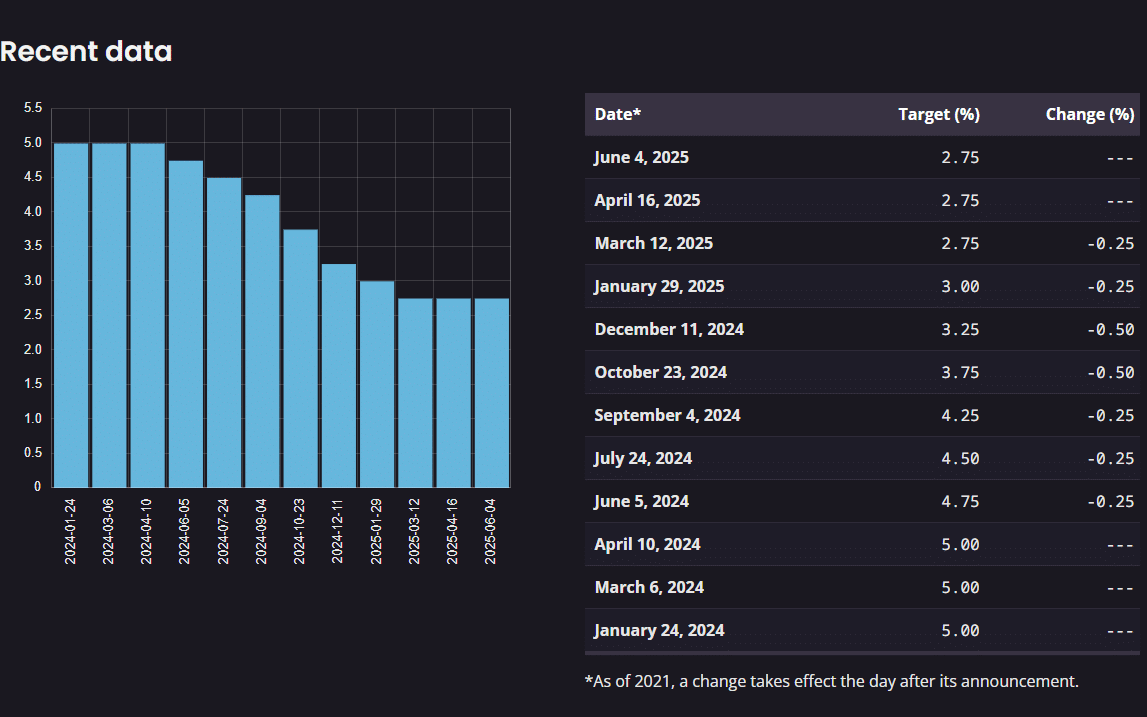
Bank of Canada hikes benchmark interest rate again, to 3.25%

The Bank of Canada today increased its target for the overnight rate to 3¼%, with the Bank Rate at 3½% and the deposit rate at 3¼%. The Bank is also continuing its policy of quantitative tightening.

The global and Canadian economies are evolving broadly in line with the Bank’s July projection. The effects of COVID-19 outbreaks, ongoing supply disruptions, and the war in Ukraine continue to dampen growth and boost prices.

Global inflation remains high and measures of core inflation are moving up in most countries. In response, central banks around the world continue to tighten monetary policy. Economic activity in the United States has moderated, although the US labour market remains tight. China is facing ongoing challenges from COVID shutdowns. Commodity prices have been volatile: oil, wheat and lumber prices have moderated while natural gas prices have risen.

In Canada, CPI inflation eased in July to 7.6% from 8.1% because of a drop in gasoline prices.  However, inflation excluding gasoline increased and data indicate a further broadening of price pressures, particularly in services. The Bank’s core measures of inflation continued to move up, ranging from 5% to 5.5% in July. Surveys suggest that short-term inflation expectations remain high. The longer this continues, the greater the risk that elevated inflation becomes entrenched.

The Canadian economy continues to operate in excess demand and labour markets remain tight. Canada’s GDP grew by 3.3% in the second quarter. While this was somewhat weaker than the Bank had projected, indicators of domestic demand were very strong – consumption grew by about 9½% and business investment was up by close to 12%. With higher mortgage rates, the housing market is pulling back as anticipated, following unsustainable growth during the pandemic. The Bank continues to expect the economy to moderate in the second half of this year, as global demand weakens and tighter monetary policy here in Canada begins to bring demand more in line with supply.

Given the outlook for inflation, the Governing Council still judges that the policy interest rate will need to rise further. Quantitative tightening is complementing increases in the policy rate. As the effects of tighter monetary policy work through the economy, we will be assessing how much higher interest rates need to go to return inflation to target. The Governing Council remains resolute in its commitment to price stability and will continue to take action as required to achieve the 2% inflation target.

Information note

The next scheduled date for announcing the overnight rate target is October 26, 2022. The Bank will publish its next full outlook for the economy and inflation, including risks to the projection, in the MPR at the same time.

(Source)

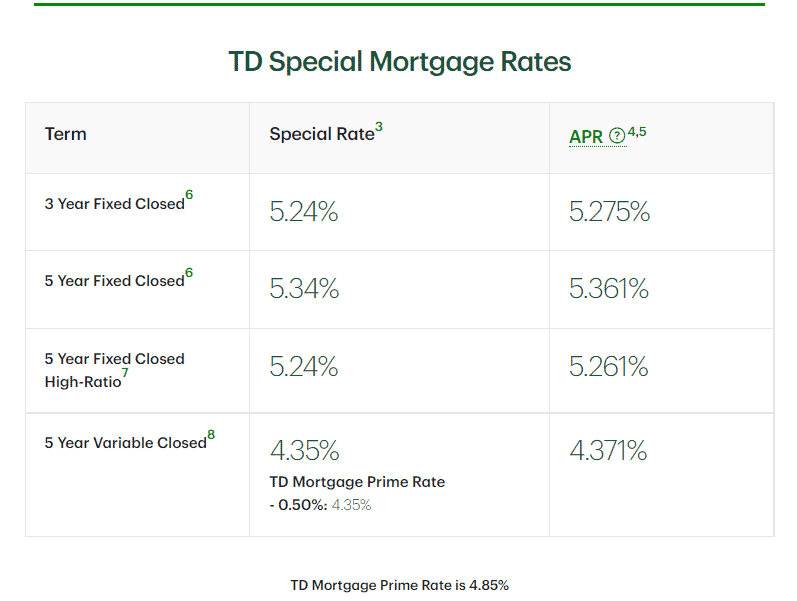
TD Bank Mortgage Rates Brampton September 2022

TD Bank is one of the biggest institutions within Canada by market capitalization and assets and is regarded as one of Canada’s top six banks. This is what makes TD an exemplary bank in Canadian Chartered Banks. TD operates across Canada as well as across all of the East Coast of the United States as well as an international presence. As of July 20, 2021, TD Bank is the third largest corporation within Canada and its total market value exceeding 150 billion dollars. In actuality, TD Bank is the 12th largest bank in the world, and one of the top 10 banks within the USA. TD offers a broad range of services for its vast customer base, which includes commercial banking, retail banking capital market services and insurance. With more than 1200 branches with 89,000 staff, TD serves over 9 million customers.

TD Mortages Rates
An Annual Percentage Ratio (APR) is calculated based on a $300,000 mortgage 25-year amortization, over the term in effect, taking into account monthly payments and a fee to calculate the value of the property at $300. If there aren’t any fees or charges, the APR and percentage of the interest are identical. APR is rounded up to the nearest three decimal place.

Brampton Mortgage Options

Brampton Fixed-Rate Mortgages

Secure yourself knowing that the interest rate you pay won’t rise during the time period you choose.

Fixed rate mortgages provide security, and along in turn security. After you’ve chosen your period, you’ll be able to rest assured that your interest rate won’t fluctuate for the time period you choose.

You can select the length of 6 months 1, 2 3, 4, 5 6, 7, or 10 years.

Payment Options:

Regular payments are able to be increased 100 percent over the course of the contract at no cost every calendar year.
You can prepay at least 15% of the principal amount of your mortgage at least once per year, at no cost.

TD Bank Variable Mortgage Rates in Brampton

The TD Bank variable rate mortgage offers fixed monthly installments over the duration of your mortgage but the interest rate is subject to fluctuation depending on changes to the TD Bank’s main rate. If TD’s prime rate moves lower the amount you pay will go to interest while a greater portion of it will be put towards the payment of the principal. If the rate at which TD’s prime rate is higher and your monthly payment increases, more will be directed towards interest and less towards your principal mortgage. This is a good investment tool for people who expect that interest rates within Canada to decrease in the coming years. Another option is a convertible mortgage. This is an fixed rate or variable mortgage that permits the possibility of converting to an interest-only mortgage anytime.

TD Variable Rates

How do I consider comparing interest rates on mortgages?

Making a decision on to take out a mortgage is an important financial decision because it requires borrowing a substantial quantity of funds. The interest rate on mortgages can be one of many variables which affect the total amount you be required to pay in the course of the amortization time. This means that you can save money by locating the lowest interest rate. Alongside the rate of your mortgage it is also important to compare the conditions and terms of each mortgage to ensure that you find the best one for your needs.

How much could I save by comparison of mortgage interest rates in Brampton, Canada?

Due to the large amount of money loaned under a mortgage even the slightest change in the interest rate of a mortgage could result in you saving money throughout the mortgage term, or even more in the course of an amortization time. Although the rate of your mortgage is an important aspect to consider but you should make sure you look over the terms and conditions of every kind of mortgage to be sure you pick the appropriate one for your needs.

What’s the main difference between a fixed and variable interest rate in TD?

Fixed interest rates is your rate of interest, in addition to the principal and interest payment will remain exactly the same throughout the mortgage time. With a variable rate your interest rate could fluctuate depending on changes in the T.D. Mortgage Prim Rate. Although your monthly payments will stay the same, the amount from each payment which will go towards principal and interest may differ. It is important to take a close review of the distinctions between variable and fixed interest rates before making the decision.

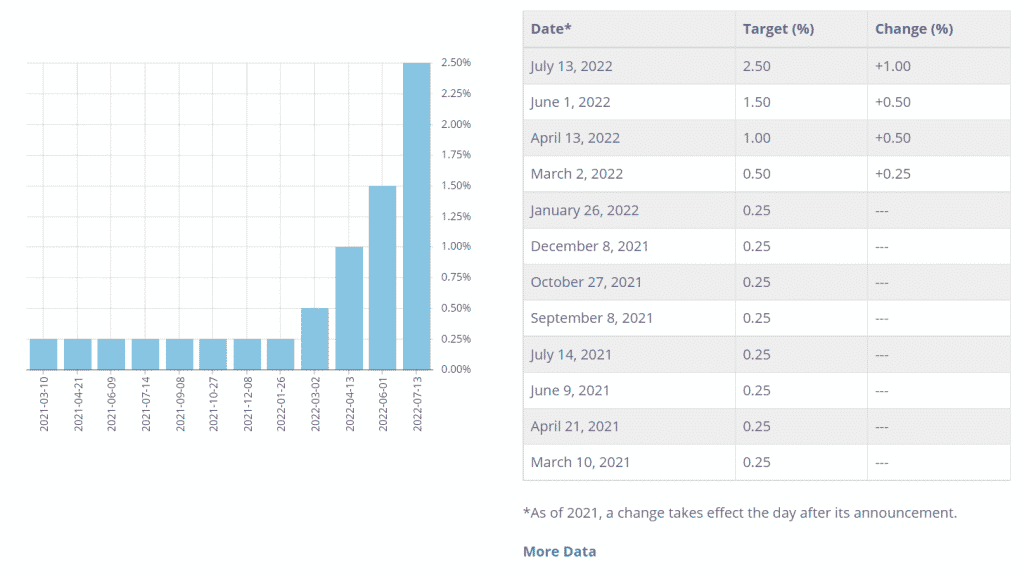
The Bank of Canada has raised its interest rate to 2.5%

In an effort to curb runaway inflation, the Bank of Canada raised its benchmark interest rate largest amount in the past 20 years.

Canada’s central banks raised Wednesday their benchmark interest rate by one percentage point to 2.5% This is the largest single increase in the bank’s rate since 1998.

Canadians will receive high rates from their lenders for things such as mortgages and credit lines.

All things being equal, a central banking institution will reduce the lending rate when it wants the economy to grow by encouraging people to borrow money and invest. When it wants to cool an overheated economy, it raises rates.

The bank had previously lowered its interest rate to record lows during the pandemic. It has since raised its rate four more times since March in an aggressive campaign against inflation. This is the bank’s highest rate in 40 years.

Recent Data

Canada’s inflation is more severe and persistent than the Bank predicted in its April Monetary Policy Review (MPR). It will likely stay around 8% for the next few months. Global factors like the conflict in Ukraine and continuing supply disruptions have been the main drivers of inflation, but domestic price pressures are increasing due to excess demand. The CPI is seeing more than half of its components rise by over 5%. The Bank’s core inflation measures have increased to between 3.9% – 5.4% due to the increasing price pressures. Surveys show that more people and businesses expect inflation to rise for longer periods of time, increasing the risk of inflation becoming entrenched in wage- and price-setting. The economic costs of restoring price stability would be higher if this happens.

The impact of Russia’s invasion of Ukraine and ongoing supply constraints as well as strong demand have all contributed to global inflation being higher. To combat inflation, many central banks tighten monetary policy. The resulting tighter financial environment is limiting economic growth. The United States is experiencing high inflation and rising interest rate, which contributes to a slowdown of domestic demand. China’s economy is being held back in the face of restrictive measures to control COVID-19 epidemics. The oil prices are still volatile and high. The Bank expects that global economic growth will slow to around 3 1/2% this year, 2% in 2023, and then strengthen to 3% by 2024.

TD Bank Mortgage Rates Brampton July 2022

The Canadian economy has seen an increase in excess demand. The labour market is tight, with a record-low unemployment rate, wide-spread labour shortages and rising wage pressures. Businesses are increasing prices to offset higher labour and input costs due to strong demand. The rebound in spending on difficult-to-distribute services is driving strong consumption. High commodity prices are boosting business investment and increasing exports. According to the Bank, GDP increased by approximately 4% in quarter 2. The third quarter is forecast to see a slowing of growth to 2%, as consumption growth slows and the housing market activity recovers from the unsustainable strength experienced during the pandemic.

The Bank predicts that Canada’s economy will grow by 3 1/2% in 2022 and 1 3/4% in 2023 respectively, and 2 1/2% in 2024. As global growth slows, the Bank expects Canada’s economy to grow by 3 1/2 % in 2022, 1 3/4 % in 2023, and 2 1/2 % in 2024. This, along with the resolution to supply disruptions will bring demand back into balance and reduce inflationary pressures. The global energy prices are expected to fall. Inflation is expected to start to fall later in the year. It will be around 3% by next year before returning to its 2% target by 2024.

The economy is clearly in excess demand and inflation high and widening. More businesses and consumers expect high inflation to continue for longer. Therefore, the Governing Council decided today to accelerate the path to higher interest rate. They raised the policy rate 100 basis points. The Governing council continues to believe that interest rates must rise further. However, the Bank’s continuing assessment of inflation and economy will determine the pace of increases. Quantitative tightening is continuing and complements increases in the policy rate. The Governing council is steadfast in its commitment price stability and will continue to take the necessary actions to reach the 2% inflation target.

(Source)

Top 10 Schools in Halton Hills

When you’re thinking about making a big move to your home, think of your children.

Moving is difficult for your children. Make sure they are as comfortable as possible in their new home.

It can be so easy to find great schools in Halton Hills.

You can also search for the ideal school for your child.

You will need to ensure that the school you choose is in your area.

These websites will assist you in locating the closest schools to your desired location.

Schools in Halton Hills

Halton Hills is home to some of the most prestigious schools in Southern Ontario.

Many schools are located in residential areas. Some have alumni who have travelled to outer space.

Below are some of the top schools in Halton Hills.

Halton Hills Homebuying Guide

It can be stressful to move and it is a major life milestone.

It is important to ensure that your move and purchase of a home are done in the right place (with great schools) at the right price.

With the right agent, you can do all that in Halton Hills

Homes by Team Arora is an expert in Halton Hills and its surrounding areas and will guide you in the right direction.

Are you still waiting?

Get in touch today to make your dreams come true.

Want To Learn More?

Contact Us to Learn More about Homes and Schools in Halton Hills Today.

Schools in Halton District School Board work diligently to make sure students are getting the best education possible, focusing on math, reading and writing. Each school has a ranking system out of 10 for how well it does this job; Halton Hills main schools rank between 5-6.

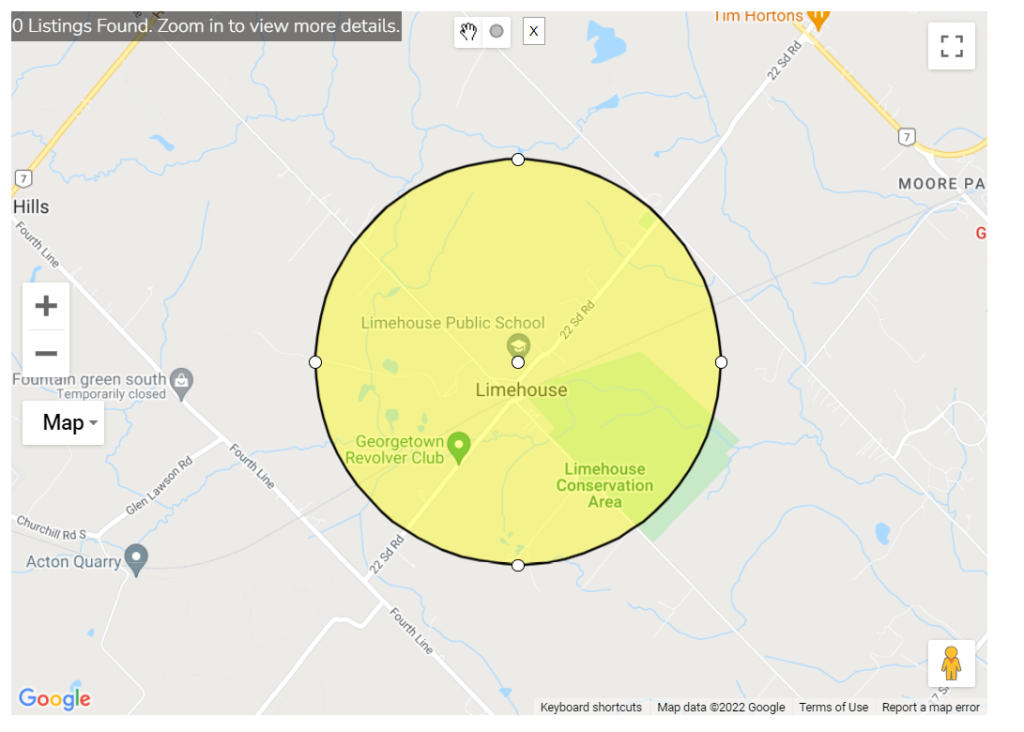
1. Limehouse Public School

Address:

11139 22 Side Rd
Limehouse, L0P 1H0
Phone: 905-873-6354
Fax: 905-873-7334

School Website

2. Holy Cross Catholic Elementary School

222 Maple Ave
Halton Hills ON, L7G 1X2
Phone: 905-877-4451

3. Ethel Gardiner Public School

14365 Danby Road
Halton Hills ON, L7G 6L8
Phone: 905-877-3849

4. ÉÉC Du Sacré-Coeur-Georgetown

34 Miller promenade
Halton Hills ON, L7G 5P7
Phone: 905-873-0510

Christ The King Catholic Secondary School

161 Guelph Street
Halton Hills ON, L7G 4A1

Stewarttown Middle School

13068 15 Side Rd RR 2
Halton Hills ON, L7G 4S5
Phone Number: 905-873-1637

St. Joseph (Acton) Catholic Elementary School

147 Mill Street
Halton Hills ON, L7J 1G7
Phone Number: 519-853-3730

Pineview Public School

13074 5 Side Rd RR 2, Halton Hills ON, L7G 4S5
Phone Number: 905-877-4363

Joseph Gibbons Public School

41 Moore Park Cres
Halton Hills ON, L7G 2T3
Phone Number: 905-877-4653

George Kennedy Public School

75 Weber Dr
Halton Hills ON, L7G 1C5
Phone Number: 905-877-4381


How to Use Team Arora Search Function

1. Go to: www.teamarora.com search

2. In the Search bar, type in the city that you’re interested in

3. Click on the set filters

Canada’s housing markets are finally moving back towards balance

The chill that gripped Canada’s housing market after the Bank of Canada raised interest rates earlier in the year has turned several degrees cooler.

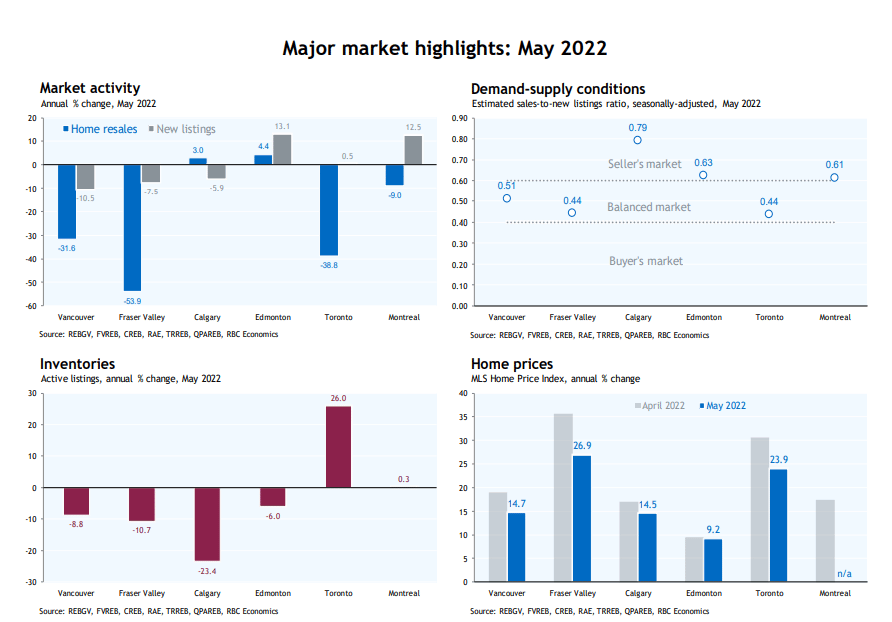
Many of Canada’s most expensive markets, including Toronto, Vancouver and Montreal, as well as Ottawa, Ottawa, Hamilton, saw their sales decline in May. This was the third month of decline for many.

Robert Hogue , assistant chief economist at RBC, stated that “Clearly the Bank of Canada has raised interest rates since March and there are prospects for more”. They’re raising the bar for buyers and lowering earlier (super-bullish) sentiment.

Since March, the central bank has increased its key rate three more times, from 0.25 to 1.5%. Economists expect that it will continue increasing until it reaches 2.5%.

major market highlights

Hogue stated tha Canada’s housing market is now undergoing rapid rebalancing.

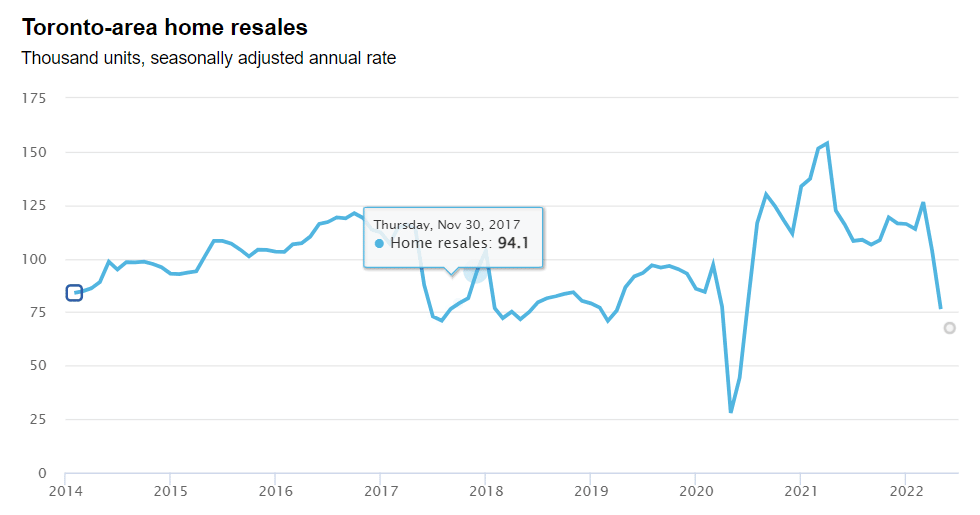
The Toronto-area market has seen a dramatic change in the last three months. The demand-supply situation has changed from being the tightest in records to almost as loose as it was during the 2017 correction. Due to the high interest rate sensitivity of buyers due to the large mortgage sizes and the steep prices in the area, the Bank of Canada’s rate increase campaign has left them on guard. In the last three months, home resales fell by a third.

This includes a 9.3% m/m decrease in May (seasonally adjusted). After falling to historic lows during the pandemic in 2004, inventories are rising and have risen 26% over May 2012. The buyers’ urgency and willingness to participate in bidding wars has decreased significantly. In April and May, the MLS Home Price Index declined m/m. The strongest headwinds are being felt by single-detached homes in the 905 belt, which had seen their values rise the most over the past year. The City of Toronto condos have shown greater resilience. As buyers gain pricing power, we expect prices to continue falling.

This was particularly evident in Toronto where “demand-supply conditions swung close to the tightest records to nearly as loosely as during the 2017 correction,” he stated.

toronto area Source: Canadian Real Estate Association, Toronto Region Real Estate Board, RBC Economics | *Yellow dot indicates estimate for May 2022

According to RBC’s seasonally adjusted estimate and the MLS Home Price Index, Vancouver was Canada’s most expensive market. Home resales dropped more than 15% compared to the previous month. Although inventories are still lower than the previous year, they increased.

Hogue wrote that Vancouver buyers are the most rate-sensitive in the country. He believes they will be severely affected by the Bank of Canada increasing their interest rates by 100 basis points. RBC expects that buyers will negotiate better prices with sellers in the future.

Montreal, where sales fell below pre-pandemic levels one year ago, has been on the path to a soft landing longer than other markets. Hogue stated that the notable development in May was a significant increase in new listings. Prices have risen so far, but this could change if there is more supply.

Calgary’s lower prices have made it a busy market in recent years. Although three rate increases have slowed the pace of activity, Hogue said that it is still “incredibly bustling”.

The supply is tight and home resales are still well above the pre-pandemic peak levels. The cooling effect is most evident in the prices. They rose slightly in April, but were flat in May. This is a significant change from blockbuster gains earlier.

Brampton housing markets are finally moving back towards balance. The supply is finally catching up with demand so prices are stabilizing. Get a good deal on your next house, before prices go up again! Visit our blog for more information about Brampton housing market trends.

(Source)

The 32-year old man makes $431,000 per year from real estate investments, while he travels and lives in a converted van.

Real estate is a great investment. This is what I tell everyone. It can be difficult to get started.

Eight years as a real-estate investor, I have learned that small steps are the best way to go. At 23 years old, I started investing to earn a little extra money in addition to my engineering salary. I had one or two rental properties.

Today, I have 61 rental units which last year brought in $431,000 in rental income. Roofstock Academy is also my real estate coaching. My wife and I reside in a converted van, which I use as my office. We live in our California duplex when we aren’t traveling the U.S. with our van.

After I pay my mortgages, property taxes and property management fees, I make about $6,000 per monthly in passive income from my real-estate portfolio.

Since 2019, I have been investing the money in a redevelopment project, converting eight units into 17 and living off my full time coaching salary.

How I bought my first property in real estate

2013 was my first year of college. I worked as a fire prevention engineer, earning $73,000 per annum.

My goal was to save money for investment properties. I lived very low. To rent an apartment with my roommates, I paid $800 per monthly. My employer paid for essential expenses such as my car and cell phone bills. This allowed me to save even more each month.

2014 was my first real estate purchase. I used $40,000 of cash I had saved and sold $20,000 of stocks to buy a $295,000 single family home in Southern California. To cover the rest of the cost, I borrowed from the bank but I was able to get a loan from a relative.

It was vacant for two months until I rented it. However, it did not need any renovations. My monthly rent of $1,810 from my tenant enabled me to pay the monthly loan payments and manage the property.

My real estate portfolio is growing
In 2016, I owned three houses. My second purchase was financed by a traditional bank loan. The third house I purchased was purchased with a $250,000 loan from my family member at a fixed rate of 4% for 30 years.

In total, I earned $51,404 in rental income from all three properties that year. While most of it went to mortgage, maintenance, and property management costs, I also took home $1,800 per monthly.

2017 was a year that I increased my savings in order to buy more real estate. I found a cheaper apartment to share with my roommates and I invested the savings and the money I made from real estate in the stock market as well as my investment accounts.

I began to look outside of California after I realized how far each dollar could go in the right markets, where cash flow was high but buying prices were low. I purchased the best multi-unit properties in the Midwest (mainly Ohio and Kentucky) and then fixed them up.

To make this happen from afar I established relationships with agents and property managers in these markets so that I would have a team to help me find the best properties and take care my tenants.

My fees average 7% of my gross rental income per property, but can go up to 20% if I’m working with family-owned management companies.

How to get started in real estate investing
I am very fortunate to be able to travel the country as a coach and work a regular 9-to-5 job. I also earn passive income from my real estate investments.

If you have enough money to save and are willing to look around, investing in real estate can give you a competitive edge — even in this era of high home prices.

Here is my top tip:

1. Start small with a well-researched strategy
My investment strategy is “BRRRRR”: Buy, Rehab, Rent, Refinance, Repeat.

I purchase homes in areas where units rent for more than their monthly mortgage payments. They are then renovated and rented out to pay the mortgage payment or to invest in other properties.

It is important to understand the basics of each strategy in order to determine which one works for you. There are many resources, including podcasts, such as my podcast, The Remote Real Estate Investor, and online courses.

To learn more about the strategies of other investors, you can reach out on forums such as BiggerPockets.

Many people wonder about their return on investment goals. People should compare the total returns they get from real estate (calculate it by adding cash flow and appreciation, loan payments, tax benefits, and tax benefits) with the returns they could be receiving in other investment vehicles.

Choose a number that is most comfortable for you. Don’t compare yourself with anyone else.

2. My method is designed to make it as easy as possible for you to accomplish your goals.
I feel comfortable buying something if it is easy to do and that the property won’t require too much management.

Even though this may mean lower profit margins upfront, it allows me to simplify my lifestyle and use most of my real estate portfolio for a passive income stream. Once you have completed the purchase and fixed the property, you will reap the benefits for as long as the property is yours.

My main goal with my real estate portfolio, is to be financially independent at 100%, or to pay all of my expenses, even future expenses.

3. To increase property value, you don’t necessarily need to do a complete renovation
You have two options to increase the value of your property: Maximize profits or maximize returns, or minimize expenses.

My portfolio has seen me spend approximately $2.5 million on renovations so far. I have tried to maximize every dollar. A few simple upgrades, such as stainless steel appliances and laundry rooms, can increase the rental value.

You can increase the value of your property by buying in favorable markets.

4. Local property professionals are available
In the markets that I invest, I work with mom-and-pop local property management businesses.

I was able to build a portfolio of properties in the Midwest, while still living in California. Now, I can travel and generate income from my properties. My agent can let me view houses via FaceTime and I can rely on trusted contractors for renovations. It is up to my property manager to find responsible tenants.

You can connect with experts in your market using online platforms such as All Property Management and get recommendations from your network and peers.

Michael Albaum is a real estate investor and Head Coach of Roofstock Academy. Follow him on Twitter @MichaelAlbaum.

(Source)

Mississauga Location

268 Derry Rd W Unit 101, Mississauga, ON L5W 0H6